recipes / camping meals
18 Easy Camping Meals That Actually Work at a Campsite
Compare 18 practical camping meals by cooler, heat, active time, cleanup and allergens, then use a complete two-night menu for six.
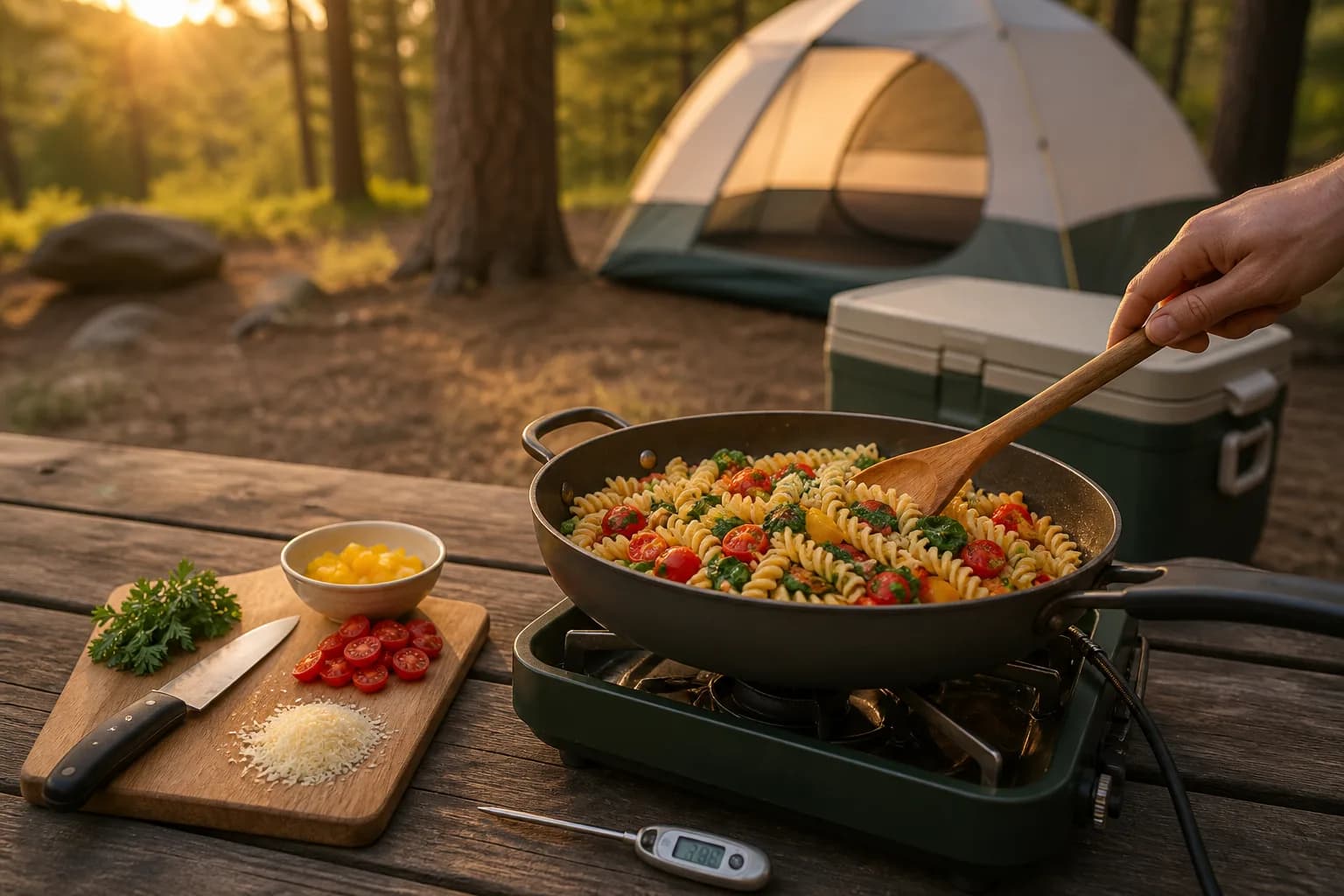
For a first camping trip, choose one-pan pasta or quesadillas. For a late arrival, choose tuna and white bean salad. For six hungry people, choose covered nachos or chili mac. If heat is prohibited, use a genuinely no-cook meal whose cold-storage requirements you can still meet.
The easiest meal is not the recipe with the shortest ingredient list. It is the one that fits your cooler, legal heat source, available water, group and daylight. Most disappointing "camping recipes" are home recipes wearing hiking boots: they quietly expect three pans, a colander and a refrigerator on day three.
This guide is the decision hub. It gives you eighteen workable bases across no-cook, breakfast, foil, one-pan and Dutch-oven methods, then points to the deeper guides when one method wins.
Compare all 18 camping meals
Loaded hummus wraps
- Method
- No heat
- Cold holding
- Yes
- Active time
- 5 min
- Cook or safety check
- Keep at 4 C / 40 F or below
- Cleanup
- Knife
- Best use
- Arrival lunch
- Allergens
- Sesame, wheat, milk if feta
Tuna and white bean salad
- Method
- No heat
- Cold holding
- No before opening if labels confirm
- Active time
- 7 min
- Cook or safety check
- Finish or chill immediately
- Cleanup
- Bowl, fork
- Best use
- No-cooler backup
- Allergens
- Fish; wheat or other bread allergens
Camp board
- Method
- No heat
- Cold holding
- Yes for meat, cheese and cut fruit
- Active time
- 5 min
- Cook or safety check
- Serve small amounts over ice
- Cleanup
- Board
- Best use
- Flexible group
- Allergens
- Milk, nuts, wheat
Cold noodle salad
- Method
- No heat
- Cold holding
- Yes
- Active time
- 5 min
- Cook or safety check
- Prepared leftover; keep cold
- Cleanup
- Bowl
- Best use
- Early-trip lunch
- Allergens
- Peanut, soy, sesame; possible wheat
Overnight oats
- Method
- No heat
- Cold holding
- Yes once mixed
- Active time
- 0 min
- Cook or safety check
- Keep at 4 C / 40 F or below
- Cleanup
- Jar
- Best use
- Fast breakfast
- Allergens
- Check oats, milk, toppings
Breakfast burritos
- Method
- Stove or permitted appliance
- Cold holding
- Yes
- Active time
- 10-15 min
- Cook or safety check
- Reheat centre to 74 C / 165 F
- Cleanup
- Low
- Best use
- Group breakfast
- Allergens
- Egg, milk, wheat
Skillet scramble
- Method
- Stove or permitted appliance
- Cold holding
- Yes for eggs and dairy
- Active time
- 12 min
- Cook or safety check
- Egg dish to 74 C / 165 F
- Cleanup
- Pan, spatula
- Best use
- Slow breakfast
- Allergens
- Egg, milk if cheese
Jar pancakes
- Method
- Stove or permitted appliance
- Cold holding
- Yes for egg and milk
- Active time
- 15-20 min
- Cook or safety check
- No wet batter storage; centre set
- Cleanup
- Jar, pan
- Best use
- Small group
- Allergens
- Egg, milk, wheat
Sausage potato packets
- Method
- Permitted coals or grill
- Cold holding
- Yes for sausage and cooked potatoes
- Active time
- 25-35 min
- Cook or safety check
- Whole packet to 74 C / 165 F
- Cleanup
- Foil, tongs
- Best use
- Individual dinners
- Allergens
- Check sausage label
Lemon fish packets
- Method
- Permitted coals or grill
- Cold holding
- Yes
- Active time
- 10-18 min
- Cook or safety check
- Fish to 70 C / 158 F
- Cleanup
- Foil, tongs
- Best use
- First-night dinner
- Allergens
- Fish, milk if butter
Camp nachos
- Method
- Stove or permitted coals
- Cold holding
- Yes for cheese and toppings
- Active time
- 10-15 min
- Cook or safety check
- Cheese melted; beans steaming
- Cleanup
- Covered pan
- Best use
- Shared group meal
- Allergens
- Milk; check chips
One-pan pasta
- Method
- Stove or permitted appliance
- Cold holding
- Depends on protein
- Active time
- 20-25 min
- Cook or safety check
- Pasta tender; leftovers to 74 C / 165 F
- Cleanup
- One deep pan
- Best use
- First-trip dinner
- Allergens
- Wheat; check sauce
Gnocchi with pesto
- Method
- Stove or permitted appliance
- Cold holding
- Check gnocchi and pesto labels
- Active time
- 10 min
- Cook or safety check
- Follow package directions
- Cleanup
- One pan
- Best use
- Fast dinner
- Allergens
- Wheat, milk, nuts may occur
Camp fried rice
- Method
- Stove or permitted appliance
- Cold holding
- Yes for cooked rice and egg
- Active time
- 15 min
- Cook or safety check
- Whole dish to 74 C / 165 F
- Cleanup
- One pan
- Best use
- Use planned leftovers
- Allergens
- Egg, soy, sesame
Quesadillas
- Method
- Stove or permitted appliance
- Cold holding
- Yes for cheese and cooked chicken
- Active time
- 5-8 min each
- Cook or safety check
- Chicken filling to 74 C / 165 F
- Cleanup
- One pan
- Best use
- Mixed preferences
- Allergens
- Milk, wheat
Chorizo chickpea stew
- Method
- Stove or permitted appliance
- Cold holding
- Follow chorizo label
- Active time
- 20-25 min
- Cook or safety check
- Raw sausage to applicable safe temperature
- Cleanup
- One pot
- Best use
- Cool evening
- Allergens
- Check sausage label
Dutch oven chili mac
- Method
- Permitted coals or stove
- Cold holding
- Yes for cooked meat base
- Active time
- 30-40 min
- Cook or safety check
- Reheated base to 74 C / 165 F
- Cleanup
- Dutch oven
- Best use
- Large group
- Allergens
- Wheat, milk
Skillet apple crisp
- Method
- Stove or permitted appliance
- Cold holding
- No with shelf-stable ingredients
- Active time
- 15-20 min
- Cook or safety check
- Apples tender
- Cleanup
- One pan
- Best use
- Simple dessert
- Allergens
- Check granola; milk if butter
| Meal | Method | Cold holding | Active time | Cook or safety check | Cleanup | Best use | Allergens |
|---|---|---|---|---|---|---|---|
| Loaded hummus wraps | No heat | Yes | 5 min | Keep at 4 C / 40 F or below | Knife | Arrival lunch | Sesame, wheat, milk if feta |
| Tuna and white bean salad | No heat | No before opening if labels confirm | 7 min | Finish or chill immediately | Bowl, fork | No-cooler backup | Fish; wheat or other bread allergens |
| Camp board | No heat | Yes for meat, cheese and cut fruit | 5 min | Serve small amounts over ice | Board | Flexible group | Milk, nuts, wheat |
| Cold noodle salad | No heat | Yes | 5 min | Prepared leftover; keep cold | Bowl | Early-trip lunch | Peanut, soy, sesame; possible wheat |
| Overnight oats | No heat | Yes once mixed | 0 min | Keep at 4 C / 40 F or below | Jar | Fast breakfast | Check oats, milk, toppings |
| Breakfast burritos | Stove or permitted appliance | Yes | 10-15 min | Reheat centre to 74 C / 165 F | Low | Group breakfast | Egg, milk, wheat |
| Skillet scramble | Stove or permitted appliance | Yes for eggs and dairy | 12 min | Egg dish to 74 C / 165 F | Pan, spatula | Slow breakfast | Egg, milk if cheese |
| Jar pancakes | Stove or permitted appliance | Yes for egg and milk | 15-20 min | No wet batter storage; centre set | Jar, pan | Small group | Egg, milk, wheat |
| Sausage potato packets | Permitted coals or grill | Yes for sausage and cooked potatoes | 25-35 min | Whole packet to 74 C / 165 F | Foil, tongs | Individual dinners | Check sausage label |
| Lemon fish packets | Permitted coals or grill | Yes | 10-18 min | Fish to 70 C / 158 F | Foil, tongs | First-night dinner | Fish, milk if butter |
| Camp nachos | Stove or permitted coals | Yes for cheese and toppings | 10-15 min | Cheese melted; beans steaming | Covered pan | Shared group meal | Milk; check chips |
| One-pan pasta | Stove or permitted appliance | Depends on protein | 20-25 min | Pasta tender; leftovers to 74 C / 165 F | One deep pan | First-trip dinner | Wheat; check sauce |
| Gnocchi with pesto | Stove or permitted appliance | Check gnocchi and pesto labels | 10 min | Follow package directions | One pan | Fast dinner | Wheat, milk, nuts may occur |
| Camp fried rice | Stove or permitted appliance | Yes for cooked rice and egg | 15 min | Whole dish to 74 C / 165 F | One pan | Use planned leftovers | Egg, soy, sesame |
| Quesadillas | Stove or permitted appliance | Yes for cheese and cooked chicken | 5-8 min each | Chicken filling to 74 C / 165 F | One pan | Mixed preferences | Milk, wheat |
| Chorizo chickpea stew | Stove or permitted appliance | Follow chorizo label | 20-25 min | Raw sausage to applicable safe temperature | One pot | Cool evening | Check sausage label |
| Dutch oven chili mac | Permitted coals or stove | Yes for cooked meat base | 30-40 min | Reheated base to 74 C / 165 F | Dutch oven | Large group | Wheat, milk |
| Skillet apple crisp | Stove or permitted appliance | No with shelf-stable ingredients | 15-20 min | Apples tender | One pan | Simple dessert | Check granola; milk if butter |
Five rules before you choose dinner
1. Measure cold holding
Keep perishable food at or below 4 C / 40 F and put a thermometer in the cooler. Health Canada identifies 4 C to 60 C / 40 F to 140 F as the danger zone and advises not leaving food at room temperature for more than one hour on hot summer days. USDA guidance uses two hours, reduced to one hour above 90 F / 32 C. Follow the rule that applies where you are and use the shorter limit when conditions are uncertain.
Hummus, cheese, cured or deli meat, cooked noodles and rice, overnight oats, egg burritos and opened cans are not no-cooler foods merely because they are served cold.
2. Use a thermometer, not a timer
Wind, fuel, pan thickness, packet size and coal temperature make camp-cooking times estimates. Health Canada lists these key internal temperatures:
| Food | Minimum internal temperature |
|---|---|
| Egg dishes and leftovers | 74 C / 165 F |
| Fish | 70 C / 158 F |
| Ground beef or pork and their sausages | 71 C / 160 F |
| Poultry and poultry sausage | 74 C / 165 F |
Clean the thermometer between foods. Time and "looks done" are texture clues, not safety proof.
3. Treat cooked food from home as leftovers
Cool cooked rice, noodles, meat bases and burritos promptly in shallow containers, refrigerate or freeze them, transport them at 4 C / 40 F or below and count their age from the day they were prepared. Health Canada advises eating properly refrigerated leftovers within two to three days and reheating them to 74 C / 165 F.
Do not try to recover food after unsafe holding by reheating it. USDA FSIS warns that some bacterial toxins can survive high cooking temperatures.
4. Check the current fire order and cook outside
A fire ban may treat wood fires, charcoal and gas appliances differently. Check the current official order for your exact campground before relying on coals or a stove, and keep a no-cook fallback.
Use portable fuel-burning equipment only outdoors on a stable surface and follow its manual. Never use a camping stove, charcoal grill or similar outdoor appliance inside a tent, camper, vehicle or other enclosed space; carbon monoxide has no colour or smell.
Let foil and cookware cool, then pack out or place waste where the campground directs. Do not burn food packaging, abandon foil in a fire ring or assume an ash bin accepts it.
5. Protect water and allergy lanes
Use potable or properly treated water for drinking, cooking, washing produce, hands and utensils. Clear water can still contain germs. Separate raw food from ready-to-eat food, wash hands, and use a clean board and utensils.
For allergies, read every label each time, separate the safe portion before shared ingredients are opened, and use distinct utensils and storage. The matrix flags common concerns - egg, milk, fish, wheat, peanut, nuts, soy, sesame - but no generic substitution is safe for every person.
No-cook meals: best for arrival and restricted heat
These avoid fuel, but only the tuna and bean option can work without a cooler before opening - and only when every label confirms shelf stability.
1. Loaded hummus wraps
Serves 4 | Active: 5 minutes | Cold holding required
Pack 4 large tortillas, 1 1/2 cups hummus, 1 bell pepper, 1 small cucumber, 2 cups greens and 1/2 cup feta, optional. Wash and dry produce at home; keep hummus, cut vegetables, greens and feta at 4 C / 40 F or below.
At camp, spread about 6 tablespoons hummus across each tortilla, add vegetables and roll. For allergy lanes, assemble the separated portion first. Check hummus for sesame and tortillas for wheat; feta adds milk.
2. Tuna and white bean salad
Serves 4 | Active: 7 minutes | Can be a no-cooler backup before opening
Pack 2 tuna pouches of about 74 g / 2.6 oz each, 1 can white beans around 398 ml / 15 oz, 1 lemon, 4 oil packets, pepper and 4 sturdy rolls or tortillas. Open and drain at mealtime, mix with lemon and oil, then divide.
Bring packages the group will finish. Once opened and mixed, eat immediately or move leftovers straight into verified cold holding. Tuna is fish; check bread and condiment labels too.
For nine complete no-cooler and cooler-dependent choices, use the dedicated no-cook camping meals guide.
3. The camp board
Serves 4 | Active: 5 minutes | Cold holding required for the perishable lane
Use 225 g / 8 oz sliced ready-to-eat meat, 225 g / 8 oz cheese, 2 cups whole grapes, 1 cup olives, 1 cup nuts or seeds and about 225 g / 8 oz crackers. Keep meat, cheese and cut produce cold.
Set out a small quantity at a time over a tray of ice and refill from the cooler. This is flexible for a group, but not automatically allergy-friendly: milk, nuts and wheat need separate lanes and utensils.
4. Cold noodle salad with peanut sauce
Serves 4 | Home prep: 20 minutes | Camp active: 5 minutes
Cook 225 g / 8 oz rice noodles at home. For sauce, mix 1/3 cup peanut butter, 3 tablespoons soy sauce, juice of 2 limes, 2 tablespoons potable water and 1 teaspoon sesame oil. Add 2 shredded carrots and 1 diced cucumber.
Cool the noodles promptly in a shallow container, refrigerate, then transport and serve at 4 C / 40 F or below. It is a prepared leftover, not a shelf-stable noodle packet. Check peanut, soy and sesame; some noodles or sauces can add wheat.
5. Overnight oats
Serves 4 | Home prep: 8 minutes | Camp active: none
Divide 2 cups rolled oats, 2 cups pasteurized milk or suitable alternative, 1 cup yogurt, 2 tablespoons maple syrup and 1 cup washed berries among four clean containers. Refrigerate promptly and keep cold.
Use them early enough to remain within the ingredients' labels and the leftover window. Check oats, milk, yogurt and toppings for the group's allergens. For a wider breakfast decision, see easy camping breakfast ideas.
Hot breakfasts: choose them when the morning can wait
6. Make-ahead breakfast burritos
Makes 8 small burritos | Home prep: 30 minutes | Camp reheat: 10 to 15 minutes
Cook 8 eggs and 225 g / 8 oz raw sausage to their applicable safe temperatures, or replace sausage with 1 drained can of beans. Spread the cooked filling in clean, shallow containers, cool it promptly and refrigerate it. Once the filling is cold, divide it with 1 1/2 cups grated cheese among 8 small tortillas and wrap individually.
Refrigerate the assembled burritos or freeze them promptly. Thaw frozen burritos in the refrigerator or verified cooler. At camp, reheat in a covered pan or other currently permitted appliance, turning for even heat, until the centre of every burrito reaches 74 C / 165 F. A warm wrapper does not prove a hot centre.
7. Skillet scramble
Serves 4 | Active: 12 minutes | One pan
Bring 8 clean, uncracked eggs in their carton, 1 diced bell pepper, 1/2 diced onion, 1 tablespoon oil and 1 cup grated cheese, optional. Keep eggs, cut vegetables and cheese cold.
Soften the vegetables in oil. Crack the eggs only when you are ready to cook, whisk in a clean bowl, add to the pan and stir until the egg dish reaches 74 C / 165 F. Health Canada advises against cracking eggs in advance, so the old bottle shortcut stays home.
8. Dry-jar pancakes
Makes about 12 small pancakes | Active: 15 to 20 minutes | One pan
At home, add 2 cups flour, 1 tablespoon baking powder, 2 tablespoons sugar and 1/2 teaspoon salt to a wide jar or sealed bag. At camp, put the dry mix in a clean bowl, then add 1 1/2 cups milk and 2 eggs cracked at use. Stir only until combined.
Cook small pancakes on a lightly oiled pan over medium heat. Flip when bubbles set around the edges; continue until both sides are browned and the centre is set, with no wet batter. Use the mixed batter immediately, keep ingredients cold until mixing and wash the bowl and utensils after raw egg contact.
For coffee alongside breakfast, use potable or treated water and choose a method from the camping coffee guide.
Foil and covered meals: only with a permitted heat source
Use heavy-duty foil or double layers, seal with space for steam, turn with long tongs and open away from your face. Cook on a stable grate or controlled coal bed only when current rules allow it.
9. Fully cooked sausage and potato packets
Serves 4 | Active: 10 minutes | Heat: roughly 25 to 35 minutes
At home, boil 680 g / 1 1/2 lb baby potatoes until barely tender, then cool promptly in a shallow container and refrigerate. Keep both the cooked potatoes and sausage at 4 C / 40 F or below. At camp, divide them with 340 g / 12 oz fully cooked, ready-to-eat sausage, 2 sliced peppers, 2 tablespoons oil and seasoning among four packets.
Heat, turning once or twice, until the potatoes are tender and the centre of each packet reaches 74 C / 165 F because the potatoes are cooked leftovers. If you substitute raw sausage, cold holding still applies and the meat must also reach its own safe target: beef or pork sausage needs 71 C / 160 F; poultry sausage needs 74 C / 165 F.
10. Lemon garlic fish packets
Serves 4 | Active: 8 minutes | Heat: roughly 10 to 18 minutes
Place one 140 g / 5 oz firm white-fish fillet in each packet with 1 cup green beans, 2 lemon slices, 1 teaspoon butter or oil and a little garlic. Keep fish at 4 C / 40 F or below and cook it on the first night.
Start checking early and continue until the thickest part of every fillet reaches 70 C / 158 F. Packet thickness and coal heat vary too much for twelve minutes to be a safety guarantee.
11. Covered camp nachos
Serves 4 to 6 | Active: 7 minutes | Heat: roughly 10 to 15 minutes
Layer 300 g / 10 oz tortilla chips, 1 drained can black beans, 2 cups grated cheese and 1/2 cup sliced olives in a lidded skillet, Dutch oven or covered foil tray. Heat on a permitted stove or moderate coals until the cheese is melted and the beans are steaming. Add salsa, avocado or greens only after heating.
Keep cheese and cut toppings cold. Check chips and toppings for milk, corn and other relevant allergens.
The foil packet camping recipes guide covers folding, raw-protein decisions and coal management in more depth.
One-pan stove meals: the safest default for beginners
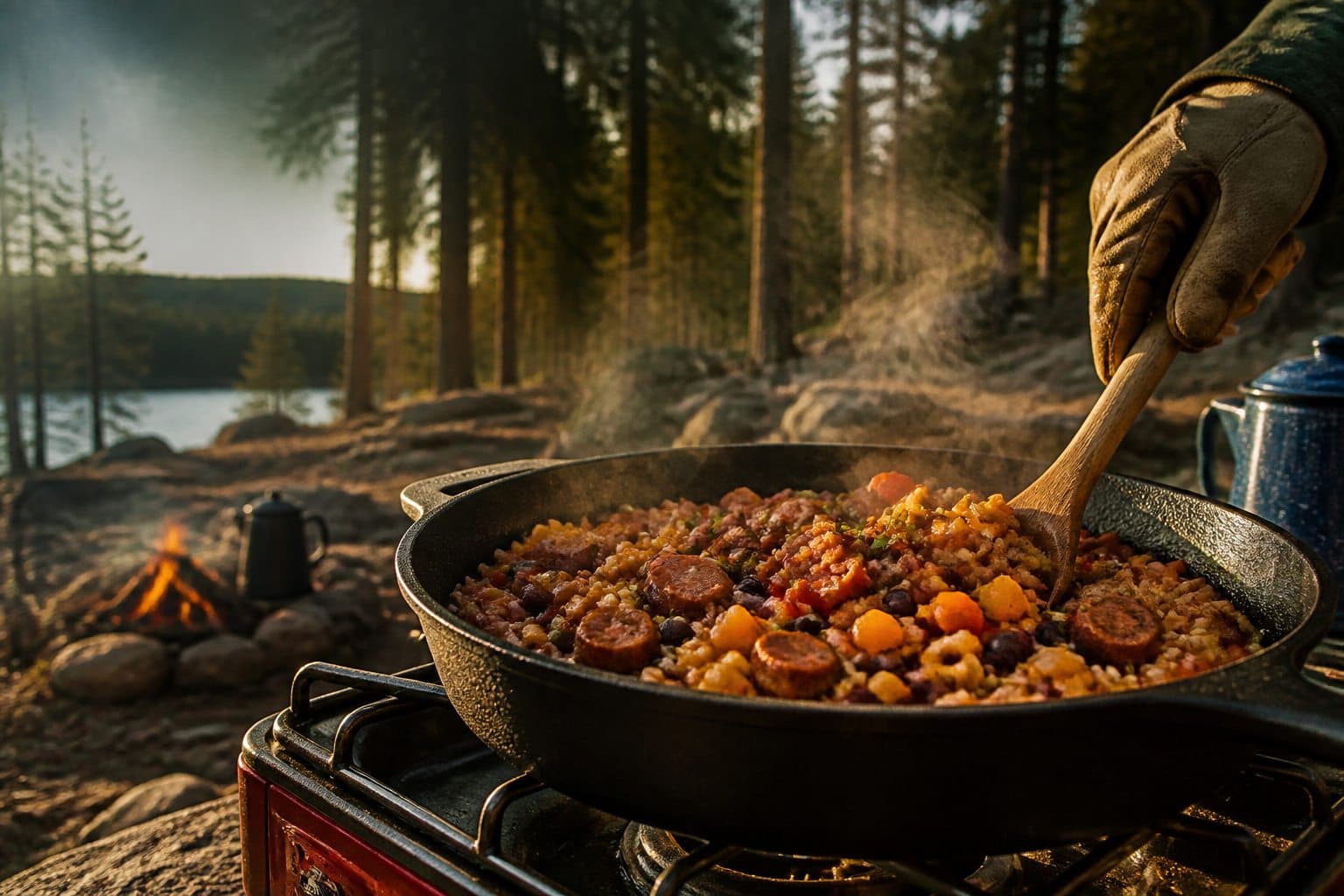
A stable outdoor stove is more predictable than a coal bed and gives you control when dinner runs late. Confirm that the appliance is permitted, use a pan that fits its grate and keep the fuel canister away from excess heat.
12. One-pan tomato pasta
Serves 4 | Active: 20 to 25 minutes | One deep pan
Combine 340 g / 12 oz short pasta, 650 ml / 22 oz tomato sauce, 750 ml / 3 cups potable water and 1 teaspoon Italian seasoning. Bring to a controlled boil, then simmer uncovered, stirring often, until the pasta is tender and the sauce clings to it. Add small amounts of water if the pan dries before the pasta softens.
Top with shelf-stable additions or cold-held cheese. This vegetarian base avoids the hidden leftover-meat problem; if you add cooked meat from home, keep it cold and reheat the whole dish to 74 C / 165 F.
13. Gnocchi with pesto and spinach
Serves 4 | Active: 10 minutes | One pan
Use 500 g / 18 oz packaged gnocchi, 1/2 cup pesto and 3 cups spinach. Follow the gnocchi package directions because shelf-stable, refrigerated and fresh versions are not interchangeable. Drain only if the label requires it, then fold in pesto and spinach until the greens wilt.
Check whether the unopened gnocchi and pesto require refrigeration, then follow after-opening instructions. Pesto commonly contains milk and nuts; gnocchi commonly contains wheat and may contain egg.
14. Camp fried rice
Serves 4 | Active: 15 minutes | One pan
At home, cook enough rice for 3 cups, cool it rapidly in a shallow container and refrigerate. Pack with 2 cups cold mixed vegetables, 4 shell eggs, 3 tablespoons soy sauce and 1 teaspoon sesame oil.
At camp, heat vegetables, add rice and stir until hot. Push it aside, crack eggs at use into the pan, scramble, then combine thoroughly. Cook the whole dish to 74 C / 165 F. Keep rice, vegetables and eggs cold throughout; use within the two-to-three-day leftover window.
15. Chicken or bean quesadillas
Makes 8 folded quesadillas | Serves 4 | Active: 5 to 8 minutes each
Fill 8 medium tortillas with 3 cups grated cheese and either 2 cups cooked shredded chicken or 1 drained can black beans. Cook one or two at a time in a dry covered pan over medium-low heat, turning once, until crisp.
For chicken, keep the cooked filling cold and verify it reaches 74 C / 165 F when reheated. Beans avoid that reheating requirement but opened beans and cheese still need cold handling. Assemble dietary lanes separately before the shared pan is used.
16. Chorizo and chickpea stew
Serves 4 | Active: 20 to 25 minutes | One pot
Cook 225 g / 8 oz raw chorizo, breaking it into small pieces, until beef or pork sausage reaches 71 C / 160 F, or poultry sausage reaches 74 C / 165 F. Add 2 drained cans chickpeas, 1 can diced tomatoes around 796 ml / 28 oz and 1 teaspoon smoked paprika. Simmer for 12 to 15 minutes.
Raw chorizo needs continuous cold holding and separation from ready-to-eat food. If you choose cured or fully cooked chorizo instead, follow that product's label rather than assuming every sausage with the same name behaves alike.
Dutch oven and dessert
17. Dutch oven chili mac
Serves 6 | Home prep: 20 minutes | Camp heat: 30 to 40 minutes
At home, brown 450 g / 1 lb ground beef to 71 C / 160 F with 1 diced onion and 2 tablespoons chili seasoning. Cool rapidly in shallow containers, refrigerate, then freeze flat if useful.
At camp, combine the cold or safely thawed base with 1 can diced tomatoes around 796 ml / 28 oz, 2 drained cans beans, 340 g / 12 oz macaroni and 1 litre / 4 cups potable water. Cover and simmer on a permitted stove or controlled coals, stirring often and adding water if needed, until the pasta is tender and the reheated meat base reaches 74 C / 165 F throughout. Add 1 1/2 cups cheese, optional.
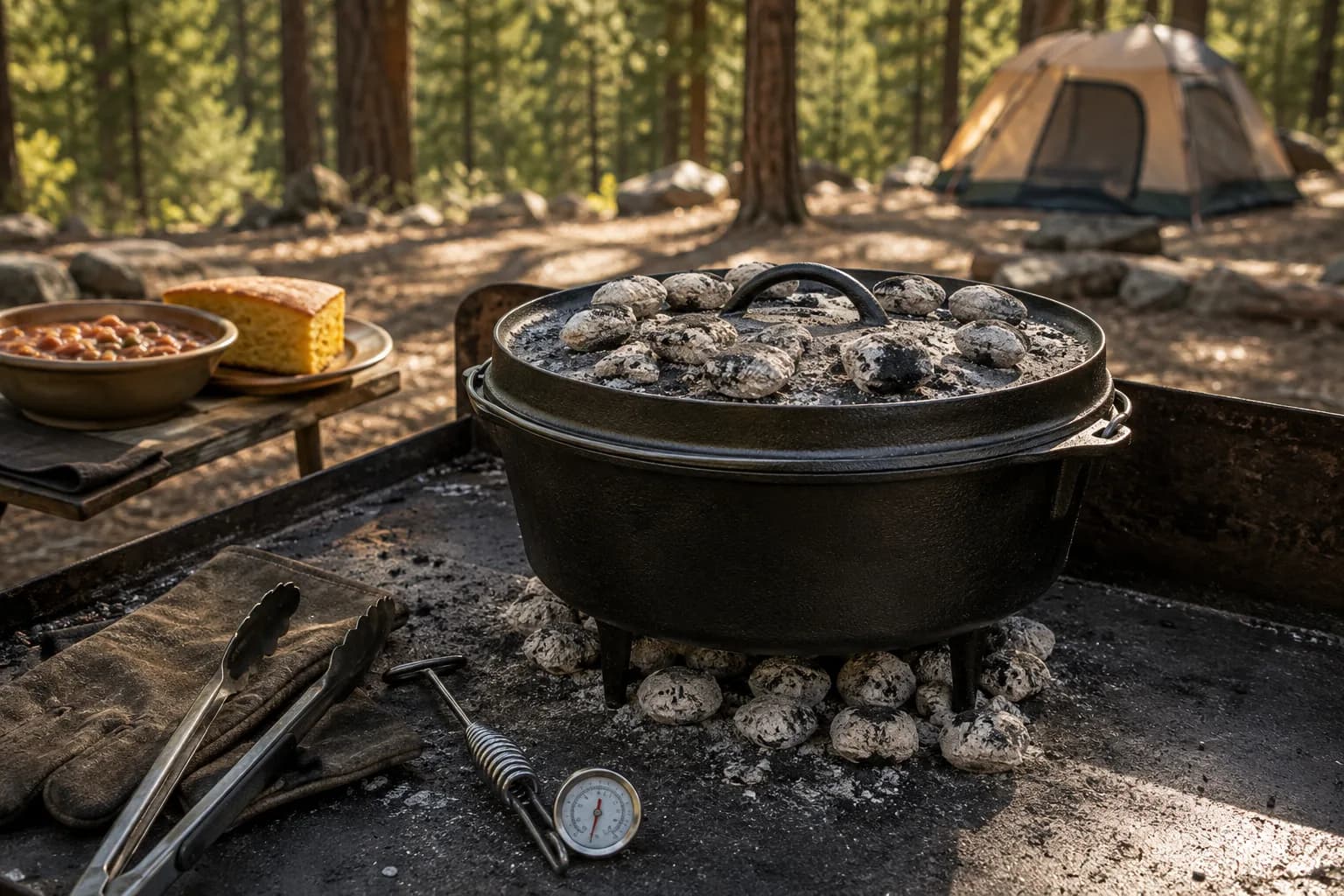
This is a group meal, not a one-night minimalist meal: choose it only when a Dutch oven, fuel plan, cleaning water and current rules all fit. The Dutch oven camping recipes guide covers heat management in detail.
18. Skillet apple crisp
Serves 4 | Active: 15 to 20 minutes | One pan
Slice 4 firm apples and cook them with 2 tablespoons butter or oil, 2 tablespoons brown sugar, 1 teaspoon cinnamon and 2 tablespoons potable water over medium-low heat. Cover until tender, stirring occasionally, then scatter 1 1/2 cups granola over the top and warm for another 3 to 5 minutes.
Use oil and a suitable granola for a dairy-free version. Granola can contain oats, wheat, milk, peanuts or tree nuts, so read the label rather than trusting the rustic-looking bag.
For a dessert-first menu and a no-fire fallback, see campfire desserts.
A two-night meal plan for six
This plan assumes car camping, arrival before dinner, departure after breakfast on day three, a cooler measured at 4 C / 40 F or below, potable water and a permitted outdoor stove. It uses cold-held prepared food early and keeps one separate shelf-stable reserve.
| When | Meal | Quantity for 6 | Home work | Camp system |
|---|---|---|---|---|
| Arrival dinner | Tuna and white bean salad rolls | 3 tuna pouches, 2 cans beans, 6 rolls, 2 lemons, oil packets | Pack one complete meal together | Bowl and fork; no heat |
| Day 2 breakfast | Breakfast burritos | 12 eggs, about 340 g / 12 oz sausage or 2 cans beans, 2 1/4 cups cheese, 12 small tortillas | Cook safely, cool rapidly, assemble and freeze or refrigerate | Covered pan; reheat centres to 74 C / 165 F |
| Day 2 lunch | Hummus wraps | 2 1/4 cups hummus, 6 tortillas, 2 peppers, 1 large cucumber, 3 cups greens | Wash and dry produce | Knife; keep fillings cold |
| Day 2 dinner | One-pan tomato pasta | 510 g / 18 oz pasta, about 1 litre sauce, about 1.1 litres potable cooking water | Portion dry ingredients | One deep pan and stove |
| Day 3 breakfast | Overnight oats | 3 cups oats, 3 cups milk, 1 1/2 cups yogurt, 3 tbsp maple syrup, 1 1/2 cups berries | Mix no earlier than needed; refrigerate promptly | Six containers and spoons |
| Reserve | Nut or seed butter banana wraps | 6 tortillas, 3/4 cup spread, 6 bananas | Check all labels and pack separately | No heat and no cooler if labels confirm |
The reserve row is the one emergency serving per person. Do not count it a second time. If the route, weather or group requires a larger buffer, calculate and label that separately.
Aggregated shopping and packing list
Shelf-stable or label-dependent: 18 meal tortillas plus 6 reserve tortillas, 6 arrival-dinner rolls, 3 tuna pouches, 2 cans white beans, pasta, tomato sauce, oats, lemons, oil packets, maple syrup, nut or seed spread and bananas. Tortillas, rolls and sauces can still carry allergy or after-opening instructions; read them.
Measured cold holding: eggs, sausage or the chosen substitute when required, cheese, hummus, prepared burritos, milk, yogurt, berries, peppers, cucumber and greens. Pack meals in reverse use order, place raw items below ready-to-eat food and keep drinks separate when possible.
Kitchen: one deep pan with lid, clean bowl, knife, board, serving spoon, spatula, cooler thermometer, digital food thermometer, long tongs if used, separate allergy-safe utensils, soap and a washing setup allowed by the campground.
Fuel and water: verify enough compatible fuel for the burrito reheat and pasta session plus a reasonable operational margin using the stove manufacturer's instructions. Carry or confirm potable water for drinking, cooking and cleaning; climate, activity, campground supply and local guidance determine the total, so this menu does not invent one universal number.
If the current order prohibits your heat source
Do not improvise with a different flame. Replace the burritos with the no-cook breakfast from the dedicated breakfast guide and replace pasta with a second, separately purchased set of six complete shelf-stable meal kits. That alternative dinner is not the emergency reserve above.
For a broader home-prep strategy, use make-ahead camping meals. For quantities beyond the kitchen, the weekend camping checklist covers the rest of a two- or three-night trip.
Frequently asked questions
What is the easiest camping meal for a first trip?+
Choose vegetarian one-pan tomato pasta for a hot dinner or tuna and white bean rolls for arrival night. Both have short equipment lists and clear failure points. Quesadillas are also simple when you can cook one or two at a time without making the group wait.
What easy camping meals work without a cooler?+
Use unopened products whose own labels explicitly allow shelf-stable storage, such as meal-sized tuna pouches, canned beans, tortillas and appropriate condiments. Open only what the group will finish. Most hummus, cheese, cooked rice, cooked noodles, overnight oats and opened canned foods still require cold holding.
What should I cook during a fire ban?+
Read the current official order for the exact campground because wood fires, charcoal and gas appliances may be treated differently. If your planned heat source is prohibited, use a complete no-cook meal rather than improvising with another flame. Refrigeration, water and wildlife rules still apply.
How much camping food should I plan per person?+
Start from each recipe yield and multiply by diners divided by the base yield, then round packaged ingredients up. Adjust for your group's known appetite, activity and dietary needs, and keep one clearly identified reserve serving per person rather than quietly doubling every meal.
How long are prepared camping meals safe?+
Keep perishables at or below 4 C / 40 F. Health Canada advises eating properly cooled refrigerated leftovers within two to three days, counted from preparation, and reheating leftovers to 74 C / 165 F. Time in a cooler is safe only while its measured temperature stays within range.
Can I use a camping stove inside a tent if it is raining?+
No. Never use a portable fuel-burning stove, charcoal grill or similar outdoor appliance inside a tent, camper, vehicle or enclosed space because of carbon monoxide and fire risk. Use it outdoors according to its manual and current campground rules, or switch to the no-cook fallback.
Use this guide as the hub
- Choose no-cook camping meals when heat or cooler space is the main constraint.
- Choose easy camping breakfast ideas when morning timing is the problem.
- Choose foil packet camping recipes for individual portions and controlled packet technique.
- Choose Dutch oven camping recipes only when the group, equipment and heat plan justify the extra system.
- Choose campfire desserts for a focused dessert plan with a no-fire alternative.
- Use how to purify water while camping when potable water is not supplied.
The best camp menu is not the most ambitious one. It is the menu that still works when arrival is late, the weather changes and nobody volunteers to wash a second pan.
Sources reviewed
Fact-checked Aug 31, 2026
These references support factual or safety-sensitive claims in this article. Access dates show when our editors last verified the source.
- Health Canada - Summer food safety tips
Official source · Accessed Aug 31, 2026
- Health Canada - Egg safety
Official source · Accessed Aug 31, 2026
- Health Canada - Food safety tips for leftovers
Official source · Accessed Aug 31, 2026
- Health Canada - Safe cooking temperatures
Official source · Accessed Aug 31, 2026
- USDA FSIS - Food safety while hiking, camping and boating
Official source · Accessed Aug 31, 2026
- CDC - Water treatment when hiking, camping or traveling
Official source · Accessed Aug 31, 2026
- Health Canada - Barbecue and portable butane stove safety
Official source · Accessed Aug 31, 2026
- Parks Canada - Cooking equipment and fire restrictions
Official source · Accessed Aug 31, 2026
- Health Canada - Food allergen labelling
Official source · Accessed Sep 7, 2026