recipes / camping meals
8 Make-Ahead Camping Meals That Reheat Without Drama
Compare 8 make-ahead camping meals by cold storage, camp work, heat and allergens, then use a complete two-night menu for six.
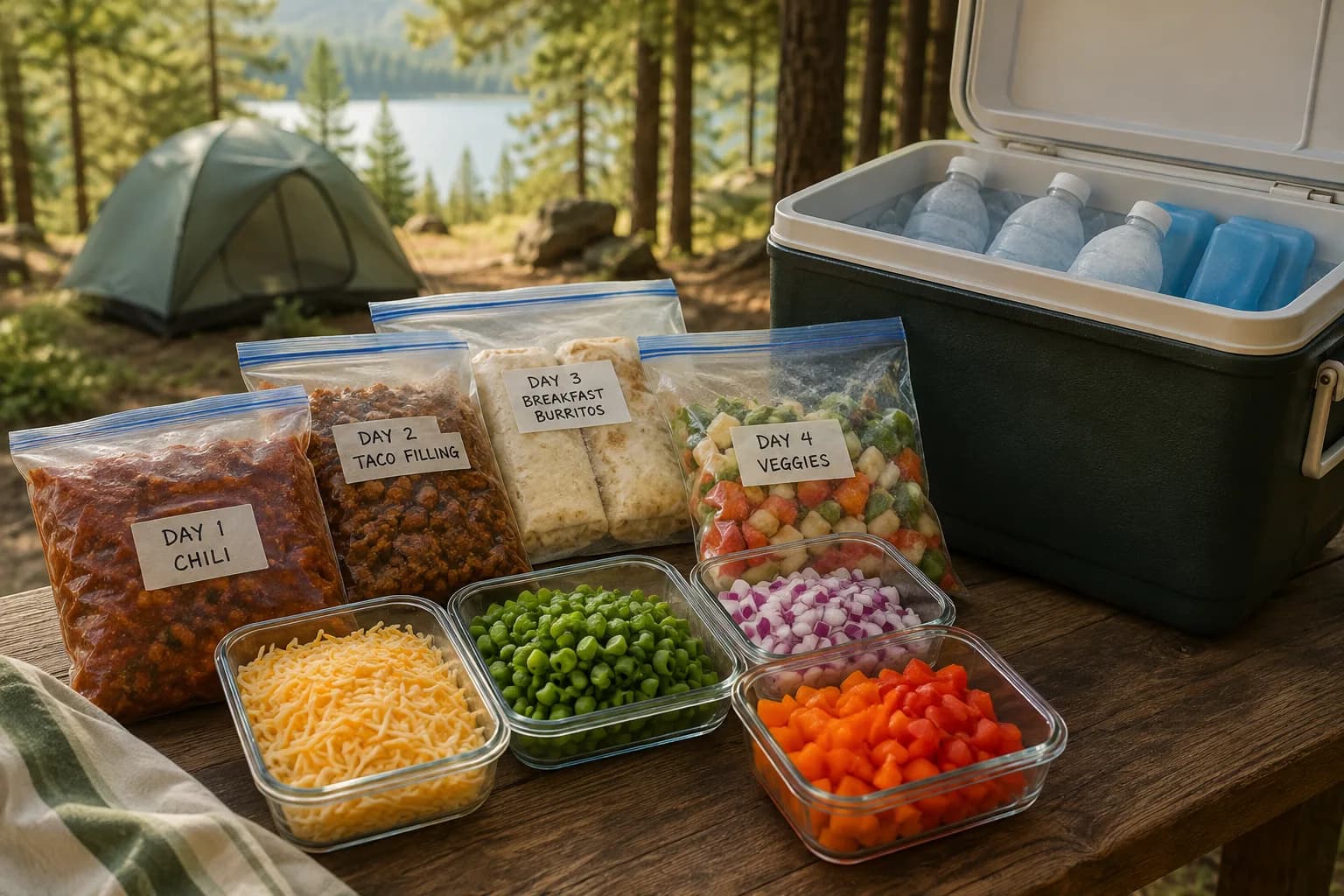
For a two-night trip, make taco filling for arrival night, breakfast burritos for Saturday, chickpea couscous for lunch, chili for the second dinner and baked oatmeal for departure morning. Freeze the cooked dinners flat, chill the lunch, label every package, and keep all perishables at or below 4 C / 40 F.
That is the short answer. The important correction is that a frozen meal is not a calendar. It may help cool the cooler, but "day three" written on a bag does not make its contents safe on day three. A cooler thermometer does.
Make-ahead camping meals work best when they remove campsite jobs: chopping, raw-meat handling, measuring spices and washing a small nation's worth of bowls. They work badly when meal prep becomes a frozen game of Tetris with no thawing plan, no backup dinner and one mysterious red bag.
This guide gives you eight complete meal bases, a comparison tool and an exact weekend plan for six. It is designed for car camping with a cooler and a permitted outdoor cooking appliance, not for backpacking without reliable cold holding.
Compare the eight make-ahead meals
Turkey or bean chili
- Home prep
- Cook fully; cool rapidly; freeze flat
- Cold holding
- Frozen or <= 4 C / 40 F
- Work at camp
- 12-18 min; stir while reheating
- Heat / safety
- Stove; 74 C / 165 F
- Best for
- Second-night dinner
- Allergens
- Check stock and seasoning
Taco filling
- Home prep
- Cook fully; cool rapidly; freeze flat
- Cold holding
- Frozen or <= 4 C / 40 F
- Work at camp
- 8-12 min; warm tortillas separately
- Heat / safety
- Stove; 74 C / 165 F
- Best for
- Fast arrival dinner
- Allergens
- Wheat in flour tortillas; milk if cheese; verify labels
Breakfast burritos
- Home prep
- Cook filling; assemble; freeze individually
- Cold holding
- Frozen or <= 4 C / 40 F
- Work at camp
- 12-18 min in covered pan; turn
- Heat / safety
- Stove; centre 74 C / 165 F
- Best for
- Cold, busy morning
- Allergens
- Egg, milk, wheat
Lentil curry
- Home prep
- Cook fully; cool rapidly; freeze flat
- Cold holding
- Frozen or <= 4 C / 40 F
- Work at camp
- 10-15 min; stir; add shelf-stable flatbread
- Heat / safety
- Stove; 74 C / 165 F
- Best for
- Plant-based dinner
- Allergens
- Check curry paste; wheat in bread
Pulled chicken
- Home prep
- Cook, shred and sauce; cool rapidly; freeze
- Cold holding
- Frozen or <= 4 C / 40 F
- Work at camp
- 10-15 min; serve in buns
- Heat / safety
- Stove; 74 C / 165 F
- Best for
- Flexible group meal
- Allergens
- Wheat; check sauce
Baked oatmeal squares
- Home prep
- Bake centre to 74 C / 165 F; cool promptly; freeze
- Cold holding
- Frozen or <= 4 C / 40 F
- Work at camp
- Eat cold or warm 5-8 min
- Heat / safety
- If warming, centre to 74 C / 165 F
- Best for
- Departure breakfast
- Allergens
- Egg, milk or alternative; use labelled oats when required
Chickpea couscous jars
- Home prep
- Cook couscous; chill promptly; assemble cold
- Cold holding
- Chill only, <= 4 C / 40 F
- Work at camp
- Shake and serve; no heat
- Heat / safety
- None
- Best for
- First-day lunch
- Allergens
- Wheat; check vinaigrette for mustard or sesame
Frozen pancakes
- Home prep
- Cook fully; cool promptly; freeze in layers
- Cold holding
- Frozen or <= 4 C / 40 F
- Work at camp
- Warm 1-2 min per side in pan
- Heat / safety
- If warming, centre to 74 C / 165 F
- Best for
- Kid-friendly breakfast
- Allergens
- Egg, milk, wheat
| Meal | Home prep | Cold holding | Work at camp | Heat / safety | Best for | Allergens |
|---|---|---|---|---|---|---|
| Turkey or bean chili | Cook fully; cool rapidly; freeze flat | Frozen or <= 4 C / 40 F | 12-18 min; stir while reheating | Stove; 74 C / 165 F | Second-night dinner | Check stock and seasoning |
| Taco filling | Cook fully; cool rapidly; freeze flat | Frozen or <= 4 C / 40 F | 8-12 min; warm tortillas separately | Stove; 74 C / 165 F | Fast arrival dinner | Wheat in flour tortillas; milk if cheese; verify labels |
| Breakfast burritos | Cook filling; assemble; freeze individually | Frozen or <= 4 C / 40 F | 12-18 min in covered pan; turn | Stove; centre 74 C / 165 F | Cold, busy morning | Egg, milk, wheat |
| Lentil curry | Cook fully; cool rapidly; freeze flat | Frozen or <= 4 C / 40 F | 10-15 min; stir; add shelf-stable flatbread | Stove; 74 C / 165 F | Plant-based dinner | Check curry paste; wheat in bread |
| Pulled chicken | Cook, shred and sauce; cool rapidly; freeze | Frozen or <= 4 C / 40 F | 10-15 min; serve in buns | Stove; 74 C / 165 F | Flexible group meal | Wheat; check sauce |
| Baked oatmeal squares | Bake centre to 74 C / 165 F; cool promptly; freeze | Frozen or <= 4 C / 40 F | Eat cold or warm 5-8 min | If warming, centre to 74 C / 165 F | Departure breakfast | Egg, milk or alternative; use labelled oats when required |
| Chickpea couscous jars | Cook couscous; chill promptly; assemble cold | Chill only, <= 4 C / 40 F | Shake and serve; no heat | None | First-day lunch | Wheat; check vinaigrette for mustard or sesame |
| Frozen pancakes | Cook fully; cool promptly; freeze in layers | Frozen or <= 4 C / 40 F | Warm 1-2 min per side in pan | If warming, centre to 74 C / 165 F | Kid-friendly breakfast | Egg, milk, wheat |
The best default is a fully cooked, saucy meal such as chili, lentil curry or pulled chicken. It freezes compactly, reheats evenly when stirred and avoids handling raw meat at camp.
Choose breakfast burritos when the morning needs to move. Choose chickpea couscous for an arrival lunch with no cooking. Choose pancakes or oatmeal squares when children want something familiar. Skip freezer meals entirely if you cannot verify cold holding; use the shelf-stable options in our no-cook camping meals guide.
The safety system: temperature, not wishful thinking
Keep the cooler at or below 4 C / 40 F
Place an appliance thermometer where you can read it without emptying the cooler. Health Canada identifies 4 C to 60 C / 40 F to 140 F as the danger zone. USDA camping guidance likewise says to keep cooler food at 40 F or below and to discard perishables when the cooler no longer contains ice or frozen gel packs.
A frozen chili bag can supplement ice, but it does not replace enough ice or frozen packs. Opening frequency, shade, cooler quality, outside temperature and how warm the contents were when packed all matter. There is no honest universal promise that a meal will stay safe for three or four days.
Health Canada advises refrigerating or freezing perishables within two hours, reduced to one hour on hot summer days. USDA states one hour when the air temperature is above 32 C / 90 F. When conditions or jurisdiction are unclear, use the shorter limit.
Cool cooked food rapidly at home
Do not leave a deep pot of chili on the counter until it "feels cool." Divide cooked food into small portions or shallow containers so heat can escape, then refrigerate or freeze it promptly. Avoid pouring very hot food straight into a thin freezer bag; cool it safely in suitable shallow containers first, then transfer when cold.
Count refrigerated leftovers from the day they were cooked. Health Canada advises eating refrigerated leftovers within two to three days. Freezing pauses that practical refrigerator window; once thawed under refrigeration, plan to use the food promptly.
Thaw under cold control
The simplest camp strategy is controlled thawing inside a cooler that remains at or below 4 C / 40 F. Keep packages sealed and leakproof. Never set a frozen meal on the picnic table for the afternoon to "help it along."
If a meal is still partly frozen at dinner, reheat it gently in a pot when the recipe allows, stirring and separating the frozen centre as it loosens. Do not put a sealed disposable freezer bag into boiling water unless its manufacturer specifically says it is designed for that use.
Reheat with a thermometer
Reheat cooked leftovers and egg dishes to 74 C / 165 F in the centre. Stir chili, curry and shredded meat so cold pockets reach the same temperature; Health Canada advises bringing soups, sauces and gravies to a rolling boil while stirring. Heat only what the group will eat. Discard cooked food that was reheated and then left uneaten rather than cooling and reheating it repeatedly.
Cooking time in this guide is an estimate, not the safety test. Wind can make a ten-minute dinner take twenty. The thermometer gets the final vote.
Cook and clean outside
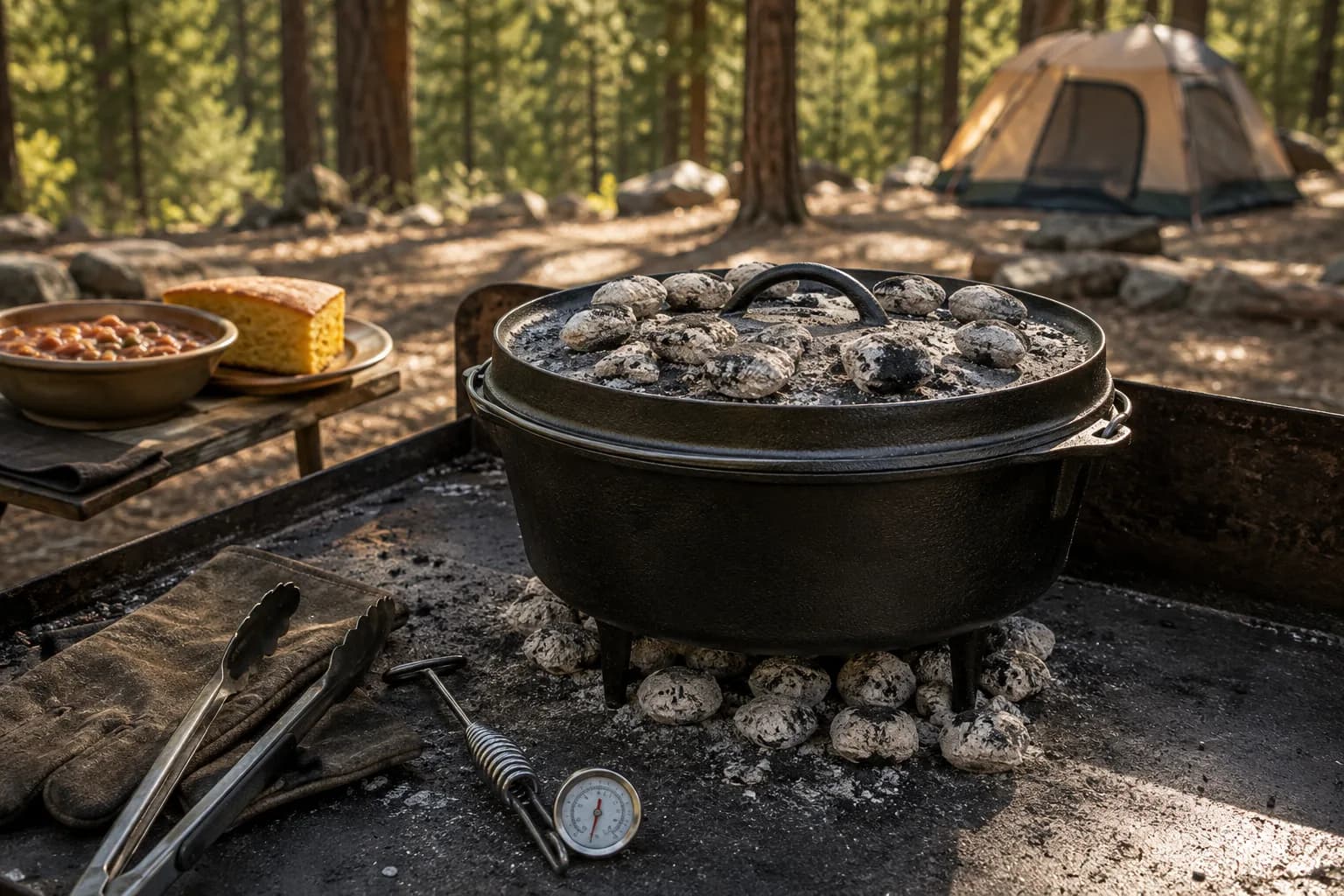
Check the current rules for the exact campground before relying on a campfire, charcoal or fuel stove. Fire restrictions do not always treat those heat sources the same way. Use a permitted appliance outdoors on a stable surface and according to its manual. Never operate a camping stove, barbecue or charcoal grill in a tent, vehicle, camper or enclosed shelter because of carbon-monoxide risk.
Use potable or properly treated water for cooking, washing hands and cleaning utensils. Keep ready-to-eat food separate from raw ingredients, use clean serving tools and store food and scented items as the campground requires.
Eight meals you can actually prepare
Each recipe serves six. Portions assume a mixed adult group with snacks or a simple side. Increase the base by about one quarter for six very hungry adults or a high-output day.
1. Turkey-and-bean chili
Best for: second-night dinner
Skip if: your pot is too small to stir six servings safely
At home: Brown 900 g / 2 lb ground turkey to 74 C / 165 F. Add 2 drained 540 mL / 19 oz cans kidney or black beans, 2 x 796 mL / 28 oz cans crushed tomatoes, 1 diced onion, 2 tbsp chili powder, 2 tsp cumin and 250 mL / 1 cup water or labelled stock. Simmer 25 minutes. Divide into two shallow containers, refrigerate promptly, then transfer cold chili to two labelled freezer bags and freeze flat.
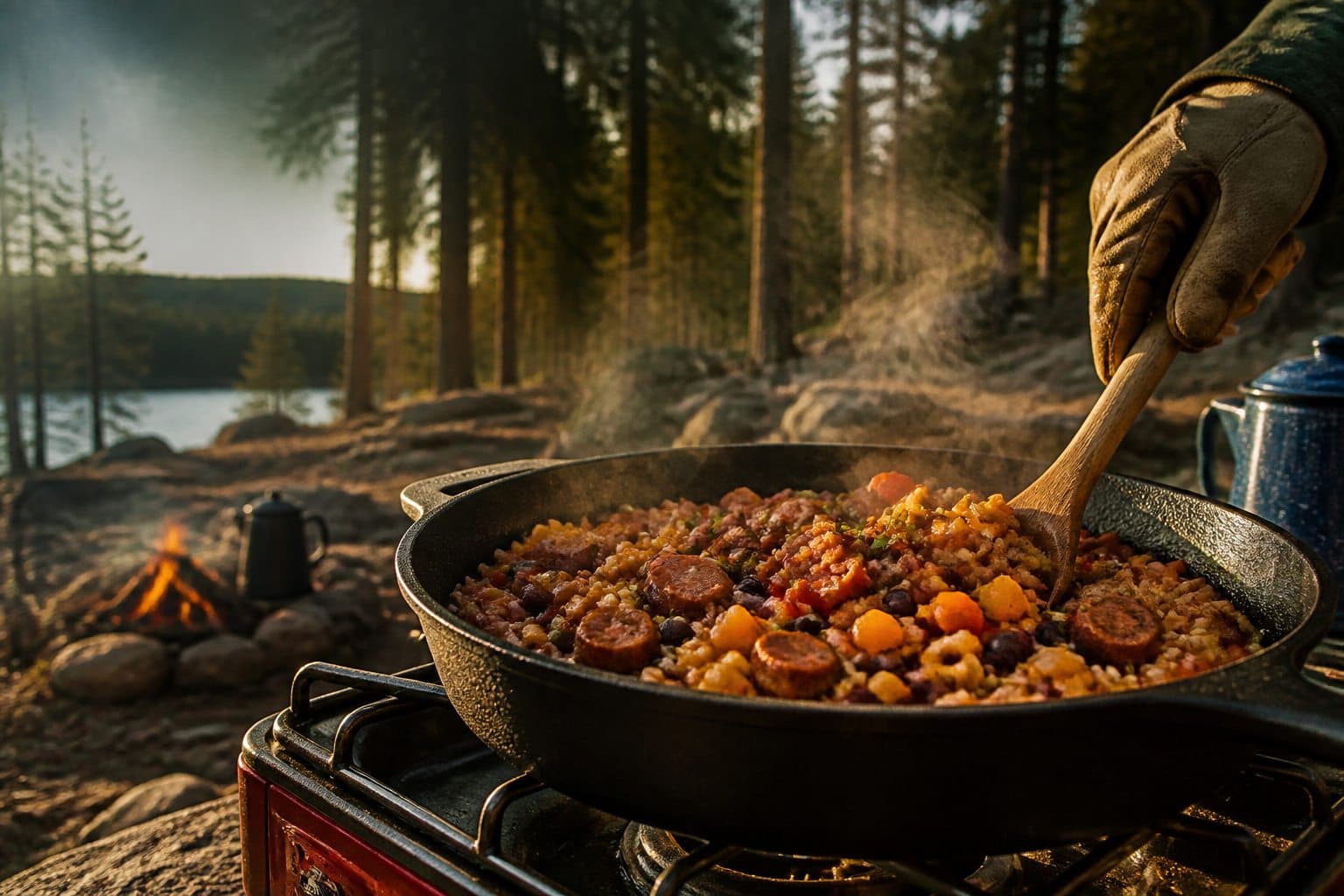
At camp: Empty both bags into a pot. Add a splash of potable water if needed. Cover and heat over a permitted stove for roughly 12 to 18 minutes, stirring often, until every tested area reaches 74 C / 165 F. Serve with 300 g / 10 oz tortilla chips or six buns.
Allergens: Check stock, spice blends and chips. This can be free of the priority allergens, but labels decide.
2. Cooked taco filling
Best for: arrival-night dinner
Skip if: you want a meal with no assembly
At home: Cook 900 g / 2 lb lean ground beef or turkey with 1 diced onion. Ground beef or pork must reach 71 C / 160 F; ground poultry must reach 74 C / 165 F. Stir in 2 tbsp taco seasoning and 250 mL / 1 cup tomato sauce. Cool rapidly in shallow containers, bag when cold and freeze flat.
For a plant-based version, replace the meat with 3 drained 540 mL / 19 oz cans black beans and mash one third of them for texture.
At camp: Reheat the filling in a covered skillet with 2 to 3 tbsp potable water, stirring until it reaches 74 C / 165 F. Serve with 12 medium tortillas, 500 mL / 2 cups shelf-stable salsa until opened, shredded cabbage and any cold-held cheese.
Allergens: Wheat in flour tortillas; milk in cheese. Choose labelled corn tortillas when appropriate and prevent cross-contact rather than assuming "corn" means safe.
3. Six breakfast burritos
Best for: a cold morning or early trail start
Skip if: your pan cannot be covered
At home: Cook 8 eggs as a firm scramble to 74 C / 165 F. Cook 450 g / 1 lb breakfast sausage to 71 C / 160 F for beef or pork sausage, or 74 C / 165 F for poultry sausage; alternatively, use 500 mL / 2 cups drained black beans. Add 375 mL / 1 1/2 cups cooked diced potato and 180 mL / 3/4 cup shredded cheese. Cool the components promptly before assembly. Divide among 6 large tortillas, roll tightly, wrap individually in foil and freeze.
At camp: Remove any plastic outer wrap. Warm the foil-wrapped burritos in a covered pan over low heat, turning every few minutes, for about 12 to 18 minutes. Do not place foil directly on a burner. Check the centre of more than one burrito; egg dishes and leftovers must reach 74 C / 165 F.
Allergens: Egg, milk and wheat. Use a separate pan and utensils for a medically required allergen-safe version.
4. Red lentil coconut curry
Best for: a plant-based dinner that reheats evenly
Skip if: coconut or the curry paste is unsafe for someone in the group
At home: Simmer 500 mL / 2 cups rinsed red lentils, 1 x 796 mL / 28 oz can diced tomatoes, 1 x 400 mL / 14 oz can coconut milk, 1 L / 4 cups water, 1 diced onion and 2 tbsp labelled curry paste or powder until the lentils are soft, about 25 minutes. Divide into shallow containers, chill promptly, bag cold and freeze flat.
At camp: Reheat in a pot, stirring frequently and adding potable water as needed, until the whole batch reaches 74 C / 165 F. Serve with 6 labelled shelf-stable flatbreads or crackers.
Allergens: Curry pastes can contain fish, shrimp, soy or sesame; flatbread commonly contains wheat. Coconut classification and advice vary by jurisdiction and individual allergy, so follow the person's care plan and labels.
5. Saucy pulled chicken
Best for: feeding mixed appetites because people build their own sandwich
Skip if: the group dislikes sweet or smoky sauces
At home: Cook 1.2 kg / 2.6 lb boneless chicken to 74 C / 165 F, shred it and mix with 500 mL / 2 cups barbecue sauce. Divide into shallow containers and chill promptly. Bag the cold mixture in two meal-size portions and freeze.
At camp: Reheat with a small splash of potable water in a covered pot, stirring until all of it reaches 74 C / 165 F. Serve on 6 large buns with cabbage slaw packed separately.
Allergens: Wheat in buns; mustard, soy or other allergens may be present in sauce. Check every label and keep the safe serving separate from shared toppings.
6. Baked oatmeal squares
Best for: departure morning, when nobody wants to wash a pan
Skip if: your group expects a savoury breakfast
At home: Mix 750 mL / 3 cups rolled oats, 500 mL / 2 cups milk or a labelled alternative, 2 eggs, 2 mashed bananas, 60 mL / 1/4 cup maple syrup, 2 tsp cinnamon and 5 mL / 1 tsp baking powder. Bake in a greased 23 cm / 9-inch square pan at 180 C / 350 F until set and the centre reaches 74 C / 165 F, about 30 to 35 minutes. Cool promptly, cut into six large squares, wrap and freeze.
At camp: Keep the squares cold. Eat safely thawed squares cold, or warm them in a covered pan for about 5 to 8 minutes until the centre reaches 74 C / 165 F. Because they contain egg and milk, do not treat them as shelf-stable.
Allergens: Oats, egg and milk or the chosen alternative. For gluten avoidance, use oats specifically labelled for that need and follow the group's cross-contact requirements.
7. Chickpea couscous jars
Best for: first-day lunch with no heat
Skip if: you need a meal that can sit in the car unrefrigerated
At home: Prepare 500 mL / 2 cups dry couscous using potable water according to the package. Spread it in a shallow container and refrigerate promptly. When cold, combine it with 2 drained 540 mL / 19 oz cans chickpeas, 500 mL / 2 cups chopped bell pepper, 250 mL / 1 cup chopped cucumber and 125 mL / 1/2 cup vinaigrette. Divide into six leakproof containers and refrigerate; do not freeze, because the vegetables lose their crunch.
At camp: Keep at or below 4 C / 40 F until lunch, toss and serve. This is a prepared refrigerated leftover, not a pantry meal.
Allergens: Couscous contains wheat. Vinaigrette may contain mustard, sesame or other allergens.
8. Twelve freezer pancakes
Best for: a familiar breakfast and flexible portions
Skip if: a no-cook departure is the real priority
At home: Make 12 medium pancakes using your recipe or a labelled mix; cook them fully. Cool promptly on clean racks, stack with parchment between them, seal and freeze. Pack 500 mL / 2 cups berries separately under cold control.
At camp: Warm pancakes in a lightly oiled pan over low heat, about 1 to 2 minutes per side, until the centre reaches 74 C / 165 F; or eat them cold once safely thawed under cold control. The berries go on top, not through a heroic attempt to flip six berry-studded pancakes at once.
Allergens: Common mixes contain wheat and may call for milk and egg. Follow labels and use separate preparation surfaces for an allergen-safe batch.
A complete two-night menu for six
This plan deliberately freezes the cooked dinners and breakfast burritos, but chills the crunchy lunch. The shelf-stable backup is additional food, not secretly counted as part of the main menu.
| Time | Meal | Pack position | Work at camp |
|---|---|---|---|
| Friday lunch or arrival snack | Chickpea couscous jars | Top food basket, at or below 4 C / 40 F | Toss and eat |
| Friday dinner | Taco filling, tortillas, salsa, cabbage | Upper frozen layer | Reheat filling to 74 C / 165 F |
| Saturday breakfast | Six breakfast burritos | Middle frozen layer | Covered pan; centres to 74 C / 165 F |
| Saturday lunch | Leftover-free snack board: crackers, whole fruit, labelled shelf-stable fish or bean pouches | Dry bin; chill opened food | Open only what will be eaten |
| Saturday dinner | Turkey-and-bean chili plus chips | Lowest frozen layer | Reheat to 74 C / 165 F |
| Sunday breakfast | Six baked oatmeal squares plus fruit | Cold basket | Eat cold or warm |
| Emergency reserve | Nut- or seed-butter packets, tortillas and whole fruit | Dry bin, unopened | Use if cold control or fuel fails |
If nut allergies are present, choose a labelled seed spread or another backup approved by the affected person. Do not place an allergen-heavy reserve loose beside their food.
Consolidated shopping list
Proteins and dairy: 900 g / 2 lb taco meat or three 540 mL / 19 oz cans black beans; 900 g / 2 lb ground turkey for chili; 10 eggs total; 450 g / 1 lb sausage or 2 cups drained black beans; 2 cups milk or alternative; 3/4 cup cheese if wanted.
Produce: two onions; one small cabbage; two bell peppers; one cucumber; two bananas; 1 1/2 cups cooked diced potato (about 450 g / 1 lb raw); six pieces of fruit for Sunday breakfast; optional chili and taco toppings.
Pantry: two 540 mL / 19 oz cans beans for chili; two 796 mL / 28 oz cans crushed tomatoes; two 540 mL / 19 oz cans chickpeas; 2 cups dry couscous; 1/2 cup vinaigrette; 1 cup labelled stock or water; 1 cup tomato sauce; 2 cups salsa; 18 tortillas total; 300 g / 10 oz tortilla chips; 3 cups oats; 1/4 cup maple syrup; baking powder and the listed spices.
This list covers the five prepared meals above. Add 6 labelled shelf-stable fish or bean pouches, about 360 g / 12 oz crackers and 6 separate pieces of whole fruit for Saturday lunch.
Pack the emergency reserve separately so it is not double-counted: 6 labelled nut- or seed-butter packets, 6 additional tortillas and 6 additional pieces of whole fruit. If any nut or seed is unsafe for the group, replace it with a labelled shelf-stable protein everyone can eat. The Sunday breakfast fruit, Saturday lunch fruit and emergency fruit are three separate sets of six.
Pack the cooler by access and risk
- Pre-chill the cooler and every cooked meal. Warm cans and room-temperature food spend your ice budget before the trip begins.
- Freeze the designated meals solid and flat. Label meal, preparation date and intended service. A label is an operations tool, not a safety guarantee.
- Use enough frozen water bottles or commercial ice packs. Put blocks or large packs on the bottom and cold sources around the sides and top.
- Place the last frozen dinner low. Chili belongs near the bottom; Friday taco filling can sit above it. Keep the first lunch accessible so the lid is not open while six people conduct an archaeological dig.
- Use leakproof secondary containment. Even fully cooked food can leak. If you carry any raw food for other meals, double-contain it at the very bottom, away from ready-to-eat food.
- Keep drinks in a second cooler when practical. The drink lid opens often; the food cooler deserves a quieter life.
- Read the thermometer morning, afternoon and before cooking. If cold control fails, switch to the dry-bin reserve.
Do not use the cooler as wildlife storage unless local rules specifically allow it. Follow the campground's official requirements for vehicles, lockers and scented items.
A preparation timeline that works
Two to four weeks before
Choose the menu, verify allergies and confirm that the campground permits your planned appliance. Cook and freeze chili, taco filling, curry or pulled chicken. Freeze bags flat on a tray, then stand them vertically once solid.
Two days before
Bake oatmeal squares or pancakes and freeze them. Make the breakfast burrito filling, cool it promptly, assemble and freeze. Freeze water bottles with expansion space or prepare ice packs.
The day before
Make the chickpea couscous, cool the couscous rapidly before assembly and refrigerate the finished containers. Pre-chill the cooler. Put all shelf-stable food in one dry bin. Pack a clean thermometer, soap, paper towels, separate utensils and enough potable water when the site supply is uncertain.
Departure morning
Confirm that frozen meals are solid, the chilled lunch is at or below 4 C / 40 F and the cooler thermometer works. Load by service order, fill empty space with cold packs and record the preparation dates on your meal plan.
Common mistakes
Treating frozen food as the only ice
It is helpful thermal mass, not a tested cold-holding system. Pack real cold sources and measure.
Cooling a deep pot on the counter
A cool rim can hide a warm centre. Use shallow portions and prompt refrigeration or freezing.
Planning every meal around the stove
Weather, fuel trouble or a restriction can erase that plan. Keep one labelled shelf-stable meal that requires no heating and no questionable water.
Packing raw "dump meals" beside lunch
This guide favours fully cooked meat bases because they simplify the campsite. If you bring a raw marinated meal, double-contain it at the bottom, thaw it only under cold control, use separate tools and cook it to the applicable safe temperature. Never reuse marinade that contacted raw meat as a sauce unless it is brought to a full boil.
Reheating by appearance
Steam at the edge is not a centre temperature. Stir and test several spots with a clean thermometer.
Ignoring allergens during assembly
A safe tortilla is no longer safe after it shares a board, knife or topping spoon. Read labels every time, prepare the safe serving first, seal it separately and identify it clearly.
Our verdict
For most two-night car-camping trips, prep two frozen cooked bases, one portable breakfast and one chilled first-day lunch. That is enough to remove the hard work without making the cooler responsible for an entire restaurant menu.
Chili is the most forgiving second-night choice. Taco filling is the fastest first-night dinner. Breakfast burritos offer the highest morning payoff, while baked oatmeal wins when cleanup matters more than a hot plate. Couscous is useful only early in the trip under verified cold control.
For more same-day options, compare all methods in 18 easy camping meals. If fire or fuel may be unavailable, build the backup from no-cook camping meals. For individually portioned dinners, use the safety distinctions in foil-packet camping recipes. Then count the non-food equipment in the weekend camping checklist.
FAQ
What are the best make-ahead camping meals?+
For most two-night car-camping trips, choose fully cooked taco filling for arrival night, breakfast burritos for the next morning, a chilled couscous lunch and frozen chili for the second dinner. These remove campsite prep and can be reheated or served with simple sides.
How long will a frozen meal stay safe in a camping cooler?+
There is no reliable number of days. Keep the cooler at or below 4 C / 40 F and verify it with a thermometer. Frozen meals can supplement ice packs, but safety depends on measured temperature, packing, outside conditions and how often the cooler opens.
Can frozen camping meals thaw on the picnic table?+
No. Thaw perishables under controlled refrigeration or inside a cooler that stays at or below 4 C / 40 F. If a suitable meal is still partly frozen, reheat it gently in a pot while stirring and verify 74 C / 165 F throughout.
Can reheating rescue food after a cooler gets warm?+
No. Reheating does not reliably make improperly held food safe because some toxins can survive cooking. If the food exceeded safe cold-holding limits, discard it and use a shelf-stable backup.
What temperature should make-ahead meals reach when reheated?+
Reheat cooked leftovers and egg dishes to 74 C / 165 F in the centre. Stir soups, sauces, chili and curry so there are no cold pockets, and use a clean food thermometer rather than relying on time or steam.
Should I freeze every make-ahead camping meal?+
No. Freeze meals that handle it well, such as chili, cooked taco filling and breakfast burritos. Chill crisp first-day meals such as couscous salad, and keep a separate shelf-stable meal for cold-control or fuel failure.
Sources reviewed
Fact-checked Sep 3, 2026
These references support factual or safety-sensitive claims in this article. Access dates show when our editors last verified the source.
- Health Canada - Summer food safety tips
Official source · Accessed Sep 3, 2026
- Health Canada - Food safety tips for leftovers
Official source · Accessed Sep 3, 2026
- Health Canada - Safe internal cooking temperatures
Official source · Accessed Sep 3, 2026
- USDA FSIS - Food safety while hiking, camping and boating
Official source · Accessed Sep 3, 2026
- USDA FSIS - Reheating cannot make food safe after improper holding
Official source · Accessed Sep 3, 2026
- CDC - Water treatment when hiking, camping or travelling
Official source · Accessed Sep 3, 2026
- Health Canada - Barbecue and portable butane stove safety
Official source · Accessed Sep 3, 2026
- Parks Canada - Cooking equipment and fire restrictions
Official source · Accessed Sep 3, 2026
- Health Canada - Food allergen labelling
Official source · Accessed Sep 7, 2026
- Food Allergy Canada - Kitchen tips to prevent allergen cross-contact
Expert guidance · Accessed Sep 7, 2026