recipes / camping meals
15 Camping Grill Recipes: One Grill, One Cooler, Two Nights
Choose 15 practical camping grill recipes by cooking time, cooler priority and cleanup, then use a complete two-night menu and packing plan for four.
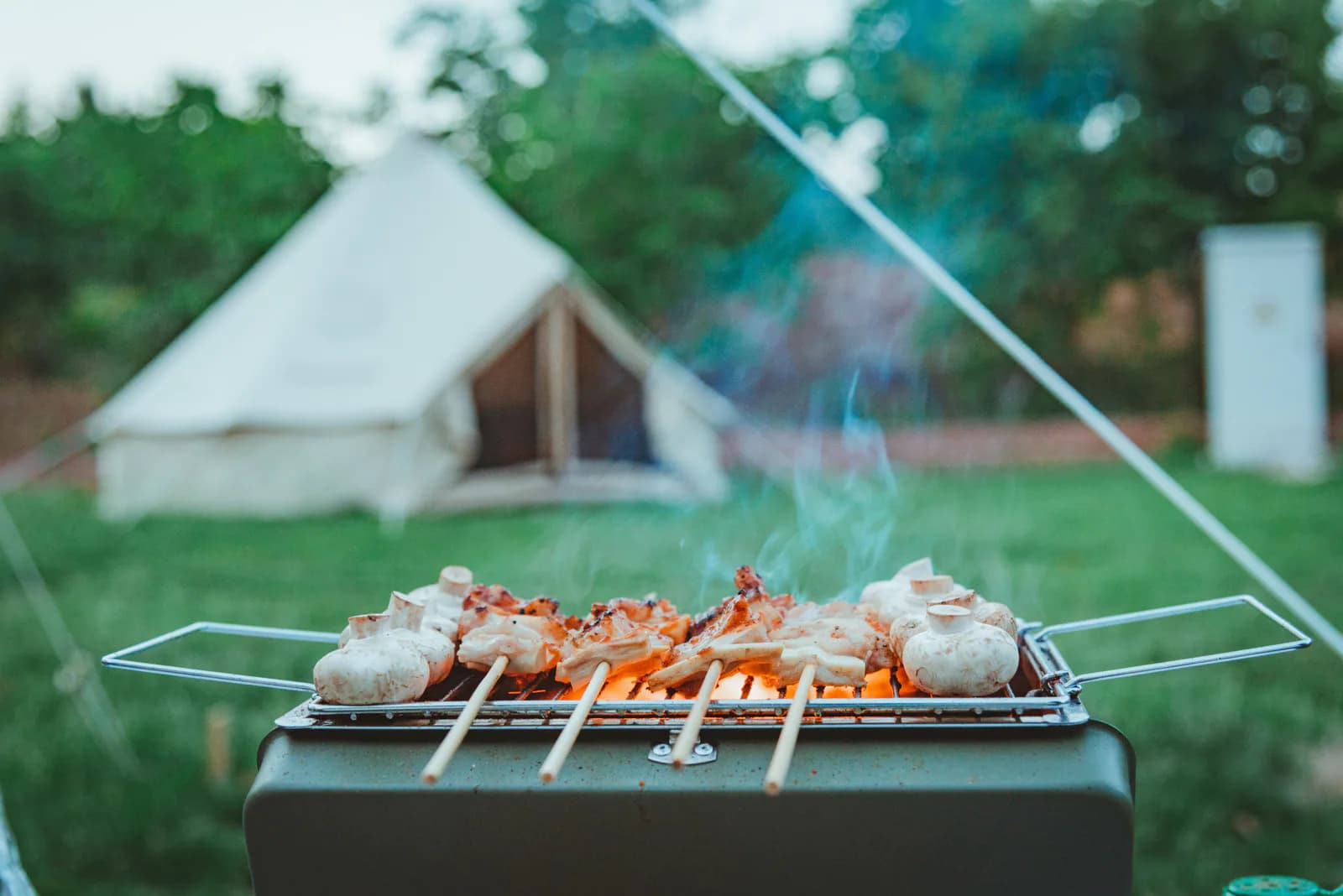
For the easiest two-night menu, grill sausages and peppers on arrival night, chicken skewers with corn on the second night, and peaches for dessert. Pack the food in cooking order, keep the cooler at 4°C / 40°F or below, and carry one meal that needs no heat.
A campsite grill does not turn your picnic table into a backyard kitchen. You have less prep space, less water, unpredictable wind and a cooler that gets warmer every time somebody goes looking for a drink.
These 15 camping grill recipes were chosen for those constraints. Every recipe serves four, uses a portable grill or a legal campground grate, and identifies the work worth doing at home. The complete menu uses one grill, one food cooler and overlapping ingredients. Cilantro should not require its own road trip.
Our method: these recipes and planning times were developed editorially, then checked against the cited official food- and appliance-safety sources. This collection is not presented as a recorded Keepsake Camp field test. Treat every time as a planning range and the thermometer as the final authority.
Compare the 15 camping grill recipes
| Recipe | Best moment | Grill time | Cooler priority | Cleanup | Best reason to choose it |
|---|---|---|---|---|---|
| Breakfast quesadillas | First morning | 12 min | High | Griddle + spatula | Fast and easy to portion |
| English-muffin egg melts | Slow morning | 18 min | High | Griddle + bowl | Full breakfast on one hot surface |
| Apple French-toast skewers | First morning | 15 min | High | Bowl + skewers | Sweet without a syrup lake |
| Lemon-herb chicken skewers | Second dinner | 15–20 min | High | Tongs + thermometer | Reliable group centrepiece |
| Camp smash burgers | First dinner | 12–16 min | High | Griddle + spatula | Fastest crowd-pleaser |
| Sausage and pepper rolls | Arrival dinner | 18–25 min | High | Tongs | Minimal work after setup |
| Steak fajita skewers | First dinner | 10–14 min | High | Tongs + thermometer | Big flavour, short cook |
| Maple-mustard pork medallions | Second dinner | 12–16 min | High | Tongs + thermometer | Faster than a whole tenderloin |
| Halloumi vegetable skewers | Lunch or dinner | 10–12 min | Medium | Tongs | Substantial meatless main |
| Black-bean corn quesadillas | Lunch | 10–12 min | Medium | Griddle + spatula | Inexpensive and flexible |
| Loaded grilled flatbreads | Lunch | 8–12 min | Medium | Tongs | Everyone builds their own |
| Chili-lime corn | Side | 10–15 min | Low | Tongs | Shares heat with any main |
| Smoky sweet-potato planks | Side | 12–18 min | Low | Tongs | Predictable alternative to whole potatoes |
| Garlic mushrooms | Side | 8–10 min | Medium | Skillet | Uses fragile produce early |
| Grilled peaches with oat crumble | Dessert | 6–8 min | Low | Tongs | Uses the final heat |
Times are planning estimates, not doneness tests. Wind, grate height, fuel, food thickness and lid design all change the clock.
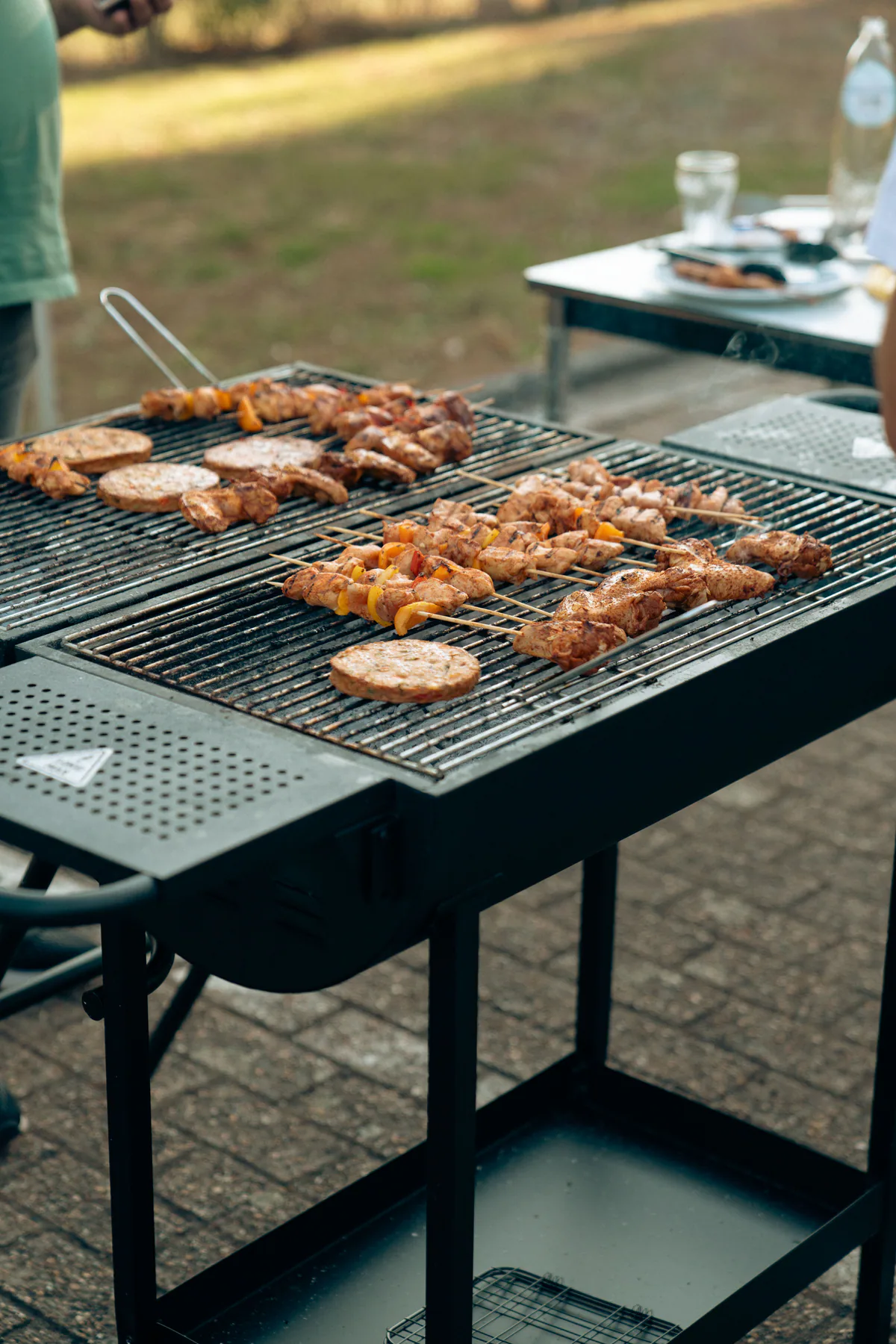
A larger grate creates useful zones, but it also makes separate raw-food tools and a clean cooked-food plate more important.
Four rules before dinner touches the grate
Keep food cold, not merely cool-looking
Keep perishable food at or below 4°C / 40°F. Put a thermometer inside the cooler, store raw meat in leakproof containers at the bottom and use a separate drinks cooler when possible.
Health Canada advises limiting room-temperature exposure to one hour on hot summer days. USDA guidance uses two hours, reduced to one hour above 32°C / 90°F. Follow the rule that applies where you are and use the shorter limit when conditions are uncertain.
Use a food thermometer
This guide follows Health Canada's current safe-cooking targets:
| Food | Minimum internal temperature |
|---|---|
| Chicken pieces and egg dishes | 74°C / 165°F |
| Ground beef or pork | 71°C / 160°F |
| Pork pieces | 71°C / 160°F |
| Fish | 70°C / 158°F |
| Reheated leftovers | 74°C / 165°F |
Check the thickest part of each piece and clean the thermometer between foods. Grill marks are attractive. They are not a pathogen-detection system.
Confirm the appliance is allowed
A campground may allow a propane appliance while prohibiting charcoal and wood. Another may restrict cooking to provided equipment. Check the current official order for the exact campground before relying on any flame; Parks Canada's fire-management page links to current fire-status information for its parks.
Operate grills and fuel-burning stoves outside, on a stable surface, away from tents, vehicles, doors, windows and combustible material. Follow the manufacturer's instructions and never leave the appliance unattended.
Pack one dinner that needs no heat
The emergency meal for this plan is four tuna-and-white-bean wraps: two tuna pouches, one can of white beans, four tortillas, oil packets and a lemon. Keep the packages sealed until dinner. Our no-cook camping meals guide gives you more complete alternatives, while the camping BBQ backup system pairs each planned grill meal with a specific no-heat substitute.
Check allergens before packing
The recipes use common allergens including milk, eggs, wheat, fish, mustard and, in some optional toppings, peanuts or tree nuts. Read every packaged-food label, choose substitutions for the whole group and prevent cross-contact on shared griddles, boards, tongs and condiment jars.
Three camping grill breakfasts
1. Breakfast quesadillas
Serves 4 | Home prep: 10 minutes | Grill: 12 minutes
Pack 8 small tortillas, 8 eggs, 1 diced bell pepper, 2 cups grated cheese and 1 tablespoon oil. Keep the eggs, cut pepper and cheese cold.
Soften the pepper on a grill-safe griddle. Crack the eggs at camp, scramble them and cook the mixture to 74°C / 165°F. Divide the filling and cheese among four tortillas, fold and grill both sides until crisp. Dice the pepper at home, but do not crack the eggs in advance.
2. English-muffin egg melts
Serves 4 | Home prep: 5 minutes | Grill: 18 minutes
Pack 4 split English muffins, 4 eggs, 4 cheese slices, 4 tomato slices and a little oil. Toast the muffins cut-side down while the eggs cook on a lightly oiled griddle. Turn the eggs, add cheese, cover briefly and verify 74°C / 165°F. Add tomato after cooking.
Choose this for a slow morning, not when everyone is already wearing backpacks.
3. Apple French-toast skewers
Serves 4 | Home prep: 8 minutes | Grill: 15 minutes
Pack 8 thick bread slices cut into roughly 3 cm / 1 1/4-inch cubes, 2 firm apples cut into similarly sized wedges, 3 eggs, 3/4 cup milk, 1 teaspoon cinnamon and 1 tablespoon oil. At camp, alternate bread and apple on eight skewers, leaving a little space between pieces so the egg coating and heat can reach the bread faces.
Whisk eggs, milk and cinnamon at camp. Brush the mixture onto the bread instead of soaking the entire skewer. Grill on an oiled medium griddle, turning until every face is browned and the egg coating reaches 74°C / 165°F.
Five meat mains
4. Lemon-herb chicken skewers
Serves 4 | Home prep: 15 minutes | Grill: 15–20 minutes
Cut 680 g / 1 1/2 lb boneless chicken thighs into even pieces. Marinate with 3 tablespoons oil, one lemon, 2 minced garlic cloves, 1 teaspoon oregano and 1/2 teaspoon salt. Refrigerate immediately in a sealed container.
Thread at camp, leaving a small gap between pieces. Grill over medium heat, turning every few minutes, until the thickest pieces reach 74°C / 165°F. Move cooked skewers to a clean platter. Thigh meat tolerates uneven campsite heat better than breast meat; the thermometer still makes the decision.
5. Camp smash burgers
Serves 4 | Home prep: 10 minutes | Grill: 12–16 minutes
Pack 680 g / 1 1/2 lb ground beef divided into eight loose balls, 4 buns, 4 cheese slices, one sliced onion and condiments. Heat a solid griddle over medium-high heat. Press each ball once, season, brown, flip and cook every patty to 71°C / 160°F. Stack two thin patties per bun.
Do not smash burgers through an open grate unless you enjoy donating dinner to the fire ring.
6. Sausage and pepper rolls
Serves 4 | Home prep: 10 minutes | Grill: 18–25 minutes
Pack 4 raw sausages, 2 bell peppers quartered lengthwise, 1 onion cut into thick rounds, 4 sturdy rolls and mustard. Grill the vegetables until tender. Cook the sausages, turning regularly, until beef or pork sausage reaches 71°C / 160°F or poultry sausage reaches 74°C / 165°F. Slice vegetables on a clean board and load the rolls.
This is our arrival-night pick because it needs no bowl, marinade or delicate timing.
7. Steak fajita skewers
Serves 4 | Home prep: 15 minutes | Grill: 10–14 minutes
Cut 570 g / 1 1/4 lb sirloin into 2.5 cm / 1-inch cubes. Pack with 2 peppers, 1 red onion, 2 tablespoons oil, 2 teaspoons chili powder, 1 teaspoon cumin, 8 small tortillas and 1 lime.
Thread meat and vegetables on separate skewers so each can finish on its own schedule. Grill the beef to the group's preferred doneness while meeting the applicable local safety guidance. Warm tortillas during the final minute and finish with lime.
8. Maple-mustard pork medallions
Serves 4 | Home prep: 12 minutes | Grill: 12–16 minutes
Slice a 680 g / 1 1/2 lb pork tenderloin into 2.5 cm / 1-inch medallions. Mix 2 tablespoons Dijon, 2 tablespoons maple syrup, 1 tablespoon oil and 1 teaspoon cider vinegar. Reserve half the untouched sauce for serving. Coat the pork with the remainder and grill to 71°C / 160°F.
Medallions cook more predictably than a whole tenderloin on a small camp grill.
Three meatless mains
9. Halloumi vegetable skewers
Serves 4 | Home prep: 15 minutes | Grill: 10–12 minutes
Cut 450 g / 1 lb halloumi, 2 zucchini and 2 peppers into large pieces. Pack with oil, oregano, one lemon and 4 pitas. Thread cheese and vegetables separately. Start the vegetables first, add the fast-browning halloumi later, then finish with lemon and serve in warm pitas.
10. Black-bean corn quesadillas
Serves 4 | Home prep: 8 minutes | Grill: 10–12 minutes
Mix 1 drained can black beans, 1 cup corn, 1 teaspoon cumin and 1/2 cup salsa. Pack with 8 small tortillas and 2 cups grated cheese. Fill, fold and grill on a clean griddle over medium-low heat until crisp and hot throughout.
Use moderate heat. A black tortilla wrapped around cold cheese is not a rustic success.
11. Loaded grilled flatbreads
Serves 4 | Home prep: 10 minutes | Grill: 8–12 minutes
Pack 4 naan, 1 cup tomato sauce, 2 cups grated mozzarella, 1 sliced pepper, 1 cup sliced mushrooms and optional fully cooked toppings. Toast one side of each flatbread, turn, add a thin layer of toppings and close the lid until the base is crisp and the cheese melts. With no lid, cover it using an inverted grill-safe pan.
Three sides and one dessert
12. Chili-lime corn
Brush 4 shucked corn cobs with oil. Grill over medium heat for 10–15 minutes, turning until tender and browned in spots. Finish with lime, chili powder and salt.
13. Smoky sweet-potato planks
Cut 2 large sweet potatoes lengthwise into 1 cm / 3/8-inch planks. Toss with 2 tablespoons oil, smoked paprika and salt. Grill over medium-low heat for 12–18 minutes, turning several times, until a fork passes through the thickest section.
14. Garlic mushrooms
Cook 450 g / 1 lb whole or halved mushrooms with oil in a grill-safe skillet for 8–10 minutes. Add one minced garlic clove during the final two minutes so it perfumes dinner instead of becoming charcoal confetti.
15. Grilled peaches with oat crumble
Halve and pit 4 firm peaches. Brush lightly with oil and grill cut-side down for 6–8 minutes until marked and just tender. Fill with shelf-stable oat crumble or granola and maple syrup. Check the crumble for wheat, milk, peanuts and tree nuts.
A complete two-night menu for four
This plan assumes car camping, potable water, a food cooler held at 4°C / 40°F or below and a grill permitted under current rules.
| When | Meal | Why it belongs here |
|---|---|---|
| Friday dinner | Sausage and pepper rolls | Almost no assembly after setup |
| Saturday breakfast | Breakfast quesadillas | Uses eggs, cut pepper and cheese while the cooler is coldest |
| Saturday lunch | Halloumi vegetable pitas | Uses fragile vegetables before they bruise |
| Saturday dinner | Lemon-herb chicken skewers + corn | The meal worth lingering over |
| Saturday dessert | Grilled peaches | Uses residual grill heat |
| Sunday breakfast | Shelf-stable oatmeal or bagels | No need to relight during pack-out |
| Emergency meal | Tuna-and-white-bean wraps | Works if the heat source becomes prohibited or fails |
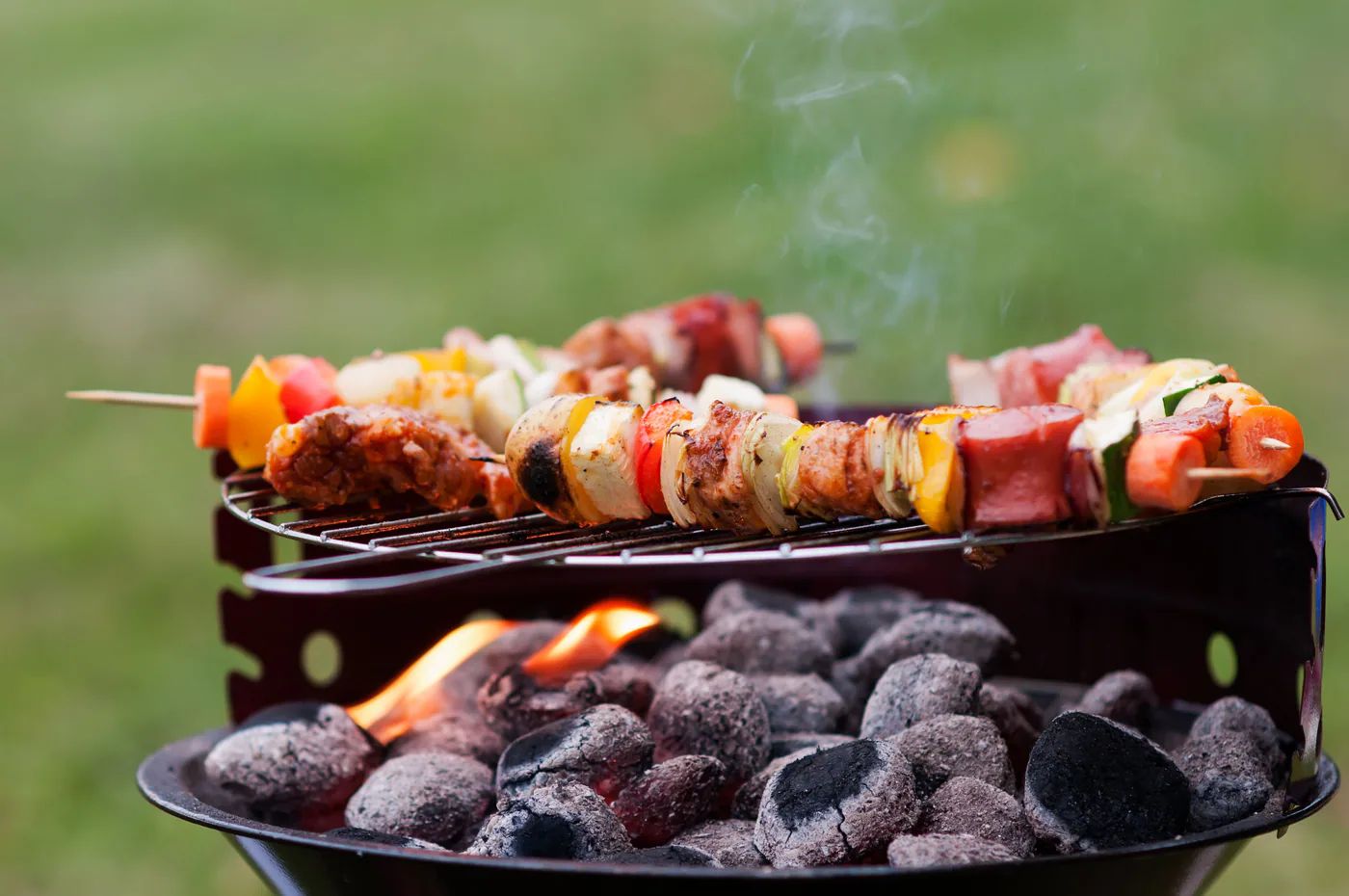
A compact grill rewards a shorter menu and ingredients cut to similar sizes. The two-night plan above keeps that small cooking surface from becoming a traffic jam.
If your cooler cannot reliably stay at 4°C / 40°F, do not stretch raw chicken to night two. Grill it on arrival night or replace it with a shelf-stable main.
The shopping list for that menu
Cold food: 4 sausages; 680 g / 1 1/2 lb chicken thighs; 450 g / 1 lb halloumi; 8 eggs; 2 cups grated cheese; 5 peppers; 1 onion; 2 zucchini; 4 corn cobs; 4 peaches; 3 lemons and 2 limes.
Pantry and bread: 4 rolls; 8 tortillas; 4 pitas; oil; oregano; cumin; chili powder; mustard; salsa; granola; departure-day oatmeal or bagels; 2 tuna pouches; 1 can white beans; 4 reserve tortillas.
Equipment: legal grill and correct fuel; grill-safe griddle; long tongs; spatula; instant-read thermometer; separate raw and ready-to-eat boards; clean cooked-food plates; cooler thermometer; potable water and washing supplies.
Pack one food cooler in cooking order
- Pre-chill the cooler and every refrigerated ingredient.
- Put night-two chicken in a sealed container at the coldest bottom layer.
- Place sausages above it, also sealed and separated.
- Add dairy and eggs in a protected middle layer.
- Place sturdy vegetables around the cold mass, with peaches on top.
- Group each meal in a labelled bag so the lid stays open briefly.
- Keep drinks elsewhere when possible.
- Read the thermometer instead of judging by touch.
If the cooler rises above the safe holding temperature, follow official discard guidance rather than negotiating with the chicken.
Which grill should you plan around?
| Heat source | Best quality | Main drawback | Use it when |
|---|---|---|---|
| Propane grill | Fast, adjustable heat | Appliance restrictions still apply | You want predictability |
| Charcoal grill | Broad, steady coal bed | Slow start and long cooling time | Charcoal is explicitly permitted |
| Campground fire-ring grate | No grill to pack | Height and heat are unpredictable | Wood fires and grate cooking are allowed |
| Grill-safe griddle | Keeps small food out of the fire | Adds weight and cleanup | You want eggs, burgers or quesadillas |
If you specifically want wood coals, use our open-fire grilling guide. It treats the fire as a heat system instead of calling every orange flame “medium-high.”
Frequently asked questions
What is the easiest meal to grill while camping?
Sausage and pepper rolls are the easiest complete dinner here: no bowl, no marinade and both components tolerate timing variation. Use a thermometer for the sausages.
Can I prepare camping grill meals ahead?
Yes. Cut vegetables, portion meat, mix marinades and group ingredients at home. Cool prepared food promptly and transport it at 4°C / 40°F or below. Do not partially grill raw meat for finishing later.
What can I grill without cast iron?
Skewers, sausages, pork medallions, corn, sweet-potato planks, peaches and halloumi can cook directly on a suitable clean grate. Eggs, smash burgers, quesadillas and small mushrooms need a griddle, skillet or tray.
Do fire bans include propane grills?
Sometimes. The wording and exceptions vary by authority, location and restriction level. Check the current official order for the exact campground rather than transferring a rule from another park.
The Keepsake Camp verdict
For a first two-night trip, skip the culinary Olympics. Choose one easy arrival dinner, one meal worth lingering over and one no-heat reserve. Sausage rolls, chicken skewers, corn and peaches make a better weekend than fifteen half-prepped ideas sweating in the cooler.
The list gives you options. The plan is what gets dinner onto a plate.
Sources reviewed
Fact-checked Sep 25, 2026
These references support factual or safety-sensitive claims in this article. Access dates show when our editors last verified the source.
- Health Canada — Barbecue and portable butane stove safety
Official source · Accessed Sep 25, 2026
- Health Canada — Safe cooking temperatures
Official source · Accessed Sep 25, 2026
- Health Canada — Summer food safety tips
Official source · Accessed Sep 25, 2026
- USDA FSIS — Food safety while hiking, camping and boating
Official source · Accessed Sep 25, 2026
- USDA FSIS — Grilling food safely
Official source · Accessed Sep 25, 2026
- National Park Service — Cooking in camp
Official source · Accessed Sep 25, 2026
- Parks Canada — Fire management and current park status
Official source · Accessed Sep 26, 2026