guides / safety
How to Purify Water While Camping
Choose a camping water-treatment sequence by source risk, germs, clarity and verified product claims—plus a printable field plan and CDC boiling times.
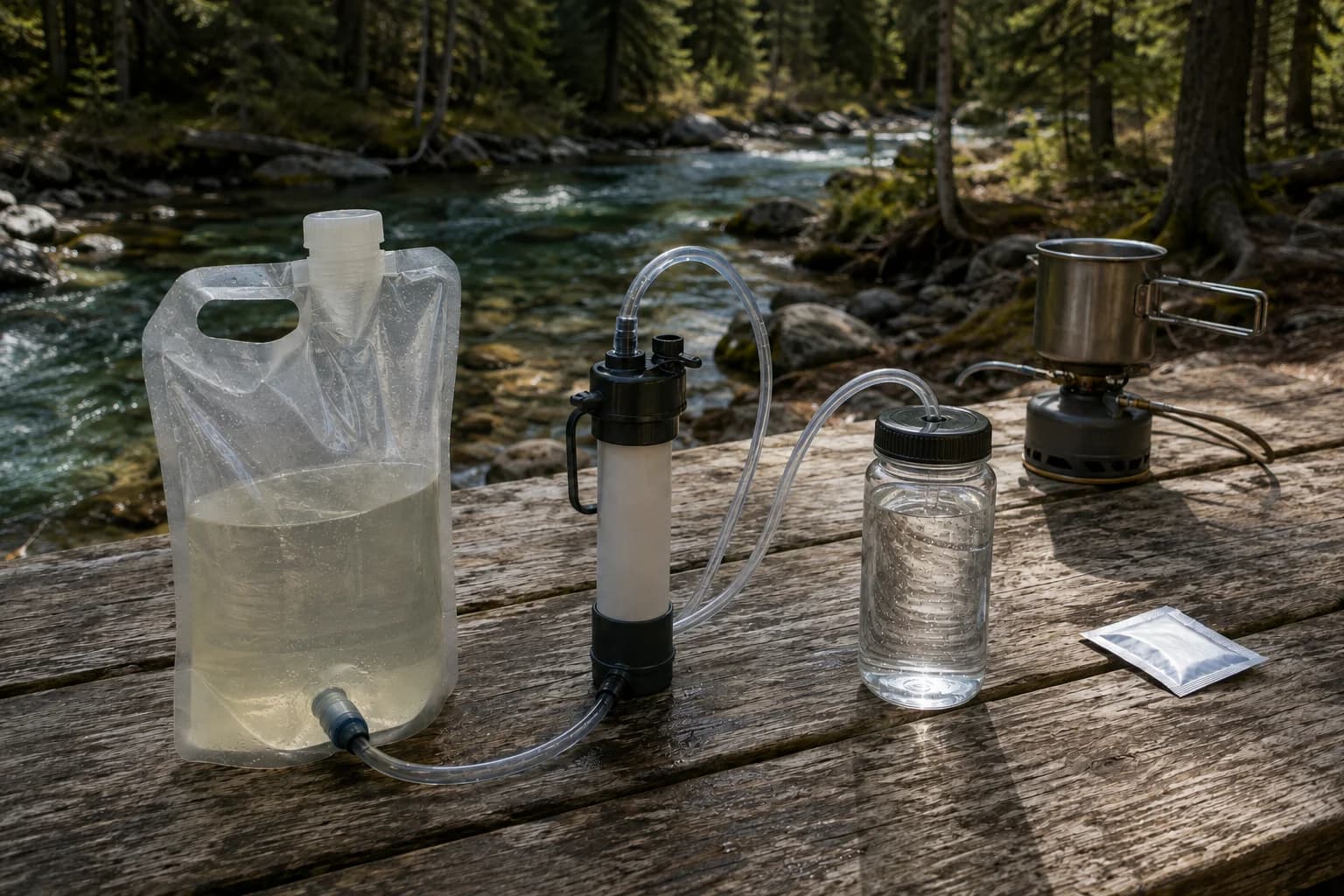
If you are not sure natural water is safe, boiling is the CDC's first choice for killing germs: bring clear water to a rolling boil for 1 minute, or 3 minutes above 6,500 feet (about 1,980 metres). If boiling is impractical, the CDC's next-best sequence is to filter and then disinfect the filtered water according to the product label.
That answer applies to germs. If there is a spill, fuel, a chemical odour, an official do-not-consume notice, radioactive contamination or a suspected cyanobacteria bloom, do not try to rescue the source with campsite treatment. Use water approved by the responsible authority. Clear mountain water can hide germs; a bright green shoreline can be telling you something much less subtle.
Keepsake Camp field decision
Choose a treatment sequence
Describe the source and equipment. The result explains the safest next step the evidence supports—not a universal tablet dose.
Verdict
Boil
- 1. Use the clearest available water and keep untreated water off the clean container.
- 2. Bring clear water to a rolling boil for 1 minute.
- 3. Let it cool naturally in a clean, covered container.
Boiling is the CDC's first choice for killing waterborne germs. It still does not remove harmful chemical contamination.
Water-treatment verdict updated: Boil.
This planning tool cannot test or identify contaminants. Current advisories and instructions from the responsible authority override it.
The method matrix
This table summarizes the CDC's field guidance. “Works” always means when the exact product claim and instructions support that organism and the device is operated correctly.
| Method | Bacteria | Viruses | Giardia / Cryptosporidium | Cloudy water | Needs | Main limitation |
|---|---|---|---|---|---|---|
| Boiling | Kills | Kills | Kills | Let settle and pre-filter first | Fuel, vessel, cooling time | Does not remove harmful chemicals or toxins |
| Typical ≤1-micron absolute or cyst-certified filter | Not all | No | Removes parasites | Pre-filtering helps clogging and clarity | Pump/gravity, maintenance | “Cyst reduction” is not a bacteria or virus claim |
| ≤0.3-micron absolute filter | Removes | No | Removes | Pre-filtering helps | Pump/gravity, maintenance | Still does not remove viruses |
| Filter, then disinfect | Broader coverage | Disinfectant can kill | Filter carries the parasite burden | Settle/pre-filter, then complete both steps | Filter plus exact contact time | Disinfectant performance varies by parasite and product |
| Validated microbiological purifier | Only if claimed | Only if claimed | Only if claimed | Follow its test conditions and manual | Product-specific | “Purifier” is meaningful only with precise verified claims |
| Chemical disinfectant alone | Usually kills | Usually kills | Bleach/iodine perform poorly; chlorine dioxide kills Giardia and is only somewhat effective for Crypto | Less reliable when cloudy | Correct product, dose and contact time | Not the CDC's preferred stand-alone answer for parasites |
| Portable UV | Can kill | Can kill | Can kill | No—filter first | Clear water, battery, correct cycle | Particles can shield germs; no residual protection |
For most campers who cannot boil, we would choose a filter with organism claims you have verified, then add a labelled drinking-water disinfectant. It covers more microbial gaps than a typical filter alone. It is not a defence against harmful chemicals, and it is not permission to collect from an obviously compromised source.
Four words that should not be used interchangeably
Pre-filter. A clean cloth, coffee filter or settling step removes visible sediment. It may improve the next treatment step, but it does not make the water safe by itself.
Filter. A device physically removes organisms or particles within its verified performance range. Pore size and specific reduction claims matter.
Disinfectant. A chemical or UV process inactivates organisms it is proven to address. Chemical products require the labelled dose and contact time; UV requires clear water and a complete operating cycle.
Purifier. Treat this as a performance claim, not a synonym for filter. The CDC Yellow Book explains that products making an EPA microbiological-purifier claim must demonstrate reductions for bacteria, viruses and protozoan cysts. EPA does not independently test every manufacturer's data, so read the actual claim and instructions.
The label “outdoor filter” tells you where marketing hopes you will take it. It does not tell you what comes out the other side.
Step 1: reject the wrong source
Check current campground, land-manager and public-health notices before collecting water. Choose the clearest available flowing source away from obvious contamination when local guidance permits—but appearance and flow never prove safety.
Use another approved source when you see or suspect:
- fuel, a spill, mine drainage, industrial or agricultural contamination
- a chemical, sewage or unusual odour
- dark water, floating material or an official do-not-consume notice
- green, blue-green, red or brown surface material that resembles paint or grass clippings
- dense mats, discoloured water, dead wildlife or a reported harmful bloom
Health Canada says it is impossible to know by sight whether a cyanobacteria bloom contains toxins, so treat any suspected bloom as toxic, stay out and report it. Keep pets from swimming, drinking, eating shoreline material or licking contaminated fur.
For drinking water, Health Canada further notes that microcystins are not destroyed by boiling, and household-scale treatment of heavily affected water is complex. At camp, the useful decision is simple: change sources rather than attempting a chemistry project beside the tent.
Step 2: boil when you can do it safely
The CDC camping-water guidance calls boiling the best method for killing waterborne germs, including viruses, bacteria, Giardia and Cryptosporidium.
For the CDC method:
- If water is cloudy, let sediment settle and pour the clearer water through a clean cloth or coffee filter.
- Bring the clear water to a rolling boil.
- Continue for 1 minute.
- Above 6,500 feet (about 1,980 metres), continue for 3 minutes.
- Let it cool naturally and transfer it only to a clean, covered container.
The altitude threshold above is deliberately the CDC rule throughout this page. Other agencies publish different conservative thresholds for emergency contexts; mixing them inside one field checklist would make the instructions harder to follow.
Boiling needs fuel, a stable outdoor stove or legal fire, a vessel and cooling time. It does not improve every taste, remove sediment or protect the water from being contaminated again. It also does not remove fuel, heavy metals, salts, harmful chemicals, cyanotoxins or radioactive material.
Step 3: verify a filter by claim, not by category
The CDC says:
- an absolute pore size of 1 micron or smaller, or certification to NSF 53 or 58 specifically for cyst reduction/removal, removes parasites but not viruses or all bacteria;
- an absolute pore size of 0.3 micron or smaller removes bacteria and parasites, but not viruses;
- reverse osmosis can remove parasites, bacteria, viruses and salt, though most backpacking microfilters are not reverse-osmosis systems.
“Absolute” matters. So does the named contaminant. NSF explains that a standard number can contain several different claims; check both the certification and the exact contaminant reduction. NSF 53 printed on a box is not automatically a cyst claim, and a cyst claim is not automatically a virus claim.
Before buying or packing a device, record:
- absolute pore size, if stated
- bacteria, virus and protozoa/cyst claims separately
- the certification body and searchable product listing
- rated capacity and flow rate
- cleaning, backflushing and replacement instructions
- storage and freeze precautions from the manufacturer
If the claim is missing, treat it as unknown. “Tested,” “advanced membrane” and an illustration of a mountain are not organism-reduction data.
Step 4: add disinfection when boiling is impractical
The CDC's next-best option after boiling is to filter and then disinfect the filtered water. Filtering removes particles and organisms within the filter's claim; disinfection helps address susceptible bacteria and viruses that may pass a typical microfilter.
Chemical disinfectants are not interchangeable:
- unscented chlorine bleach and iodine can kill bacteria and viruses but do not work well against parasites;
- chlorine dioxide can kill Giardia and is somewhat effective against Cryptosporidium;
- because of those limits, the CDC still advises filtering first to remove parasites.
For backpacking tablets or drops, follow the exact drinking-water label. Product strength, volume, water temperature and clarity affect the required dose or contact time. This page intentionally does not invent one tablet count or waiting period.
Household bleach belongs to a different emergency context. The EPA publishes current instructions that depend on sodium-hypochlorite concentration and exclude scented, colour-safe products or bleach with added cleaners. Do not improvise a campsite recipe from memory. Use bleach only under current public-health instructions after confirming the product concentration and additives.
The CDC says pregnant people, people with thyroid problems and people hypersensitive to iodine should avoid iodine-disinfected water, and nobody should drink it for more than a few weeks. When a health condition or medication affects method choice, ask a clinician or pharmacist before the trip.
What about portable UV?
Portable UV units can kill parasites, bacteria and viruses in small quantities of clear water when their complete cycle and volume instructions are followed. The CDC says to filter first because particles can shield germs from the light.
UV requires working batteries, clean optical surfaces and the correct exposure cycle. It leaves no residual disinfectant to protect the water after treatment. We would not make a battery-powered method the only plan on a route where failure leaves no safe alternative.
Keep a dirty side and a clean side
Treatment can work perfectly and the bottle can still undo it. Build a one-way workflow:
- Mark one pouch, scoop or bottle raw water only.
- Let sediment settle and pre-filter when needed.
- Complete the chosen treatment—do not shorten a boil, cycle or contact time.
- Receive or transfer water into a clean container.
- Cover the clean container while it cools or waits.
- Protect clean hands, threads, caps, filter outlets and hoses from raw water.
- Never dip the clean bottle or outlet hose back into the source.
The EPA likewise recommends cooling and storing treated water in clean, covered containers. Use treated water for drinking, cooking, brushing teeth, making ice or drinks, washing produce and cleaning anything that directly contacts food.
Coffee deserves one clarification: heat used to brew coffee is not automatically the CDC one-minute rolling-boil procedure. Treat the water first, then use the camping coffee guide to make the drink. Your pour-over cone has enough responsibility already.
Build capacity and a backup before leaving
A method that treats one litre perfectly but cannot cover the group's daily needs is not a complete plan. Before departure, test the workflow with the actual equipment and record:
- expected group demand for drinking, meals and hygiene
- realistic litres per treatment cycle and time per cycle
- fuel required for boiling or battery capacity for UV
- filter capacity, condition and replacement/backflush parts
- enough labelled disinfectant for the intended plan
- a second method that covers the first method's likely failure
- one raw-water vessel and one clean, covered vessel
- paper or offline manufacturer instructions
- current destination notices and an alternative source
For a developed campsite, known safe water carried from home may be the simplest backup. For a remote route, combine treatment redundancy with the emergency and communication planning in our camping first aid kit guide. Add the complete system—not only the filter—to your camping essentials or ultimate camping checklist.
Fast failure check in the field
Choose another source immediately if a harmful bloom, spill, chemical contamination or do-not-consume notice is suspected.
Stop and verify if the filter's organism claim is unknown, the element may have been damaged, the chemical label cannot be read, or the UV unit cannot complete its cycle.
Protect the result if treatment completed but the clean outlet, cap or bottle touched untreated water. Follow the equipment instructions for cleaning and repeat a valid treatment sequence where appropriate.
Use the backup before you are down to the final mouthful. A clogged filter is an equipment problem at noon and a decision problem after dark.
Our broader camping safety guide covers alerts, communications and emergency planning. This article remains the canonical guide for treating microbiologically uncertain camping water; it cannot identify the contaminants in a particular source.
FAQ
How long should camping water boil?+
Using the CDC method applied throughout this guide, bring clear water to a rolling boil for 1 minute, or 3 minutes above 6,500 feet (about 1,980 metres), then let it cool naturally in a clean, covered container.
Do portable camping filters remove viruses?+
Most typical microfilters do not. The CDC says a 0.3-micron absolute filter removes bacteria and parasites but not viruses. Check the exact product claim; when boiling is impractical, the CDC recommends filtering and then disinfecting.
Can boiling make chemically contaminated water safe?+
No. Boiling and normal field disinfection do not make water with harmful chemicals, toxins or radioactive material safe. Health Canada also says microcystins from cyanobacteria are not destroyed by boiling. Choose another approved source.
Is pre-filtered water safe to drink?+
No. Settling water or passing it through a clean cloth or coffee filter reduces sediment but is not purification. Complete a valid boiling, filtration-plus-disinfection, purifier or UV sequence appropriate to the hazards and product claims.
What does NSF 53 mean on a camping filter?+
The number alone is not enough. NSF says to verify both the standard and the specific contaminant-reduction claim. For the CDC cyst guidance, the certification must specifically state cyst reduction or removal.
Can I use household bleach to treat camping water?+
Do not improvise from memory. EPA emergency instructions depend on the bleach concentration and exclude scented, colour-safe products and products with added cleaners. Prefer a labelled drinking-water treatment product, or use bleach only under current public-health instructions after verifying the exact product.
Sources reviewed
Fact-checked Sep 3, 2026
These references support factual or safety-sensitive claims in this article. Access dates show when our editors last verified the source.
- CDC — Water Treatment Options When Hiking, Camping, or Traveling
Official source · Accessed Sep 3, 2026
- CDC Yellow Book — Water Disinfection for Travelers
Official source · Accessed Sep 3, 2026
- Health Canada — Cyanobacteria and Their Toxins
Official source · Accessed Sep 3, 2026
- Health Canada — Cyanobacterial Toxins in Drinking Water
Official source · Accessed Sep 3, 2026
- US EPA — Emergency Disinfection of Drinking Water
Official source · Accessed Sep 3, 2026
- NSF — Home Water Treatment
Official source · Accessed Sep 3, 2026