guides / checklists
Camping First Aid Kit: A Trip-Sized Checklist
Build a camping first aid kit around group size, trip length and distance from help, with an official family-of-four baseline and a printable trip planner.
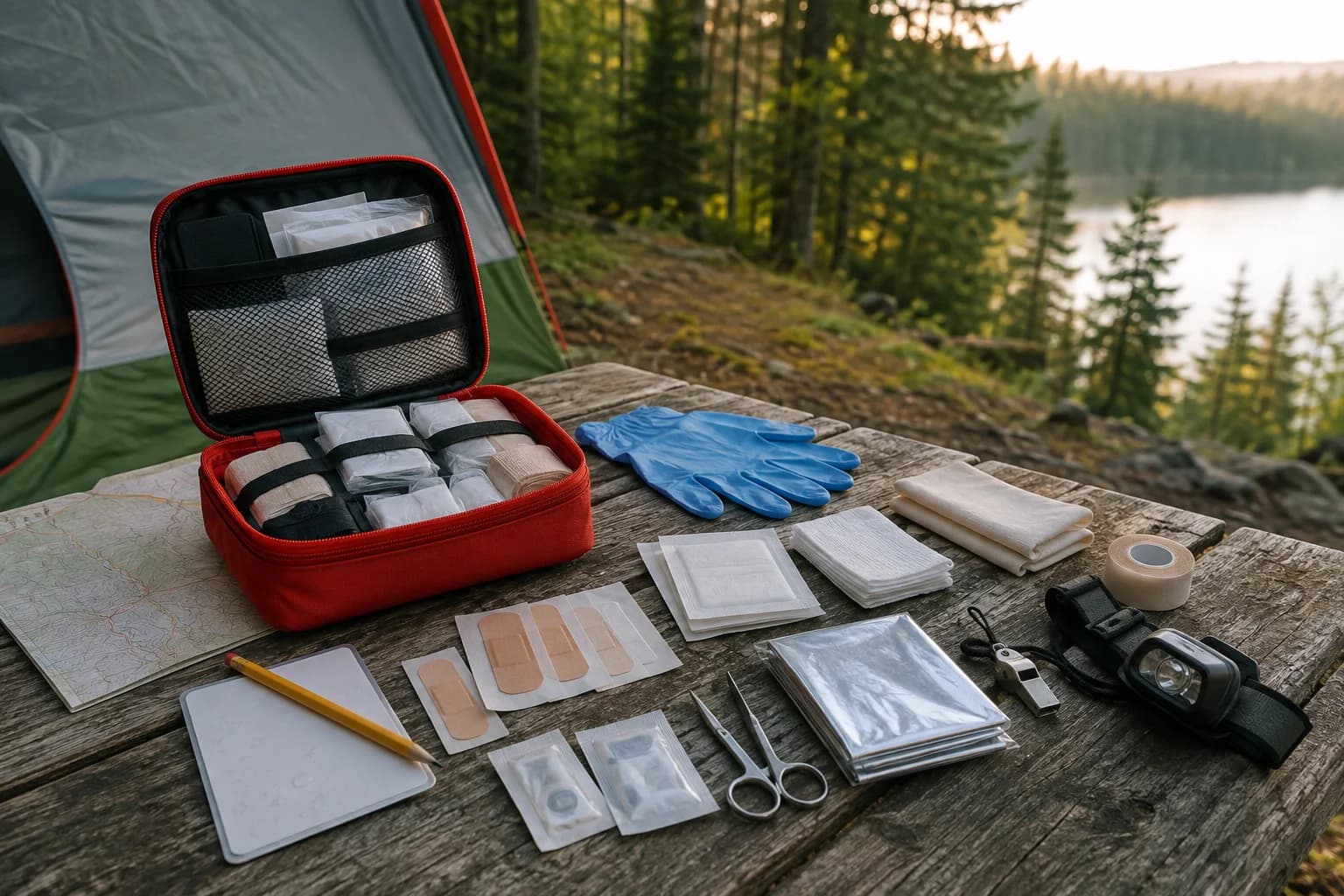
A useful camping first aid kit is a checked core kit plus three trip-specific layers: the people, the activity and the time to help. Start with wound care, protective equipment, bandages, tools, an emergency blanket and first aid instructions. Then add each camper's labelled medication and action plan, supplies for likely activities, and the communication and shelter needed while help is delayed.
Do not build it by multiplying every object by the number of campers. Consumables may need more depth; scissors do not reproduce because two friends joined the trip. The kit is equipment—not training, a diagnosis or a tiny wilderness hospital with a zipper.
Keepsake Camp kit check
Build the layer for this trip
Set the trip frame. This tool changes planning prompts; it never invents medication doses or promises that more supplies can replace training and evacuation.
0 of 9 kit layers checked
Before leaving, record the route, return time, trusted contact, destination emergency number and communication limits. A checked box records planning; it does not verify medical readiness.
The short answer: what belongs in a camping first aid kit?
Use this as the inventory spine, then personalize it.
| Layer | Pack | Why it is there |
|---|---|---|
| Barrier protection | Multiple pairs of nonlatex gloves; breathing barrier | Protect the responder and reduce cross-contamination |
| Bleeding and wounds | Absorbent compress dressings; sterile gauze in more than one size; gauze rolls; cloth tape | Direct pressure, covering and securing dressings |
| Minor cuts | Assorted adhesive bandages; potable water or sterile saline; soap for hands and surrounding skin | Clean and protect minor wounds |
| Support and blisters | Triangular bandages; elastic wrap; blister dressings or moleskin | Support and early hot-spot care when used correctly |
| Tools | Blunt-tip scissors; clean fine-point tweezers; non-glass thermometer | Cut dressings, remove splinters or ticks, and record temperature when relevant |
| Exposure | Emergency blanket; instant cold pack with directions | Temporary warmth or brief cold application while following safe-use limits |
| Information | Offline first aid guide; waterproof paper and pencil; emergency contacts; trip plan | A phone may be flat, wet or outside coverage |
| Personal layer | Labelled medication, prescribed devices and written personal action plans | A generic kit cannot know the people using it |
The Canadian Red Cross outdoor list also calls out blister care, additional wound supplies, thermal protection, emergency shelter, water, a whistle and a signalling device for outdoor travel. Some of those are survival equipment rather than medical consumables. Keep them adjacent to the kit if forcing everything into one pouch makes the useful items impossible to find.
A real quantity baseline—for four people
The American Red Cross publishes a family-of-four baseline. The following are its selected non-medication items. This is a defensible starting point, not a guarantee for every camping trip:
- 2 absorbent compress dressings, 5 × 9 inches
- 25 adhesive bandages in assorted sizes
- 1 roll of adhesive cloth tape, 10 yards × 1 inch
- 5 antiseptic wipe packets
- 1 emergency blanket and 1 breathing barrier
- 1 instant cold compress
- 2 pairs of large nonlatex gloves
- 1 three-inch and 1 four-inch roller bandage
- 5 sterile gauze pads, 3 × 3 inches, and 5, 4 × 4 inches
- 2 triangular bandages
- tweezers, a non-mercury/non-glass oral thermometer and first aid instructions
The Red Cross list also contains medication and topical-treatment items. Those are not universal recommendations for every camper. Before packing any medicine, confirm that it is appropriate for the actual person, age, allergies, conditions and other medicines. Follow the current label and the person's clinician or pharmacist; do not create a group dosing plan from an internet checklist.
For one, two or six people, use the four-person list as a comparison point. Review the number of gloves, dressings, gauze and blister supplies against the group and activities. Do not divide or multiply prescription devices, tools or medication. A trained first aid provider can help identify realistic gaps without turning arithmetic into medical advice.
Size the kit by group, duration and distance from help
| Trip frame | What the core kit needs | What changes | What does not change |
|---|---|---|---|
| 1–2 people, developed campground, 1–2 nights | Checked core, personal items, site contacts | Modest consumable depth; small carry kit for walks | Access to a car does not replace a response plan |
| Family of four, developed campground, weekend | Use the official four-person baseline as the inventory check | Child-appropriate personal plans, correct sizes, caregiver copies and secure medication storage | Never assume an adult product or dose suits a child |
| 5–8 people or activity-heavy trip | Core plus reviewed quantities of gloves, gauze, dressings, tape and blister care | More than one trained responder; equipment split so it remains accessible | One shared prescription or one person's medication is not group stock |
| Any group, remote or backcountry | Core plus destination-specific emergency communication, warmth, shelter and extra wound-care capacity | Wilderness/remote training, evacuation thresholds, power reserve and supplies for delayed response | More gear cannot make rescue immediate or a communicator infallible |
Duration matters most where something is consumed, contaminated, wet or used once. Remoteness changes the response system: training, communications, shelter, warmth and evacuation planning. It does not make untrained procedures safer.
Three worked examples
Two adults, two nights, frontcountry. Check the core kit, personal medication and campground emergency number. Put a smaller bandage/blister/tick layer in the daypack; a beautiful kit locked in the vehicle is scenery when the ankle rolls three kilometres away.
Family of four at a drive-in site. Compare the inventory directly with the Red Cross four-person baseline. Confirm child-specific medicines or prescribed devices with a clinician or pharmacist, keep them in labelled containers, and make sure more than one adult knows where the action plans are.
Six adults, remote route. Review consumable depth with a trained provider, distribute essential supplies, carry a tested satellite communication device and power reserve, and leave a written trip plan. At least one person should have training appropriate to remote care. The goal is not to carry six of everything; it is to avoid one inaccessible kit, one untrained responder and one dead battery.
Buy, build or use a hybrid kit?
| Approach | Best when | Strength | Failure to catch |
|---|---|---|---|
| Pre-made | You need a fast, organized core | Pouch and basic categories arrive together | Tiny quantities, poor sizes, unknown quality or no room for personal items |
| Build from scratch | You know the group's needs and can audit every item | Full control over sizes, quality and organization | Easy to forget a category; higher setup time |
| Hybrid | Most campers | Start with a coherent core, then replace weak items and add personal/activity layers | Still requires opening every compartment and recording expiry dates |
Our recommendation is hybrid. Buy a well-organized core if it saves time, but treat its item count as marketing until you inspect the contents. Twenty identical tiny bandages do not become a sophisticated kit because the package says “120 pieces.” Replace unhelpful sizes, add fine-point tweezers and blister care, reserve space for personal items, and include instructions you can read offline.
If you build from scratch, use clear modules: barrier/bleeding, minor wounds, support/blisters, tools, personal medication and emergency information. Label modules from the outside. In an urgent moment, “somewhere under the marshmallows” is not a storage system.
Plan the emergency response before the shopping list
Parks Canada says cell coverage is not always reliable in remote areas and recommends leaving a trip plan with a trusted person. Record:
- route, campsite, group size, vehicle and expected return time
- who will call for help, at what overdue time and with which authority
- 911 and the destination's specific dispatch or ranger number
- exact location formats available: campsite number, trail, coordinates or map reference
- expected cell coverage and the limitations of the backup device
- satellite communicator login, test status, charging cable and power reserve
- allergies, important conditions, prescribed devices and emergency contacts, stored with appropriate privacy
- shelter and warmth available while waiting for assistance
Parks Canada's written trip-plan example includes route, camping plan, party size, times and identifying details for tents, vehicles or vessels. Close the plan with the trusted contact when you return. A satellite device can initiate a response; it cannot guarantee connection, weather, travel time or rescue.
For a remote trip, take wilderness or remote first aid training appropriate to the route. For a developed campsite, current first aid/CPR training still changes what you can recognize and do safely. Supplies are useful in trained hands and confusing props in sealed wrappers nobody has opened.
Five safety corrections that belong on the checklist
1. For a tick, fine-point tweezers are the first-line tool
The Public Health Agency of Canada says to use clean, fine-point tweezers, grasp the tick as close to the skin as possible and pull slowly straight out. Do not twist, squeeze, burn or smother it. If mouthparts remain and do not come out easily, leave them alone and let the skin heal. Clean the area, record when and where the bite occurred, and contact a health professional if you feel unwell or are concerned.
A dedicated tick tool can be an optional extra, but it is not a reason to omit fine-point tweezers or claim that one gadget “removes the whole head” more reliably.
2. An antihistamine is not an anaphylaxis plan
An over-the-counter antihistamine may be appropriate for some mild symptoms only when it is suitable for that person and used according to its label or professional advice. It does not replace prescribed epinephrine for anaphylaxis. In its general food-allergy guidance, Health Canada says prescribed epinephrine should be carried, used as directed for a severe reaction and followed by emergency care; antihistamines, if used, come after epinephrine. In the narrower context of anaphylaxis after immunization, the Public Health Agency of Canada likewise states that antihistamines must never replace epinephrine for respiratory or cardiovascular symptoms.
For a severe allergic reaction, follow the person's emergency action plan, use their prescribed epinephrine as directed and contact 911 or local emergency services immediately. The kit should hold the plan and device accessibly; this article cannot diagnose a reaction or prescribe a dose.
3. Clean a minor wound with water—not a chemistry experiment
For a minor cut or scrape, wash hands, control minor bleeding with clean pressure, rinse the wound with potable water, clean around it and cover it. Mayo Clinic advises against putting hydrogen peroxide or iodine into a wound because they can irritate tissue. Antiseptic wipes may be labelled for hands or intact skin; that does not automatically make them wound irrigation.
Heavy bleeding, a deep wound, an embedded object, loss of sensation/function or a wound you cannot clean is outside a campsite DIY checklist. Use your training and contact emergency or medical services.
4. Wrap the cold pack
The NHS sprain guidance says an ice pack should be wrapped and used for up to 20 minutes at a time. Follow the pack's directions rather than placing it directly on bare skin. Seek urgent medical advice when an injured area is numb or tingling, looks deformed, turns blue or grey, feels cold, or when a crack was heard—not another round with the cold pack.
5. Medication belongs to people, not generic lists
Health Canada's non-prescription label guidance highlights active ingredients, warnings, directions, storage and when to seek help. Keep medication labelled, protect it from the temperatures and moisture named on its instructions, check expiry dates, and keep it secured from children. Ask a pharmacist or clinician about interactions, age restrictions, pregnancy, allergies, travel delays and temperature-sensitive products. Never share prescriptions.
Pack a carry kit, not only a camp kit
The main kit may live in a dry, accessible place at camp. A smaller kit should travel with the group when it leaves the site. Its contents follow the activity, but the usual core is gloves, dressings, gauze, tape, blister care, fine-point tweezers, emergency information and each person's critical prescribed items.
Add navigation, communication, water, weather protection and emergency warmth outside the medical pouch. See the camping safety guide for the broader response system, the mosquito-bite prevention guide for bite prevention, and the first camping trip planner for route and campground decisions.
This page deliberately stays narrower than the camping essentials guide and ultimate camping checklist. Those pages organize the whole trip. This one audits the first aid system.
The 10-minute pre-trip audit
- Open every module; never trust the seal or the printed piece count.
- Replace anything used, damaged, wet, contaminated or expired.
- Confirm labels, storage conditions and personal action plans.
- Check glove and bandage sizes against real group members.
- Put fine-point tweezers and gloves where they can be reached quickly.
- Add a mini kit to the daypack.
- Download or print first aid instructions and destination contacts.
- Test the phone, satellite device and power reserve without assuming coverage.
- Leave the written trip plan with a trusted person.
- Make sure another adult knows where the kit is and who is trained to use it.
Then reseal it in a waterproof or water-resistant container and store it where everyone can reach it but children cannot. Audit it after every use and before every trip. A pristine pouch from three summers ago is a time capsule, not readiness.
Limits of this guide
This article is general planning information. It does not diagnose injuries, recommend medication for a particular person, provide dosing, replace product directions, first aid training or professional care, or guarantee rescue. Current instructions from emergency services, land managers, clinicians, pharmacists and a person's emergency action plan override this checklist.
FAQ
What should be in a basic camping first aid kit?+
Start with nonlatex gloves, a breathing barrier, absorbent dressings, sterile gauze, gauze rolls, cloth tape, assorted bandages, triangular bandages, blister care, blunt-tip scissors, fine-point tweezers, a thermometer, an emergency blanket, offline instructions and personal emergency information. Add labelled personal medication and trip-specific communication, shelter and supplies.
How big should a camping first aid kit be?+
Size consumables to the group and likely activities, then add training, communication, shelter and replacement capacity as help becomes more distant. The American Red Cross publishes a family-of-four baseline; use its non-medication items as a comparison point rather than multiplying every item blindly.
Is it better to buy or build a camping first aid kit?+
A hybrid is the practical choice for most campers: start with an organized pre-made core, inspect every item, replace weak sizes or quantities, and add blister care, fine-point tweezers, personal medication, action plans and destination contacts.
Do I need a special tool to remove a tick?+
No. The Public Health Agency of Canada recommends clean, fine-point tweezers: grasp close to the skin and pull slowly straight out without twisting or squeezing. A dedicated tool is optional, not a substitute for correct technique.
Can an antihistamine replace an epinephrine auto-injector?+
No. An antihistamine does not replace prescribed epinephrine for anaphylaxis. Follow the person's emergency action plan, use their prescribed epinephrine as directed and contact emergency services immediately for a severe allergic reaction.
What changes for a remote camping first aid kit?+
Remote travel adds wilderness-appropriate training, a tested communication device and power reserve, a written trip plan, emergency shelter and warmth, destination contacts and reviewed consumable depth. More supplies do not make communications or rescue guaranteed.
Sources reviewed
Fact-checked Sep 3, 2026
These references support factual or safety-sensitive claims in this article. Access dates show when our editors last verified the source.
- Canadian Red Cross — First Aid Kit Contents
Official source · Accessed Sep 3, 2026
- American Red Cross — Make a First Aid Kit
Official source · Accessed Sep 3, 2026
- Public Health Agency of Canada — How to Remove a Tick
Official source · Accessed Sep 3, 2026
- Public Health Agency of Canada — Anaphylaxis after Immunization
Official source · Accessed Sep 3, 2026
- Health Canada — Peanut Allergy and Anaphylaxis
Official source · Accessed Sep 3, 2026
- Health Canada — Non-prescription Drug Labels
Official source · Accessed Sep 3, 2026
- Parks Canada — Emergency Contacts
Official source · Accessed Sep 3, 2026
- Parks Canada — Trip Plan
Official source · Accessed Sep 3, 2026
- NHS — Sprains and Strains
Official source · Accessed Sep 3, 2026
- Mayo Clinic — Cuts and Scrapes: First Aid
· Accessed Sep 3, 2026