guides / safety
How to Prevent Mosquito Bites While Camping
A four-layer plan for repellent, clothing, campsite and tent — with what published testing actually shows for each method, and separate US and Canada rules.
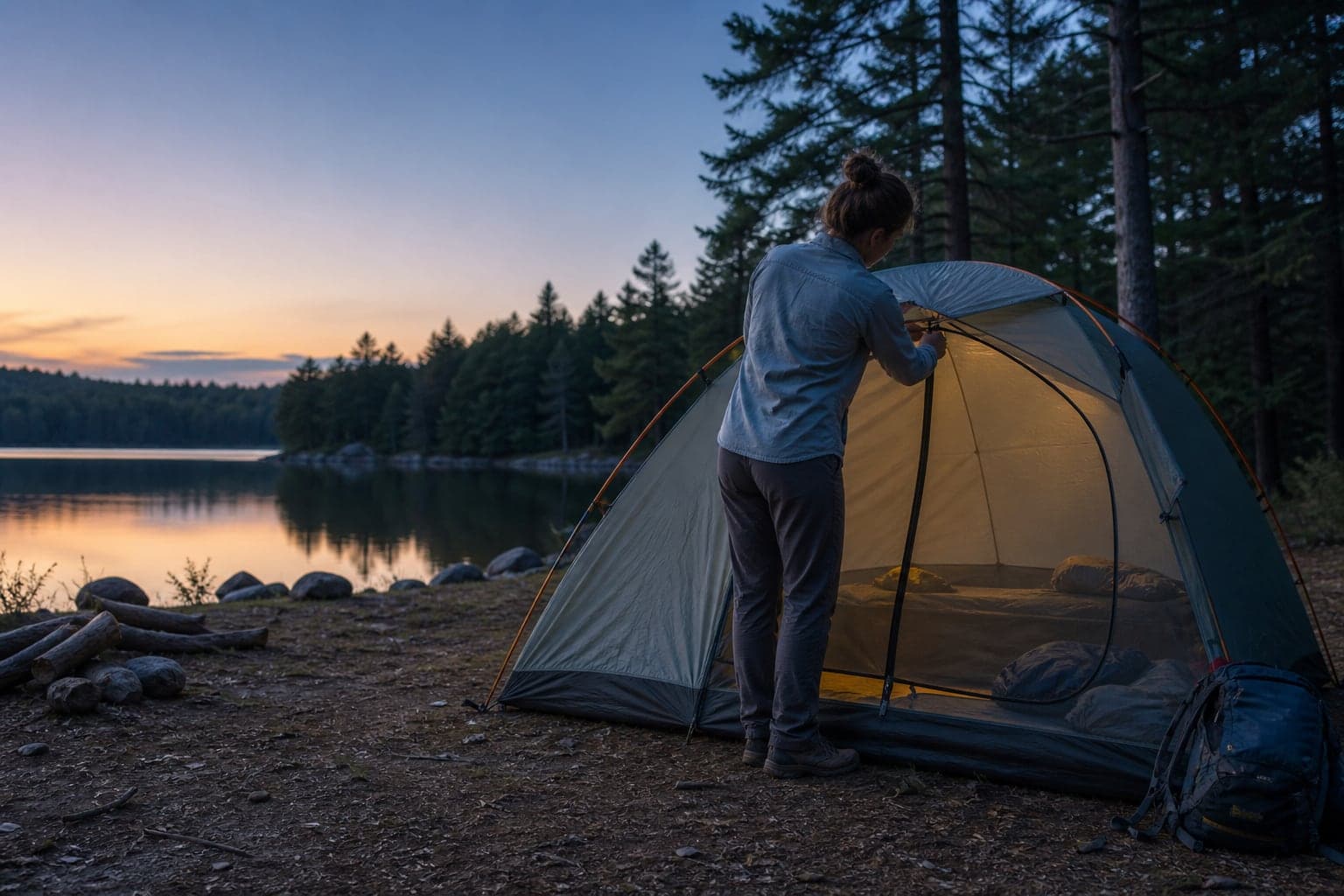
You are zipped into the tent, the lights are off, and then comes the sound: one mosquito running a tiny motorcycle time trial around your left ear.
That battle was mostly decided hours ago.
The best way to prevent mosquito bites while camping is not one miracle spray or a picnic table ringed with citronella candles. It is a four-layer defence: a registered repellent on exposed skin, covered skin and treated clothing, a smarter campsite setup, and intact mesh between you and the night shift.
Testing consistently separates full-coverage measures from gadgets that protect only a wrist, a tiny pocket of air, or nothing measurable at all. That is why the plan is layered: start with registered repellent and coverage, then reinforce the campsite and shelter.
The 60-second answer: Use an EPA-registered repellent in the US or a Health Canada-registered product with a PCP number in Canada, and follow the label. For adults, that usually means DEET or picaridin/icaridin — up to 30% DEET in Canada, higher concentrations are sold in the US. Wear loose long sleeves, pants and socks. Add permethrin-treated clothing where it is approved for you (US: self-treat or buy treated; Canada: treated garments are labelled for ages 16+). Choose a breezy site, run a registered spatial repellent while you sit still, and keep the tent mesh zipped and intact.
What works, what helps, and what can stay on the store shelf
Most of what you'll read about how to repel mosquitoes camping gets confusing because "it seemed to help" and "it measurably prevented bites" are presented as the same claim. They are not. Every verdict below is scored against published testing or official guidance rather than product marketing.
| Method | What the evidence shows | Keepsake verdict |
|---|---|---|
| Registered skin repellent | Registered actives reduce bites; protection time varies by ingredient, concentration, formulation and conditions | Use it — the layer everything else supports |
| Loose, long clothing | Mosquitoes can bite through thin fabric pulled tight against skin; coverage reduces the surface available | Use it — free, and it multiplies every other layer |
| Permethrin-treated clothing | 0.5% permethrin repels and kills mosquitoes, ticks and chiggers, and survives repeated washings | Use it where it's approved for you — rules differ by country |
| Intact tent or screen-room mesh | A physical barrier, and the only layer that works while you sleep | Use it |
| Registered spatial repellent (metofluthrin/allethrin) | Selected devices reduced bites in product-specific trials, but that does not prove disease prevention | Helpful extra while stationary — not a substitute for skin repellent |
| Fan across the seating area | Moving air can help; the often-cited 75% result came from a fan used with DEET vapour, not a bare fan | Helpful extra — car camping with power |
| Breezy, drier campsite | Sites beside shallow ponds, swamps and marshland carry heavier mosquito pressure | Helpful choice — reduces pressure, guarantees nothing |
| Citronella candle or smoky fire | The effect is limited and does not outperform ordinary smoke reliably enough to be a primary tactic | Ambience, not a plan |
| Repellent wristbands and patches | Citronella and geraniol bands showed no significant protection in field testing; DEET wristbands gave none in the NEJM trial | Skip |
| Ultrasonic apps and devices | Repeated testing has not shown meaningful mosquito protection | Skip |
| Bug zappers | Mosquitoes were 4.1% and 6.4% of catches; no significant difference between yards with and without them | Skip |
| Garlic, vitamin B, "mosquito-proof" foods | Ingested systemics showed no impact on biting in controlled study; a B1 patch gave no significant protection | Skip |
This ranking is deliberately boring. Boring is good when boring works.
The numerical evidence is kept in the relevant sections below, where its limits are easier to see. Primary references include the CDC Yellow Book, Health Canada, the Fradin and Day repellent trial, and studies of wearable and spatial products.
Layer 1: choosing and using a registered mosquito repellent
Start with the label, not the front of the bottle.
In the United States, CDC and EPA recognise six skin-applied actives: DEET, picaridin (icaridin outside the US), IR3535, oil of lemon eucalyptus (OLE), para-menthane-diol (PMD) and 2-undecanone. In Canada, look for a Health Canada registration — usually shown as a PCP number — and follow the approved Canadian label.
Registration matters because the product has been assessed for safety and effectiveness when used as directed. "Plant-based", "family" and "camp strength" are marketing descriptions, not assessments.
How long each concentration lasts
For the same active ingredient and a comparable formulation, a higher concentration generally extends protection rather than making the product dramatically more powerful at minute one. Formulation still matters: controlled-release products can outlast simpler formulas with a similar percentage.
| Product | Planning figure |
|---|---|
| Under 10% active ingredient | Often only 1–2 hours |
| 10% DEET | ~3 hours |
| 15% DEET | ~5 hours |
| 20–25% DEET | One lab trial measured 301.5 minutes at 23.8% |
| 30% DEET | ~6 hours |
| 20% picaridin | Held above 90% protection to roughly 8–10 hours in field trials |
| OLE / PMD | Product-specific; use the registered label rather than a universal duration |
Sources: the CDC Yellow Book, HealthLink BC's DEET guidance, the Fradin and Day trial, and a review comparing picaridin with DEET. These are planning figures, not guarantees — formulation, heat, sweat, swimming and towelling off all change the real result, and the label in your hand governs.
DEET efficacy tends to peak around 50%; above that, published guidance does not show a marked increase in protection time. A normal evening at camp may fit within the labelled protection time of a 20–30% DEET or picaridin product, but water, heavy sweat and towelling can change that calculation.
Verdict: for most adults, start with a registered DEET or picaridin product whose label covers the planned time outside. Picaridin is odourless and does not damage plastics and synthetic fabrics the way DEET can. In Canada, personal-use DEET is capped at 30%; elsewhere, the registered label still outranks a universal percentage recommendation.
Apply it where mosquitoes find the gaps
Repellent works only where it is applied. Bites cluster in the places you can't easily see yourself covering.
- Apply to exposed skin only, or to clothing where the label permits it. Not under clothing.
- Don't spray the face. Spray adult hands first, then apply, avoiding eyes and mouth.
- Keep it away from cuts, wounds and irritated skin.
- An adult should apply it to children, and not to children's hands.
- Wash treated skin when you come indoors, per the label.
- Reapply only as the label directs — and after water, heavy sweating or towelling off.
If you also need sunscreen, US and Canadian guidance both put sunscreen first, repellent second. The CDC Yellow Book notes limited evidence that DEET over sunscreen can reduce the sunscreen's SPF by about one-third, so reapply sunscreen as its label directs. Avoid combination sunscreen-repellent products, which push you to reapply one on the other's schedule.
"Natural" is not an ingredient
Oil of lemon eucalyptus (OLE) and PMD are formulated, registered repellents. Pure lemon eucalyptus essential oil is a different product sold in the same aisle.
The CDC Yellow Book does not recommend pure lemon eucalyptus essential oil: it is not the tested, formulated and EPA-registered repellent sold as OLE or PMD.
Check for a registration number. The names look related and the bottles often share a reassuring palette of leaves. The fern illustration does not count.
Layer 2: give mosquitoes less skin to work with
Clothing is the lowest-maintenance part of the system. Long sleeves, long pants, socks and closed shoes when pressure is high — and loose, because mosquitoes can bite through thin fabric held tight against skin.
A lightweight overshirt and loose hiking pants beat heavy clothing in summer. Overlap the vulnerable transitions — shirt to waistband, pants to socks — without overheating. A head net costs almost nothing, packs to nothing, and turns a bad portage or a dawn coffee from frantic into merely unglamorous.
Colour is a secondary cue, not a protection layer. One 2022 laboratory study found colour preferences in Aedes aegypti only after the mosquitoes detected carbon dioxide, and the result does not transfer neatly to every species or campsite. Choose light clothing for heat management and visibility if it suits the trip; do not rebuild your wardrobe around mosquito colour theory.
Permethrin: useful, but the border matters
Permethrin goes on clothing and gear — never directly on skin. It's the one measure that helps prevent bug bites of several kinds at once — mosquitoes, ticks and chiggers — and it is the highest-leverage step most campers skip. But US instructions must not be copied into Canada.
In the United States, CDC guidance covers factory-treated items or self-treatment with a 0.5% permethrin product registered and labelled for clothing and gear — boots, shirts, pants, socks and tents included. Treated items keep working after multiple washings; the label states how many. Let treated garments dry fully before packing.
In Canada, Health Canada describes permethrin-treated clothing as available for adults and children aged 16 and older — including during pregnancy — and notes that adults wearing it may hug young children but should avoid prolonged contact such as carrying one. Treated clothing is not available for children under 16. Do not assume a US clothing spray or a forum's do-it-yourself method is approved for Canadian use; check for a Canadian registration.
Wherever you camp, the product label governs what may be treated, how long protection lasts and how items are washed. "A guy at Site 34 has done it for years" is not a regulatory approval.
Layer 3: how to keep mosquitoes away from your campsite
You can't landscape a public campground, but you can choose and arrange a site.
Think in terms of pressure, not certainty. A higher, drier site with airflow will usually be easier than a sheltered hollow beside marshy or stagnant water. A waterfront site can still be wonderful — it just raises the value of the other three layers.
When choosing among available sites, look for:
- airflow, rather than a pocket enclosed by dense brush;
- distance from swampy edges, clogged drainage and shallow standing water;
- room to position chairs in whatever breeze exists;
- a screen shelter if local mosquito pressure is famously enthusiastic.
You are the attractant, so positioning helps only by changing the pressure around you. It never replaces repellent or coverage.
When they actually bite
CDC's blunt version is that mosquitoes can bite day and night. The examples below describe important vector groups, not a precise forecast for every local species:
| Group | Peak biting | Relevance in the US and Canada |
|---|---|---|
| Aedes | Dawn and dusk | Aggressive nuisance biters across much of North America |
| Culex | After sunset, typically 10–11 p.m. | The main West Nile vector group |
| Anopheles | Evening and night | Present; locally acquired malaria is rare |
The practical translation: the golden hour you want for photos is also the hour you most want covered, and a late campfire sits inside the Culex window. If mosquitoes are landing, protection time has already started — "we're fine until sunset" is not a safe assumption.
Spatial repellents are a supporting player
Repellent handles you. It doesn't handle the airspace around a picnic table where four people are exhaling for three hours. That's what registered spatial repellents — clip-on and mat devices releasing metofluthrin or allethrin — are for.
In one outdoor evaluation of seven commercial products, two personal diffusers reduced biting by roughly 88–97% under the study conditions. A separate wind-tunnel study found that a metofluthrin clip-on reduced attraction from about 89% to 27%. Those are product- and test-specific results, not a promise for every device, wind level or campsite.
Two caveats matter. The device builds a limited treated area, so placement and wind matter. And the CDC Yellow Book notes that spatial repellents have not been adequately evaluated for preventing vector-borne disease — so treat them as a supplement, not a substitute for skin repellent, clothing or netting.
Use only a product registered for your country, follow its ventilation and clearance instructions, and keep it away from children exactly as the label requires. If the label says outdoor use, the tent is not a small outdoor patio.
Fans, smoke and fire bans
A fan moves air across exposed skin and can make approach and landing harder. Aim it across legs and ankles around the seating area. The often-repeated claim that a fan reduces landings by about 75% comes from an experiment that also used DEET vapour, so it should not be assigned to a bare fan. Treat a plain fan as useful comfort, not a quantified protection guarantee.
Smoke is the oldest trick at camp and the hardest to score. AMCA's framing is that citronella candles have a mild effect and don't outperform other candles producing smoke — which deflates citronella while granting that smoke does something. It is also unreliable, unpleasant to breathe, and subject to fire restrictions.
Never build a fire solely as mosquito control. Check campground rules and current fire bans first, use designated fire areas only, and don't add green material to manufacture extra smoke.
Don't create tomorrow's mosquitoes
On a one-night trip, water sitting in a mug did not produce the adults currently biting you — a mosquito needs days, not hours. On a seasonal or long-stay site, it matters a great deal.
Check tarp folds, buckets, toys, coolers, pet bowls and unused cookware. CDC's weekly routine for homes applies to a long-stay campsite: empty, scrub, turn over, cover or throw out anything holding water. This is source reduction, not a rescue tactic — and keeping that distinction is what stops good advice from becoming camp folklore.
Layer 4: how to prevent mosquito bites at night in your tent
A sound tent is an excellent barrier, and the only layer still working while you're asleep. Mosquitoes usually get in through an open door or damaged mesh, not through a sophisticated siege operation.
Before the trip:
- Pitch the tent in daylight.
- Inspect mesh panels, door seams and zipper tracks.
- Repair small tears with mesh repair tape or a proper patch.
- Confirm the door closes fully with no fabric caught in the slider.
At camp, keep the mesh door zipped from setup onward. Keep frequently used items in the vestibule so nobody mounts twelve evening expeditions for a toothbrush. Turn bright lights down before opening the door, enter one person at a time, and close it immediately.
If biting midges are a factor where you're headed, standard mosquito netting may not be enough. The CDC Yellow Book recommends finer screening for that job, which is what "no-see-um mesh" means on a tent spec sheet.
For hammocks, tarps and shelters without integrated mesh, use a net that fully encloses the sleeping area and can be sealed without resting tight against bare skin. Repellent alone doesn't cover open-air sleeping, because it wears off while you're asleep and nobody reapplies at 2 a.m.
And if one still gets in, use a headlamp against the pale tent wall and deal with it before bed. It is the difference between sleeping and listening.
Camping with children: the age rules differ by country
Children are not small adults for repellent decisions, and the US and Canada do not phrase every restriction the same way. Read the label for the country you're in.
| United States (CDC/EPA) | Canada (Health Canada) | |
|---|---|---|
| Youngest age guidance | CDC travel pages favour clothing and netting for babies under 2 months; EPA registration guidance does not state the DEET limit identically. Follow the product label | No DEET or icaridin under 6 months; use netting and clothing |
| DEET, 6 months – 2 years | Follow the registered product's label | Up to 10%, once per day |
| DEET, 2 – 12 years | Follow the registered product's label | Up to 10%, up to 3 times per day |
| DEET, adults and 12+ | Higher concentrations are sold; efficacy peaks near 50% | Up to 30% for personal use |
| Picaridin / icaridin | Per product label | Approved products; not for infants under 6 months |
| OLE / PMD | Generally avoid under age 3; follow the registered product label | Not on children under 3 |
| Permethrin-treated clothing | 0.5% products for clothing and gear, per label; never on skin | Treated clothing labelled for ages 16 and older |
The US sources require one honest caveat. Current CDC traveller pages use clothing and netting for infants under 2 months, while the EPA DEET page says registered DEET products do not have an age restriction and the CDC Yellow Book also phrases the rule differently. For a young infant, favour physical barriers, read the current label, and ask a paediatric clinician when individual health or destination risk changes the decision.
Two Canadian differences are clearer. Health Canada caps personal-use DEET at 30%, and permethrin-treated clothing is not available for Canadian children under 16. A US family packing list therefore does not transfer intact.
For toddlers, make protection routine rather than dramatic: dress first, have an adult apply the labelled product, wash hands, zip the tent. Our guide to camping with toddlers covers the wider sleep and supervision logistics.
During pregnancy and breastfeeding, CDC and Health Canada support using registered products according to their labels; Health Canada explicitly includes pregnant adults among those who may wear permethrin-treated clothing. Individual medical questions belong with a clinician or pharmacist.
The campsite rescue plan: when they're already winning
If you're reading this beside the fire while one member of the group has become the designated decoy, start here.
- Cover exposed skin. Loose pants, socks, long sleeves, hat or head net. Reduce the surface before you treat it.
- Apply registered repellent correctly. Ankles, wrists, neck, backs of hands. Follow the label.
- Move the chairs. Out of still, damp brush, into whatever airflow exists.
- Start the fan or spatial repellent now, not in twenty minutes — it needs time to build a pocket of treated air, and it only works if you stay in it.
- Close the tent now. Not at bedtime. Later is how the tiny motorcycle gets inside.
- Change tomorrow's plan. Recheck the label, repair mesh, bring the right clothing, shift the dusk routine.
If the site stays intolerable or public-health warnings are active, moving sites or ending the trip is a legitimate decision.
Why the popular fixes disappoint
Repellent wristbands and stickers. A band on one wrist does not create reliable whole-body coverage, and tested products have repeatedly failed to provide meaningful protection.
Ultrasonic apps and devices. Repeated testing has not shown meaningful protection. A phone is more useful for setting a reapplication reminder.
Bug zappers. They kill many insects, mostly non-target ones, without reliably reducing the mosquitoes biting nearby people.
Garlic, vitamin B and special foods. Controlled testing has not shown reliable bite protection. Garlic remains welcome in camp pasta.
Citronella alone. A small, airflow-dependent effect that doesn't travel with a moving person. It can accompany a four-layer plan; it can't replace one.
The evidence behind these verdicts includes a controlled comparison of skin repellents and wristbands, an evaluation of wearable and spatial products, and the American Mosquito Control Association's evidence summaries. The numbers describe those studies; the practical verdict is the part meant to travel to camp.
If you were bitten anyway
Most mosquito bites cause temporary itching and swelling. CDC travel guidance advises avoiding scratching and using an over-the-counter anti-itch or antihistamine cream when appropriate. A cold compress can help with comfort. A pharmacist or clinician can advise on products for children, pregnancy, allergies or other conditions.
Mosquito-borne illness in the US and Canada is uncommon but real. West Nile virus is the main mosquito-borne disease in the contiguous US: the CDC reports that most infections cause no symptoms, while more than 1,300 people a year develop severe illness affecting the central nervous system. The Culex mosquitoes associated with transmission commonly bite after sunset — precisely the window campers tend to leave uncovered.
Seek medical advice if symptoms worsen or you're concerned, and particularly if in the days or weeks after being bitten you develop fever with severe headache, neck stiffness, confusion or muscle weakness, or if a bite site becomes hot, spreading and increasingly painful rather than simply itchy. Get urgent care for signs of a severe allergic reaction, such as difficulty breathing or swelling of the face or throat. After travel in an area with mosquito-borne disease, tell the clinician where and when you travelled. Current local public-health instructions take priority over this general guide.
Add bite care and personal medications to your camping first aid kit, and review the broader habits in Camping Safety 101.
Mosquito-proof packing checklist
Before leaving
- Check mosquito activity and public-health notices for the destination.
- Choose a registered repellent suitable for every person and the expected hours outdoors (30% max in Canada; 10% max for children under 12 there).
- Read the age, pregnancy, application and reapplication instructions on each label.
- Prepare permethrin-treated clothing only where it's approved for the wearer.
- Inspect and repair tent or hammock mesh.
- Pack loose long sleeves, pants, socks, closed shoes and head nets.
- Pack a registered spatial repellent or a fan if the trip suits one.
At camp
- Keep tent mesh zipped from setup onward.
- Sunscreen first, then repellent; follow each product's reapplication directions.
- Cover up before pressure rises, not after the first dozen bites.
- Put chairs in the breeziest practical part of the site.
- Empty standing water on long stays.
- Reapply repellent only per the label, and after water or heavy sweat.
This list can live beside the ultimate camping checklist.
The Keepsake Camp verdict
If you change one thing, stop treating mosquito protection as a single-product decision.
The order is: protect exposed skin, cover more of it, then reinforce the campsite and the sleeping shelter. Build those layers before buying another gadget — the evidence gap between a correctly applied registered repellent and the average camp-store device is not close.
You may still hear the occasional whine. It should no longer dictate the trip.
This article provides general outdoor-safety information, not individual medical advice. Product labels, local regulations and destination-specific public-health guidance take priority.
Related reading: Camping Safety 101 · Camping First Aid Kit · Ultimate Camping Checklist
Sources reviewed
Fact-checked Aug 26, 2026
These references support factual or safety-sensitive claims in this article. Access dates show when our editors last verified the source.
- Health Canada — Insect repellents
Official source · Accessed Aug 26, 2026
- CDC — Preventing Mosquito Bites
Official source · Accessed Aug 26, 2026
- CDC — Avoid Bug Bites
Official source · Accessed Aug 26, 2026
- CDC — Permethrin-Treated Clothing and Gear
Official source · Accessed Aug 26, 2026
- CDC Yellow Book — Mosquitoes, Ticks, and Other Arthropods
Official source · Accessed Aug 26, 2026
- US EPA — Skin-Applied Repellent Ingredients
Official source · Accessed Aug 26, 2026
- US EPA — Find the Repellent That Is Right for You
Official source · Accessed Aug 26, 2026
- US EPA — DEET
Official source · Accessed Aug 26, 2026
- HealthLink BC — Insect repellents and DEET
Official source · Accessed Aug 26, 2026
- American Mosquito Control Association — FAQs
Expert guidance · Accessed Aug 26, 2026
- Fradin & Day (2002), Comparative Efficacy of Insect Repellents against Mosquito Bites, NEJM 347:13–18
Expert guidance · Accessed Aug 26, 2026
- Revay et al. (2013), Evaluation of commercial products for personal protection against mosquitoes, Acta Tropica
Expert guidance · Accessed Aug 26, 2026
- Rodriguez et al. (2017), Efficacy of Some Wearable Devices Compared with Spray-On Insect Repellents, Journal of Insect Science
Expert guidance · Accessed Aug 26, 2026
- Frances & Rigby (2018), Mosquito repellents for the traveller: does picaridin provide longer protection than DEET?, Journal of Travel Medicine
Expert guidance · Accessed Aug 26, 2026
- CDC — About West Nile
Official source · Accessed Aug 26, 2026