guides / safety
Bear Safety While Camping: Build a Local Plan
Prepare for bear country with a local-rule checklist, attractant-storage plan, bear-spray checks and a behavior-first encounter matrix.
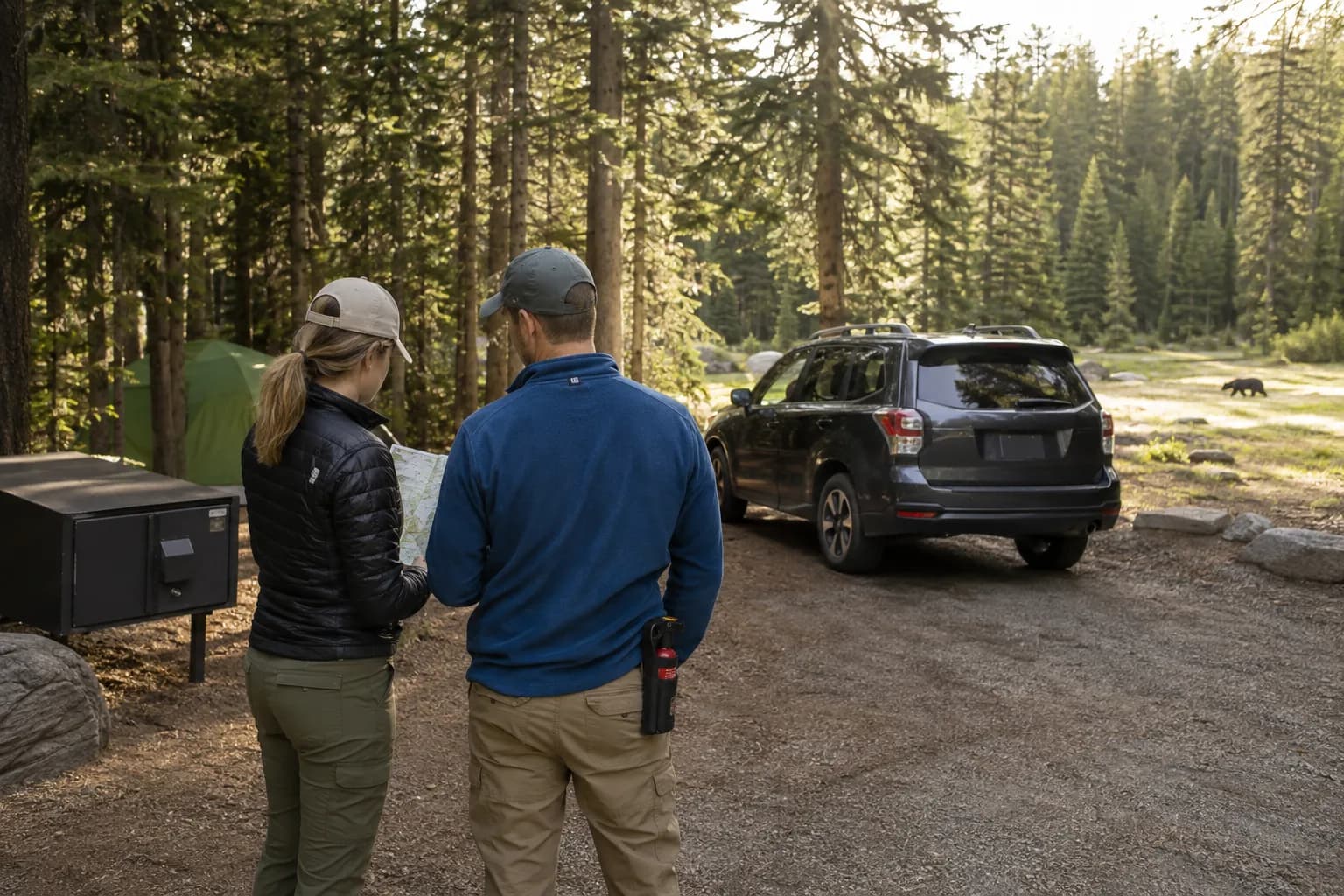
The safest bear plan is the one you learn from the land manager before you arrive. Check which bears live there, current closures, required food storage, whether bear spray is allowed and the exact encounter instructions for that destination. Then prevent the encounter: stay alert, avoid surprising bears, secure every attractant and never approach one.
If you do see a bear, do not run. Gather your group, pick up small children, speak calmly, give the bear an escape route and back away slowly when the local instructions tell you to do so. If contact becomes possible, behavior and context matter—and official instructions are not identical everywhere. That is why “black bear means fight; grizzly means play dead” is too crude to be your entire plan.
Keepsake Camp pre-trip card
Build your bear-country briefing
Check preparation tasks before leaving service. This planner deliberately does not diagnose a live encounter.
Preparation status
4 planning actions for your briefing
- 1. Save the exact land manager's current bear, closure and encounter guidance for offline use.
- 2. Confirm the required locker, hard-sided vehicle, certified container, cache or permitted hang for every campsite and zone.
- 3. Confirm whether bear spray is recommended and allowed; check the animal-use label, expiry, transport plan and an accessible holster.
- 4. Save the park or land-manager reporting number and your emergency communication plan.
Bear-country preparation updated: 4 planning actions for your briefing.
Do not consult this tool during a close encounter. The responsible authority’s current instructions override it.
The behavior-first encounter matrix
Read this matrix before the trip, then save the official destination page offline. It is a study aid, not something to scroll through while a bear is close.
| What you observe | General action supported by NPS and Parks Canada | What must be learned locally |
|---|---|---|
| Bear has not noticed you | Do not approach. Quietly leave or make a wide detour without blocking its route. | Required viewing distance and any active closure |
| Bear notices you but remains stationary | Stay calm, group together, pick up small children, talk calmly and move away slowly when safe. Leave an escape route. | Whether the park advises backing sideways, avoiding direct eye contact or holding position |
| Bear follows or approaches | Stop retreating if continued movement draws it with you. Stay grouped, prepare bear spray if allowed and follow the destination’s escalation instructions. Never run, drop your pack or abandon food to distract the bear. | Species present, defensive signs and the park’s specific response |
| Defensive approach or charge | Bear spray is a last-resort tool when an aggressive bear is close enough for the product and authority guidance. Do not spray merely because a bear is visible. | Effective range, wind limits, spray technique and what to do if contact occurs |
| Defensive contact | Follow the protocol you learned for that place. Parks Canada’s general behavior-based guidance says to play dead after defensive contact; NPS general guidance separates brown/grizzly and black-bear responses. | The exact local instruction is essential because official guidance differs |
| Persistent stalking, entry into a tent, attack at night or other predatory behavior | Try to reach a secure building or vehicle. Do not play dead; fight back if escape is impossible. | Local reporting and emergency procedure |
The NPS general bear page tells people attacked by a brown/grizzly bear to play dead and people attacked by a black bear to escape or fight back. Parks Canada’s general encounter guidance instead emphasizes motivation: play dead during defensive contact, but fight back against stalking, a night attack or predatory behavior.
Those are not interchangeable slogans. We would save the rule for the exact park and species before leaving cell service. Brown bear and grizzly are grouped together in NPS guidance; color alone does not reliably identify either bear type.
Do not make climbing a tree your default escape plan. NPS says both black and grizzly bears can climb; some Parks Canada destination guidance mentions a tree only as a possible escape during a predatory attack and warns that black bears are particularly capable climbers. Learn the rule for the exact destination instead of betting the emergency on a branch.
Prevent the surprise before debating the response
The NPS 2026 bear-safety reminder recommends staying alert, avoiding headphones, hiking in groups when possible and making noise near streams, dense vegetation and blind corners. Noise helps a bear detect you; it is one part of prevention, not a force field.
Before and during travel:
- check alerts, closures, seasonal restrictions and recent bear activity;
- travel in a group when possible and keep the group together;
- make your presence known where wind, water or vegetation may hide your approach;
- leave earbuds off so you can hear movement and warnings;
- avoid carcasses, fresh tracks, scat, digging, berry patches and other concentrated food sources;
- never place yourself between a bear and cubs, food or an escape route;
- keep children close enough to control immediately;
- keep dogs leashed where permitted—an off-leash dog can provoke wildlife and return with the problem;
- never approach, feed or follow a bear for a photograph.
A bear standing on its hind legs may be trying to identify you, not preparing a movie-villain monologue. Stay calm and follow the local encounter procedure rather than treating one posture as a diagnosis.
Make the campsite boring to a bear
For bear safety, boring is excellent. No bacon perfume in the tent. No cooler “just for a minute” on the picnic table. No toothpaste promoted to pillow companion.
Store every food item and attractant using the method required for the exact campground or backcountry zone:
- food, beverages, spices and pet food;
- garbage, scraps, wrappers, recyclables and empty containers;
- coolers, whether full or empty;
- dishes, pots, grills and stoves, whether clean or dirty;
- toothpaste, soap, deodorant, cosmetics, sunscreen and insect repellent;
- medication or other scented items when the land manager includes them;
- pet bowls, treats and feeding supplies;
- clothing or towels carrying strong food odors when local instructions require it.
In Parks Canada’s mountain-park Bare Campsite Program, unattended food and scented items belong in a hard-sided vehicle, trailer, motorhome or campground locker—not a tent, open truck bed, dining shelter or soft-sided trailer. Backcountry rules may instead require a certified canister, provided cache, cable or another approved method.
Do not assume a tree hang is accepted. Our bear-bag guide begins with the legal method because some destinations require canisters or lockers and others publish different hanging dimensions. This article owns the prevention and encounter plan; that guide owns the storage technique only where hanging is allowed.
Cook, eat, wash and store food at the locations and distances published for your site. Never burn or bury food waste. Dispose of dishwater exactly as directed. Before bed and whenever camp is unattended, walk one slow lap and look for the tiny items people forget: a snack wrapper in a pocket, dog kibble under the table, a mug by the fire ring.
If a bear enters camp
Do not run toward the bear to rescue a cooler, and do not corner it between people, vehicles or tents. Bring the group together, pick up small children, keep the dog controlled, prepare bear spray if local rules recommend it and move toward a secure vehicle or building when that can be done safely.
Follow the campground’s instructions for hazing, noise or evacuation; these vary. Do not improvise by throwing food away from camp. If the bear takes an item, do not attempt to recover it. Report the encounter as soon as you are safe so staff can respond and warn other campers.
If a bear investigates or enters an occupied tent, treat that as an emergency and follow the destination’s predatory or tent-entry guidance. Both NPS and Parks Canada warn that a stalking, night or tent attack is not a play-dead situation.
Bear spray: Canada and the United States are not the same label
Bear spray is a last-resort deterrent, not a substitute for distance, storage or awareness. Carrying it in the bottom of a pack is rather like storing a seat belt in the trunk.
| Check | United States | Canada |
|---|---|---|
| Correct product | NPS says use an EPA-registered product designed for bears, not personal-defense pepper spray | Parks Canada says the label must clearly identify animal use; package volume cannot exceed 500 ml |
| Before travel | Read the complete label, check expiry and practice drawing with an inert trainer | Read the label, check expiry and safety clip; confirm transport rules |
| On the trail | Holster it where it is immediately accessible, not inside the pack | Holster it for the dominant hand; a pack is too slow |
| Deployment | Use only for an aggressive, charging or attacking bear and follow the product’s effective range | Use at close range for aggressive behavior, creating a barrier with short bursts as instructed |
| Conditions | Wind, rain, snow, cold and product age can reduce distance or performance | Wind and rain can reduce effectiveness and cause blowback |
| Never do this | Do not spray skin, clothing, tents or gear as prevention | Do not spray people, tents or gear; lingering odor may attract bears |
| Transport/storage | Do not leave a canister in a hot enclosed vehicle; check every carrier’s rules | Parks Canada says bear spray is prohibited on commercial aircraft, including checked baggage; avoid heat and puncture |
See the NPS bear-spray guidance and Parks Canada bear-spray guidance. Buy and transport it under the law where you are traveling, then follow the exact canister label. Do not copy a distance from another product or wait for a generic number from an article.
Practice removing an inert trainer from the same holster with either hand. Everyone carrying spray should know where the safety is, which direction the nozzle faces and how weather affects the plan. Keep the live canister secured against accidental discharge and away from children.
Your five-minute departure briefing
Before leaving the trailhead or campsite, say the plan out loud:
- Species and alerts: which bears live here, and which closures or warnings are active?
- Spacing: where do we regroup, and who immediately handles children or the dog?
- Storage: which locker, vehicle, cache, canister or legal hang holds every attractant?
- Spray: who carries it, is it allowed and current, and can each carrier reach it?
- Encounter: what does this land manager say for an unaware bear, approach, defensive contact and predatory behavior?
- Exit and report: where is the secure place, and what ranger or dispatch number is saved offline?
If nobody can answer item five without guessing, the group is not ready for the trail yet. Downloading the official page takes less time than debating mammal identification beside the parking lot.
Pair this plan with the broader preparation in Camping Safety 101, the group-specific precautions in camping with dogs and the communication and supplies in our camping first-aid kit guide.
FAQ
What should I do if I see a bear while camping?+
Do not run, drop your pack or abandon food as a distraction. Gather the group, pick up small children, speak calmly, leave the bear an escape route and follow the exact land manager’s encounter guidance. If the bear has not noticed you, quietly leave or detour without approaching it.
Should you always fight a black bear and play dead with a grizzly?+
No universal slogan is safe for every jurisdiction and encounter. NPS general guidance distinguishes black from brown/grizzly attacks, while Parks Canada also distinguishes defensive from predatory behavior. Learn the exact destination rule before the trip; stalking, tent entry and predatory attacks are fight-back situations in both frameworks.
Should I climb a tree to escape a bear?+
Do not make climbing your default plan. NPS says black and grizzly bears can climb; some Parks Canada guidance mentions a tree only as a possible escape during a predatory attack. Learn the exact destination protocol before the trip.
Can I spray bear spray on my tent to keep bears away?+
No. NPS and Parks Canada say bear spray is not a preventive surface repellent. Do not apply it to people, tents, clothing or gear; Parks Canada warns that lingering odor may attract bears.
What counts as a bear attractant at camp?+
Treat food, drinks, garbage, coolers, dishes, stoves, toiletries, sunscreen, insect repellent, pet food and bowls, and other scented items as attractants. Store them in the exact vehicle, locker, canister, cache or other system required locally.
Does this guide apply in polar-bear country?+
No. Polar-bear travel requires specialized destination guidance and may involve trained guides, deterrence systems or camp procedures beyond this article. Follow the responsible authority for that location.
Sources reviewed
Fact-checked Sep 3, 2026
These references support factual or safety-sensitive claims in this article. Access dates show when our editors last verified the source.
- National Park Service — Staying Safe Around Bears
Official source · Accessed Sep 3, 2026
- National Park Service — 2026 Bear Aware Reminder
Official source · Accessed Sep 3, 2026
- National Park Service — Bear Spray and Firearms
Official source · Accessed Sep 3, 2026
- Parks Canada — If You Encounter a Bear
Official source · Accessed Sep 3, 2026
- Parks Canada — Bear Spray
Official source · Accessed Sep 3, 2026
- Parks Canada — Bare Campsite Program
Official source · Accessed Sep 3, 2026
- Parks Canada — Kluane Bear Country
Official source · Accessed Sep 3, 2026