guides / safety
How to Hang a Bear Bag—Only Where It Is Allowed
Check whether a bear bag is legal, then build a compliant hang using the exact height, distance and storage rules for your destination.
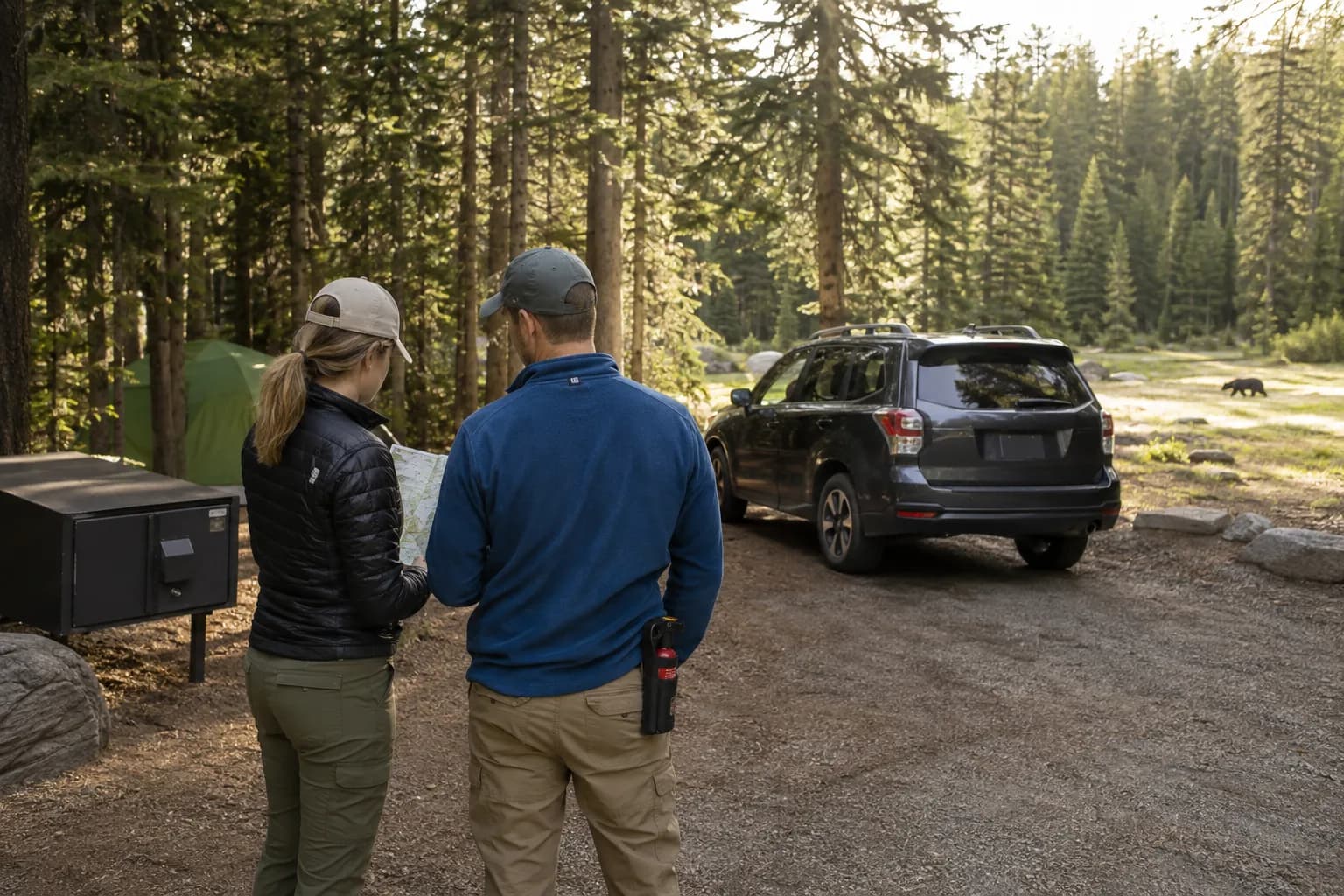
First, find the food-storage rule for your exact campground or backcountry zone. Use a provided locker or pole when required, carry an approved bear-resistant container where mandated, and hang food only where the land manager permits it. There is no universal height or distance that makes a bear hang legal everywhere.
Choose the storage method before you pack
| What the destination says | What to do |
|---|---|
| A food locker, cable or bear pole is provided and required | Use it exactly as posted. Do not improvise a tree hang instead. |
| An approved hard-sided canister is required | Carry a model accepted by that land manager. A bag hang is not a substitute. |
| Hanging is allowed and exact dimensions are published | Follow those local dimensions and campsite-distance rules. |
| Hanging is discouraged, trees are unsuitable or the rule is unclear | Use an accepted canister or contact the ranger office before the trip. |
Rules genuinely vary. North Cascades National Park requires approved canisters in certain camps and zones, while allowing proper hangs elsewhere. Glacier Bay permits a compliant hang but strongly recommends canisters because suitable trees are scarce. Canyonlands says hanging is not recommended and requires hard-sided containers in specified areas.
What belongs in bear-safe storage
Store all food and attractants, not merely tonight's dinner:
- human and pet food;
- garbage, wrappers and recyclables;
- toothpaste, soap, deodorant, cosmetics and sunscreen;
- insect repellent, creams and lotions;
- beverages, cooking gear and dirty dishes;
- coolers or food containers unless the local authority explicitly treats them as approved storage.
North Cascades lists these items because wildlife follows scent, not the labels in your packing cubes. Keep them out of the tent, including while you are away for five minutes. If you camp with a pet, its kibble and treats follow the same storage rule; our camping with dogs guide covers the rest of that setup.
How to make a legal bear hang
Use these steps only after confirming that hanging is allowed and writing down the local measurements.
- Pack the right system. Bring a waterproof food bag, enough cord for the published method, gloves if thin cord is difficult to handle, and a small throw bag that will not damage the tree.
- Choose a live, sturdy tree and branch. The final bag must meet every local clearance—from the ground, trunk and supporting limb. If the branch bends, is dead, or cannot create those clearances, reject it.
- Move to the required distance from sleeping areas. North Cascades specifies at least 100 feet; Crater Lake prefers at least 200 feet. Use your destination's rule rather than assuming either number applies everywhere.
- Throw the line over the branch. Keep people clear of the throwing arc. Do not use a loose rock that can separate from the line.
- Attach and raise every attractant. Hoist the bag until it meets the local vertical and horizontal clearances.
- Secure the system using the published local method. Follow its knot, tie-off and cord-management instructions rather than adding a generic rule from another destination. Confirm that the bag meets every required clearance.
- Inspect it from several angles. A hang can look distant from one side and sit directly above a sloping bank on the other.
Practice at home before relying on the method in wind, darkness or cold hands.
The five-point acceptance test
Do not call the job finished until all five answers are yes:
| Check | Pass condition |
|---|---|
| Legal method | This location and trip date allow a tree hang. |
| Correct contents | Food, trash, toiletries, cookware and every other attractant are included. |
| Correct geometry | The bag meets the destination's height and horizontal-clearance numbers. |
| Correct camp distance | The storage point meets the local distance from sleeping and cooking areas. |
| Correct final setup | Bag clearances, tie-off and cord management match the published local method. |
If one answer is no, lower the bag and change the system until it satisfies the local rule.
When a bear canister is the better choice
A canister is not automatically legal just because it is hard-sided. Some destinations accept only products on a specific approval list, and placement rules still apply. Check the current list and learn how to lock your model before leaving home.
Even where hanging is allowed, choose an accepted canister when:
- the route crosses alpine, desert or coastal terrain with few suitable trees;
- you expect to reach camp after dark;
- the group carries too much food for one manageable hang;
- local bears are known to defeat hangs;
- the ranger or permit instructions recommend one.
Store a canister where an animal cannot roll it into water, off a cliff or through camp. Do not tie it to a tree unless its instructions and local rules specifically say to do so.
Common failures and the correct response
| Failure | Why it matters | Better response |
|---|---|---|
| No qualifying branch | The bag cannot meet the required clearances | Use an approved canister, locker or another legal site—not a marginal branch. |
| Food remains in the tent | Fabric is not scent-proof or bear-resistant | Move all attractants into the approved storage system. |
| The bag is high but close to the trunk | A climbing bear may reach it | Rebuild the hang to satisfy the horizontal rule too. |
| The cord or tie-off differs from the published method | The system may no longer meet the local rule | Rebuild it exactly as instructed by the responsible land manager. |
| The rule changed after planning | Seasonal orders and wildlife activity can change requirements | Recheck the official page, permit and trailhead notice immediately before departure. |
Before-you-leave checklist
- Save the official food-storage page offline.
- Record the exact rule for each campsite or zone, not merely the park name.
- Confirm whether the rule is seasonal or tied to your permit.
- Verify that your canister model is accepted, if carrying one.
- Pack capacity for every attractant and every trip day.
- Practice opening, closing and hanging the system at home.
- Ask the ranger office when two official instructions appear to conflict.
Our broader bear safety while camping guide covers campsite behavior and encounters. Food storage reduces the chance that an animal learns to associate people with a meal; it does not replace distance, awareness or local wildlife guidance.
FAQ
How high should a bear bag hang?+
Use the exact dimensions published for your destination. There is no universal number: North Cascades publishes 12 feet high and 5 feet from limb and trunk, while Glacier Bay and Crater Lake publish 10 feet high and 4 feet horizontally.
Is a PCT-style bear hang allowed everywhere?+
No. A named technique does not override a park rule. Some locations require a provided locker, pole or an approved hard-sided canister; other locations discourage hanging because suitable trees are absent.
How far should food be stored from a tent?+
Follow the local rule. North Cascades specifies at least 100 feet from sleeping areas, while Crater Lake prefers at least 200 feet from camp. Do not assume either distance applies universally.
Can toiletries stay in the tent?+
Not where bear-safe food storage is required. Store toothpaste, soap, cosmetics, sunscreen, insect repellent, garbage, cookware and pet food with the other attractants.
Sources reviewed
Fact-checked Aug 30, 2026
These references support factual or safety-sensitive claims in this article. Access dates show when our editors last verified the source.
- North Cascades National Park — Food Storage Requirements
Official source · Accessed Aug 30, 2026
- Glacier Bay National Park — Bear-Resistant Food Canisters
Official source · Accessed Aug 30, 2026
- Crater Lake National Park — Backcountry FAQ
Official source · Accessed Aug 30, 2026
- Canyonlands National Park — Backcountry Food Storage
Official source · Accessed Aug 30, 2026