recipes / campfire recipes
Dutch Oven Camping Recipes: 4 Techniques That Teach the Oven
Four executable camp Dutch oven recipes, Lodge's exact 350 F briquette chart, food-safety temperatures and a one-oven dinner timeline for six.
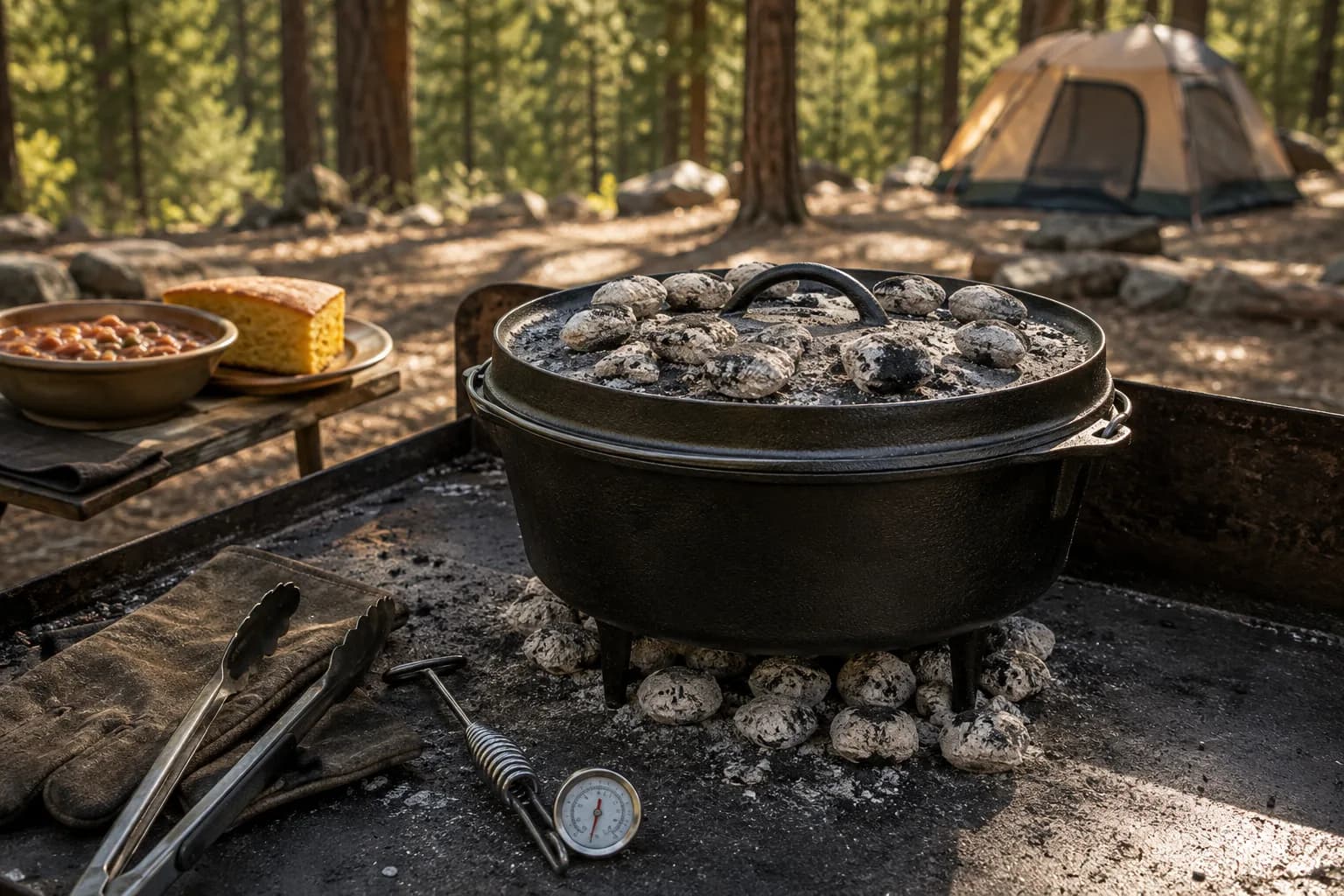
For a first camp Dutch oven meal, use a 12-inch oven to make chicken and potatoes with controlled bottom heat. Once you can hold a quiet simmer, learn top-and-bottom baking with cornbread. Save strata for a morning when verified refrigeration is available, and cobbler for the low-stakes victory lap.
A camp Dutch oven is not a kitchen pot wearing little iron boots. The legs hold it above coals; the flanged lid holds heat above the food. That makes baking possible, but it also creates two heat zones that must be managed, rotated and watched.
This guide deliberately teaches four technique archetypes, not twenty near-identical ingredient lists: braising, bread baking, fruit baking and an egg casserole. Master those and you can judge most other camp Dutch oven recipes without trusting a magical timer.
Chicken and potato braise
- Oven
- 12 in / 6 qt
- Heat plan
- Moderate bottom heat; steady simmer
- Time
- 45-60 min
- Cold holding
- Chicken and leftovers <= 4 C / 40 F
- Doneness
- Each thigh 74 C / 165 F
- Best for
- Main dinner
- Allergens
- Check broth
Cornbread
- Oven
- 10 in / 4 qt
- Heat plan
- About 350 F chart row; top-heavy
- Time
- 25-35 min
- Cold holding
- Egg and milk <= 4 C / 40 F
- Doneness
- Centre 74 C / 165 F
- Best for
- First bake
- Allergens
- Egg, milk, wheat
Peach cobbler
- Oven
- 12 in / 6 qt
- Heat plan
- About 350 F chart row; top-heavy
- Time
- 30-40 min
- Cold holding
- No, if labels confirm shelf stability
- Doneness
- Centre bubbling; topping set
- Best for
- Easy group dessert
- Allergens
- Cake mix: usually wheat; check milk/soy
Breakfast strata
- Oven
- 12 in / 6 qt
- Heat plan
- About 350 F chart row; top-heavy
- Time
- 40-55 min
- Cold holding
- Entire mixture <= 4 C / 40 F
- Doneness
- Centre 74 C / 165 F
- Best for
- Group breakfast
- Allergens
- Egg, milk, wheat; check sausage
| Recipe | Oven | Heat plan | Time | Cold holding | Doneness | Best for | Allergens |
|---|---|---|---|---|---|---|---|
| Chicken and potato braise | 12 in / 6 qt | Moderate bottom heat; steady simmer | 45-60 min | Chicken and leftovers <= 4 C / 40 F | Each thigh 74 C / 165 F | Main dinner | Check broth |
| Cornbread | 10 in / 4 qt | About 350 F chart row; top-heavy | 25-35 min | Egg and milk <= 4 C / 40 F | Centre 74 C / 165 F | First bake | Egg, milk, wheat |
| Peach cobbler | 12 in / 6 qt | About 350 F chart row; top-heavy | 30-40 min | No, if labels confirm shelf stability | Centre bubbling; topping set | Easy group dessert | Cake mix: usually wheat; check milk/soy |
| Breakfast strata | 12 in / 6 qt | About 350 F chart row; top-heavy | 40-55 min | Entire mixture <= 4 C / 40 F | Centre 74 C / 165 F | Group breakfast | Egg, milk, wheat; check sausage |
Before the menu: confirm charcoal is legal
Check the current official fire order for the exact campground on the day you cook. Charcoal and briquettes are often prohibited during a fire ban even when a certified gas or propane cooking appliance remains allowed. For example, Parks Canada's Banff fire-ban guidance explicitly separates prohibited charcoal from permitted gas or propane cooking equipment.
If charcoal is prohibited or the status is uncertain, do not light it. A lidded cast-iron pot can still braise on a permitted outdoor stove if the manufacturer allows that setup, but it cannot reproduce top-coal baking without a separate approved oven system. Choose easy camping meals or no-cook camping meals instead of improvising.
Use charcoal and all fuel-burning appliances outdoors in a well-ventilated area, never in a tent, vehicle, camper or enclosed shelter. Keep the cooker attended, stable and clear of dry vegetation. Extinguish and dispose of coals exactly as local rules require.
Lodge's 350 F charcoal chart
The numbers below are transcribed from Lodge's current official camp Dutch oven coal chart. The first number goes on the flanged lid; the second goes underneath.
| Oven diameter | Total briquettes | On lid | Under oven | Approximate target |
|---|---|---|---|---|
| 8 inches | 16 | 11 | 5 | 350 F / 177 C |
| 10 inches | 21 | 14 | 7 | 350 F / 177 C |
| 12 inches | 25 | 17 | 8 | 350 F / 177 C |
| 14 inches | 32 | 21 | 11 | 350 F / 177 C |
These are starting conditions, not a thermostat. Briquette brand and size, wind, cold, elevation, pot depth and how often the lid opens all change the result. For baking, distribute lid briquettes rather than bunching them. Lodge's briquette technique guide advises rotating the oven a quarter turn every 10 to 15 minutes and rotating the lid a quarter turn in the opposite direction to reduce hot spots; it also allows roughly 15 to 20 minutes for briquettes to light.
For frying or bringing liquid to a boil, start with heat underneath and adjust to what the food is doing. For a braise, the useful target is a quiet, controlled simmer. Twenty briquettes under one spot can scorch dinner while still looking impressively mathematical.
Food safety rules shared by all four recipes
Keep chicken, eggs, milk, sausage, prepared strata and leftovers at or below 4 C / 40 F. Use a cooler thermometer. Health Canada says not to leave food at room temperature for more than two hours, reduced to one hour on hot summer days. Use the shorter applicable limit.
Use a clean digital food thermometer:
| Food | Safe internal temperature |
|---|---|
| Chicken pieces | 74 C / 165 F |
| Egg dishes, including strata and cornbread batter | 74 C / 165 F |
| Beef or pork sausage | 71 C / 160 F |
| Poultry sausage | 74 C / 165 F |
| Reheated leftovers | 74 C / 165 F |
Measure the thickest or coolest part without touching bone or iron. Times in every recipe are estimates.
Use potable or properly treated water for bouillon, handwashing and cleaning. Keep raw chicken and eggs separated from ready-to-eat food. Read every package label for allergens each time; a generic substitution is not automatically safe from cross-contact.
1. Chicken and potato braise
Best for: learning bottom-heat control
Skip if: raw-chicken handling at camp does not fit your water and cleaning setup
Serves: 6
Vessel: 12-inch / roughly 6-quart camp Dutch oven
Estimated time: 20 minutes prep, 45 to 60 minutes cooking
Ingredients
- 6 bone-in chicken thighs, about 1.2 kg / 2.6 lb total
- 680 g / 1.5 lb small potatoes, halved
- 3 carrots, cut into 5 cm / 2-inch pieces
- 1 onion, chopped
- 3 garlic cloves, minced
- 250 mL / 1 cup labelled chicken broth
- 30 mL / 2 tbsp olive oil
- 5 mL / 1 tsp dried thyme
- salt and pepper
Method
Light enough briquettes to create an even bottom heat zone plus replacements. Heat the oil until shimmering, but not smoking. Brown the chicken skin-side down in batches for about 4 to 5 minutes; browning is flavour, not proof of doneness. Move browned pieces to a clean plate that never held raw chicken.
Cook onion and carrots for 3 minutes, then garlic for 30 seconds. Add broth, potatoes and thyme. Return chicken skin-side up, cover and adjust the coals to maintain a gentle simmer rather than a hard boil. Rotate the oven over the heat every 10 to 15 minutes. Begin checking at 40 minutes.
Every thigh must reach 74 C / 165 F in its thickest portion without the probe touching bone. If one piece is below target, keep cooking and recheck it with a cleaned thermometer.
Cold holding, leftovers and allergens
Keep raw chicken at or below 4 C / 40 F in a leakproof container at the bottom of the cooler. Divide leftovers promptly into clean shallow containers; do not try to cool the meal overnight in the heavy iron pot. Refrigerate or return to verified cold holding promptly and reheat to 74 C / 165 F.
Check the broth for allergens such as wheat, soy or celery according to local labelling and the person's care plan.
2. Ten-inch Dutch oven cornbread
Best for: a first top-and-bottom bake
Skip if: you cannot maintain egg and milk under verified cold control
Serves: 6 to 8 as a side
Vessel: 10-inch camp Dutch oven
Heat plan: Lodge 350 F row, 14 briquettes on top and 7 underneath
Estimated time: 10 minutes prep, 25 to 35 minutes baking
Ingredients
- 150 g / 1 cup cornmeal
- 125 g / 1 cup all-purpose flour
- 50 g / 1/4 cup sugar
- 12 g / 1 tbsp baking powder
- 2.5 mL / 1/2 tsp salt
- 250 mL / 1 cup milk or prepared powdered milk
- 1 egg
- 60 mL / 1/4 cup melted butter or neutral oil
- additional oil for the pot
Method
Mix cornmeal, flour, sugar, baking powder and salt at home in one labelled container. At camp, grease the oven. Whisk cold milk, egg and melted butter in a bowl, then stir in the dry mix only until no dry pockets remain.
Pour into the oven. Arrange 14 lit briquettes across the lid and 7 underneath. Rotate pot and lid in opposite directions every 10 to 15 minutes. Start checking the centre after 25 minutes. Bake until the centre reaches 74 C / 165 F; a clean skewer and springy top are texture checks, not substitutes for temperature.
Rest 5 minutes before cutting. The cornbread will slice more cleanly, and the cook gets five minutes during which nobody should ask whether dinner is ready.
Allergens and substitutions
Contains egg, milk and wheat. A flax mixture may change structure and eliminates egg as an ingredient, but it does not make the recipe allergen-safe if the flour, mix, utensils or work area are contaminated. Use only substitutions approved for the affected person.
3. Peach dump cobbler
Best for: a forgiving shared dessert
Skip if: the cake-mix allergen label does not fit the group
Serves: 6 to 8
Vessel: 12-inch camp Dutch oven
Heat plan: Lodge 350 F row, 17 briquettes on top and 8 underneath
Estimated time: 5 minutes prep, 30 to 40 minutes baking
Ingredients
- 2 cans sliced peaches in juice, each about 425 mL / 15 oz
- 1 box yellow cake mix, about 430 g / 15 oz
- 115 g / 1/2 cup butter, cut into thin pieces
- 5 mL / 1 tsp cinnamon
Method
Pour peaches and juice into the clean oven. Sprinkle cake mix evenly over the fruit without stirring. Distribute butter pieces across the dry surface and add cinnamon.
Arrange 17 briquettes on the lid and 8 underneath. Rotate oven and lid in opposite directions every 10 to 15 minutes. Begin checking at 30 minutes. It is ready when the fruit bubbles across the centre and the topping has no broad patches of dry mix. Do not use colour alone; ash, shade and sunset are enthusiastic liars.
Let the cobbler stand 10 minutes before serving because fruit syrup holds heat remarkably well.
Storage and allergens
Unopened fruit and some cake mixes may be shelf-stable; verify each label. Butter requires cold holding unless its label explicitly says otherwise. Once prepared, treat leftovers as perishable, cool promptly in shallow containers and keep at or below 4 C / 40 F.
Cake mix usually contains wheat and may contain milk, soy or other allergens. Check the current package, not a remembered ingredient list.
4. Breakfast strata
Best for: six people sharing one substantial breakfast
Skip if: the whole assembled dish cannot remain at or below 4 C / 40 F
Serves: 6
Vessel: 12-inch camp Dutch oven
Heat plan: Lodge 350 F row, 17 briquettes on top and 8 underneath
Estimated time: 15 minutes assembly, 40 to 55 minutes baking
Ingredients
- 6 cups day-old bread cubes, about 340 g / 12 oz
- 8 eggs
- 375 mL / 1.5 cups milk
- 170 g / 1.5 cups shredded cheddar
- 450 g / 1 lb breakfast sausage
- 2 cups cooked vegetables, such as mushrooms and spinach, for a meat-free version
- 2.5 mL / 1/2 tsp smoked paprika
- salt and pepper
Prepare safely
Cook beef or pork sausage to 71 C / 160 F, or poultry sausage to 74 C / 165 F. Cool it promptly in a shallow container. If assembling ahead, do it at home with clean equipment, refrigerate immediately at or below 4 C / 40 F and cook it promptly according to the storage guidance that applies where you are. Do not assume a heavy pot buried in a cooler is cold enough; measure the food temperature.
Grease the oven. Layer bread, cooked sausage or vegetables and half the cheese. Whisk eggs, milk and seasoning, pour over the bread and press gently. Add remaining cheese.
Arrange 17 briquettes on top and 8 underneath. Rotate both parts in opposite directions every 10 to 15 minutes. Begin checking at 40 minutes. The centre, not just the edge, must reach 74 C / 165 F. If the top browns before the middle is safe, remove some lid briquettes and continue cooking.
Allergens
Contains egg, milk and wheat; sausage may contain additional allergens. A vegetarian version removes meat but not those three allergens. Prepare a medically required safe portion separately with distinct tools and storage.
One Dutch oven, one dinner for six
This is a genuinely single-oven plan using the 12-inch oven for the braise only. Serve purchased bread and a no-cook dessert. Make the 10-inch cornbread or 12-inch cobbler in a separate cooking session; one piece of iron cannot change diameter or bake two courses at once.
| Time | Task |
|---|---|
| 4:15 pm | Confirm fire status, set the safety area and light the main briquette batch |
| 4:35 pm | When briquettes are ready, brown the chicken and vegetables |
| 4:50 pm | Add liquid, cover and begin the controlled braise |
| 5:10 pm | If the first batch is fading, light replacement briquettes now; allow 15 to 20 minutes before use |
| 5:30 pm | Add only the ready replacements needed to maintain a quiet simmer |
| 5:35 pm | Begin temperature checks in every thigh and confirm potato tenderness |
| 5:45-6:00 pm | Serve only when every thigh reaches 74 C / 165 F |
With two Dutch ovens and two attentive adults, cornbread or cobbler can bake while the braise cooks. That is a separate two-oven plan; do not assign both hot vessels to one distracted cook.
Equipment checklist
- camp Dutch oven with legs and a flanged lid
- manufacturer coal chart saved offline
- chimney starter and permitted ignition method
- long charcoal tongs
- lid lifter
- dry heat-resistant gloves
- stable, designated fireproof cooking area
- digital food thermometer
- cooler thermometer
- clean plate for cooked meat
- potable or properly treated water
- soap, washing basin and separate cleaning tools
- shallow leakproof leftover containers
- metal ash container or disposal method required by the campground
- shelf-stable backup meal
For prep-at-home alternatives, use make-ahead camping meals. For individually portioned cooking with less iron, compare foil-packet camping recipes. The dessert page has more options and a no-fire fallback in campfire desserts.
Cleaning and storage
Follow the cookware manufacturer's instructions. Lodge currently advises scraping out food, hand-washing with hot water and optionally a small amount of mild detergent, drying thoroughly and applying a very light coat of oil while warm. Lodge also recommends storing the lid ajar so moisture does not collect.
Do not pour grease, food scraps or wash water into a fire ring or onto the ground. Collect residue and dispose of it according to campground rules. Store the cleaned oven and every scented item where the local wildlife rules require.
FAQ
For the overnight version specifically, USDA FSIS advises refrigerating cooked egg dishes and using them within three to four days, while uncooked egg mixtures should be cooked promptly. Our 24-hour strata limit is the narrower operational rule used in this guide, not a general extension of refrigerator life.
How many briquettes does a 12-inch Dutch oven need at 350 F?+
Lodge\u0027s current chart specifies 25 total: 17 on the flanged lid and 8 underneath. Treat that as a starting point, rotate the oven and lid in opposite directions every 10 to 15 minutes, and judge food with temperature and doneness checks.
Can I use charcoal during a fire ban?+
Often no. Many official fire bans prohibit charcoal and briquettes while allowing specific certified gas or propane cooking appliances. Check the current order for the exact campground; if the status is uncertain, do not light coals.
What is the easiest Dutch oven camping recipe for beginners?+
A chicken-and-potato braise teaches bottom-heat control, but it requires careful raw-chicken handling. Cornbread is the clearest first baking exercise. Cobbler is the most forgiving dessert, while strata demands the strongest cold-control plan.
Can a kitchen Dutch oven replace a camp Dutch oven?+
A flat-bottom kitchen oven can braise on a permitted compatible stove, but it lacks the legs and flanged lid designed for coals above and below. Do not balance a kitchen pot over unstable coals or pile briquettes on a lid that was not designed for them.
Can I prepare breakfast strata the night before?+
Yes, if it is assembled cleanly, refrigerated immediately at or below 4 C / 40 F, cooked within 24 hours and baked until the centre reaches 74 C / 165 F. Verify temperature rather than assuming a crowded cooler stayed cold.
Can I walk away while a Dutch oven cooks?+
No. Hot coals and fuel-burning equipment require active supervision. Stay with the cooking area, keep it clear and stable, and fully extinguish and dispose of coals according to local rules.
Sources reviewed
Fact-checked Sep 3, 2026
These references support factual or safety-sensitive claims in this article. Access dates show when our editors last verified the source.
- Lodge Cast Iron - Camp Dutch oven cleaning, coal chart and technique
Official source · Accessed Sep 3, 2026
- Lodge Cast Iron - Official camp Dutch oven coal chart image
Official source · Accessed Sep 3, 2026
- Lodge Cast Iron - Briquette placement, lighting and rotation
Official source · Accessed Sep 3, 2026
- Health Canada - Safe cooking temperatures
Official source · Accessed Sep 3, 2026
- USDA FSIS - Shell eggs from farm to table
Official source · Accessed Sep 3, 2026
- Health Canada - Summer food safety tips
Official source · Accessed Sep 3, 2026
- Health Canada - Food safety tips for leftovers
Official source · Accessed Sep 3, 2026
- Health Canada - Barbecue and portable butane stove safety
Official source · Accessed Sep 3, 2026
- Parks Canada - Banff fire ban information
Official source · Accessed Sep 3, 2026
- Parks Canada - Yoho camping cooking equipment
Official source · Accessed Sep 3, 2026
- CDC - Water treatment when hiking, camping or travelling
Official source · Accessed Sep 3, 2026
- Health Canada - Food allergen labelling
Official source · Accessed Sep 7, 2026
- Food Allergy Canada - Kitchen tips to prevent allergen cross-contact
Expert guidance · Accessed Sep 7, 2026