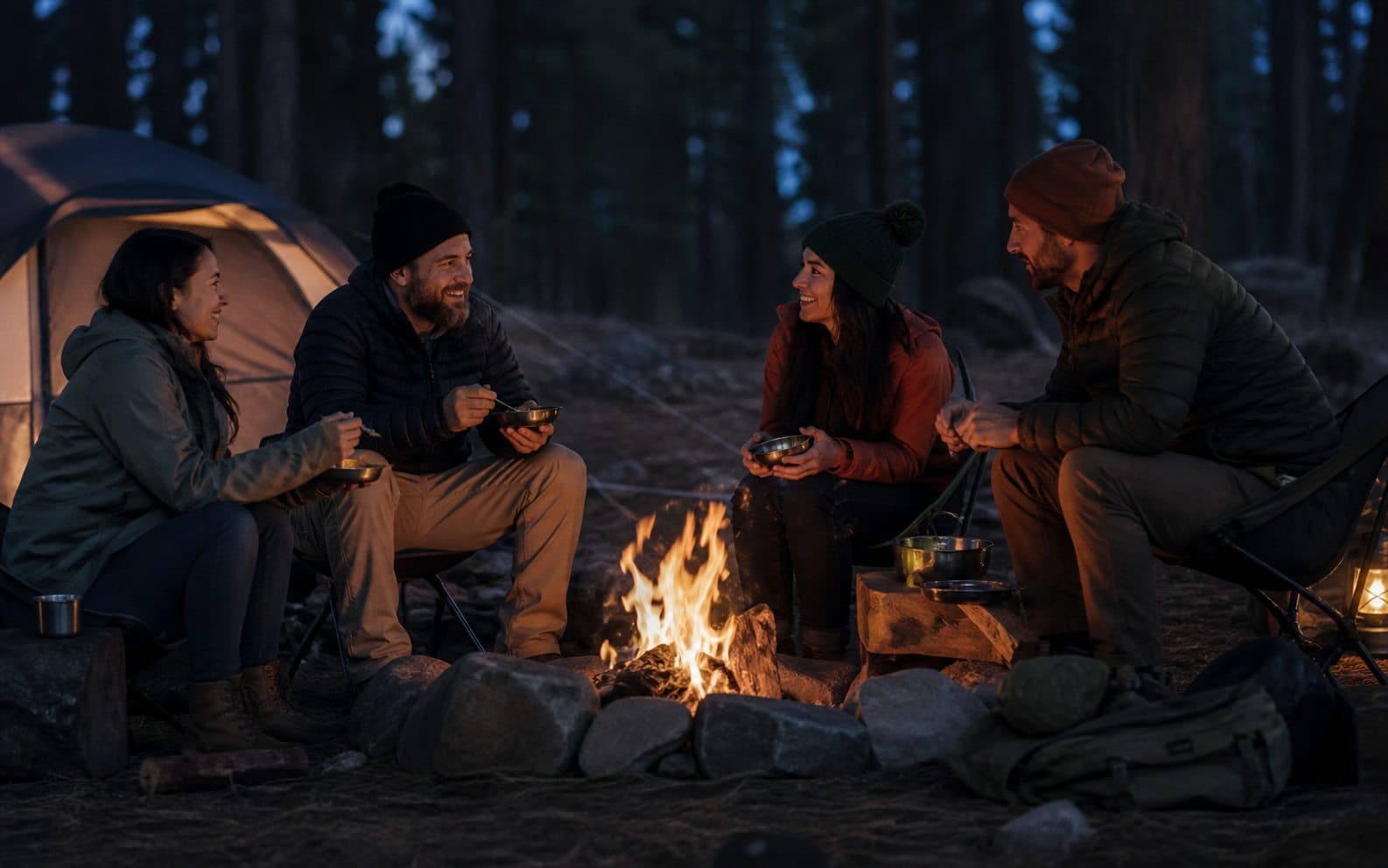
campfire / outdoor activities
Camping Activities for Adults
Choose camping activities for adults by group, energy, weather and time. Includes nine specific ideas, a printable planner and useful fallbacks.
An adult trip does not need a laminated agenda. It does benefit from one good anchor activity and one low-setup rain fallback—with a substantial building or hard-topped vehicle as the separate thunder plan. Choose those, leave the rest of the day open, and nobody has to spend Saturday performing relaxation with military precision.
The best activity depends less on age than on four constraints: who came, how much energy remains, what the weather allows, and how long you actually have. Use the planner first, then jump to the exact instructions below.
Keepsake Camp decision tool
Build a realistic camp plan
Choose the company, energy, conditions and time you actually have. The fallback is deliberately boring enough to survive rain and fatigue.
Anchor: Blind coffee tasting. Fallback: Three-question trip journal. All anchor filters matched.
Anchor
Blind coffee tasting →Matches every selected constraint.
Brew two methods or beans, hide the labels and compare notes.
Fallback
Three-question trip journal →Lower-setup backup for rain, delay or low energy.
Write one surprise, one sensory detail and one change for tomorrow.
Thunder is different from rain: stop the activity and enter a substantial building or hard-topped vehicle. Wait at least 30 minutes after the last thunder. A tent, gazebo or open picnic shelter is not lightning shelter.
The two-activity rule
Pick one anchor that gives the day a shape — a photo walk, a cache, fishing, a short objective — and one fallback requiring almost no setup. Do not choose five anchors. That is an itinerary wearing hiking boots.
| Trip type | Good anchor | Reliable fallback |
|---|---|---|
| Solo reset | Observation sit or photo walk | Three-question journal |
| Couple | Two-person micro-adventure | Blind coffee tasting |
| Friends | Geocache or camp tournament | Map-and-memory night |
| Rainy day | Visitor-centre stop if open | Journal, cards or story game |
| Low-energy arrival | Short shoreline walk | Slow morning plan for tomorrow |
Golden-hour photography
The hour after sunrise and before sunset often gives softer shadows and warmer light than midday. A phone camera handles this fine; timing and position matter more than gear. Scout a permitted spot in daylight if you are aiming for sunrise.
Try a five-frame constraint: one wide scene, one person or campsite, one texture, one sign of weather, and one detail you would normally walk past. Constraints create a reason to look; 140 nearly identical sunset photos create a battery problem.
Trip journaling
A small notebook needs no signal and creates less friction than a blank-document ritual. Answer three prompts:
- What surprised me?
- What did I notice that a photo would miss?
- What should we change tomorrow?
Date the page and add the campsite or route name. Future-you will not remember whether “the windy lake” was this trip or the other windy lake.
Geocaching
Geocaching is a real-world search using published coordinates. Every listed cache has separate one-to-five-star ratings for difficulty and terrain. For a first attempt, choose a low rating in both categories on a route that is already open and permitted.
Open the listing before leaving signal and read recent logs; repeated “did not find” entries can mean the cache is missing. The official app's downloadable Offline Lists and maps require Premium membership, so do not discover that limitation at the trailhead. A screenshot is not a navigation plan: carry the park map and obey closures, hours and no-entry areas.
Do not move a cache, add food, or damage vegetation while searching. If you take a trade item, leave something of equal or greater value and sign the log.
Quiet-water fishing
Even without serious experience, an hour with a rod at a quiet lake or slow river can give the day a deliberate pause. Choose the location before buying anything. Confirm the licence, open season, species rules, access rules and whether live bait is permitted in that exact jurisdiction.
It does not need to produce a fish. If the weather turns electrical, leave the shoreline: there is no safe outdoor place during a thunderstorm.
Slow mornings
The easiest adult-camping activity to overlook is doing nothing quickly. A proper coffee setup — a pour-over, a percolator, whatever beats instant — and no schedule for the first hour of the day turns a routine task into the best part of the trip for a lot of people. This works specifically because it's adult-paced: no one waking up hungry and needing breakfast in the next ten minutes, no gear to set up before the fun starts. Building 45 minutes of nothing into the morning, deliberately, is the whole activity.
For two people, turn coffee into a blind comparison: brew two beans or two methods, hide which is which, and each write three words before discussing them. It is just structured enough to feel like an activity and not so structured that someone produces a spreadsheet.
Map-and-memory night
Put a paper map on the table. Each person marks one place from the day and tells the 60-second version: what happened, what they noticed, and whether they would return. It works because the map gives every story a concrete beginning.
Keep the boundary firm: one minute each, no correcting another person's memory, and no pressure to share anything personal. Finish by choosing one realistic option for tomorrow and one weather fallback.
Camp tournament
Choose three short games with different advantages: one luck game, one word or knowledge game, and one light physical game if space and rules allow. Award three points for first, two for second and one for participating. No elimination; people came to spend time together, not watch the finalists.
Good combinations:
- Cards, camping trivia, then cornhole where permitted.
- Dice, campfire storytelling, then a short observation challenge.
- Euchre, a blind snack tasting, then best photo of one agreed subject.
Keep noise, projectiles and lights inside campground rules and quiet hours. A headlamp tournament is memorable mostly to the neighbouring site.
Micro-adventure
A micro-adventure is one nearby objective with a hard turnaround: reach a viewpoint, paddle a sheltered shoreline, walk a short interpretive loop, or find a permitted picnic spot. Define success before leaving.
- Objective: one place, not a chain of stops.
- Turnaround: a clock time independent of progress.
- Weather trigger: the condition that cancels or shortens it.
- Fallback: something back at camp.
The turnaround is the useful part. It prevents a small idea from quietly becoming a poorly supplied day trip.
Observation sit
Pick one durable, permitted surface with a view and stay there for 20 minutes. At minute 0, 10 and 20, record the nearest sound, the farthest sound, wind direction and one change in light. Do not approach wildlife or leave the trail to improve the view.
This is particularly good solo because it creates a task without adding distance. Tell someone where you will be if you leave the immediate campground area.
Matching activities to the group
Photography, journaling and an observation sit work well solo or in comfortable silence with others nearby. Geocaching and fishing give a reason to move without mileage becoming the achievement. A map night or tournament works better for a group. Slow mornings work only when the group agrees; one person rushing everyone else undoes the point.
If nobody can agree, each person privately rates the options from one to three. Pick the highest total that fits the weather, then choose a fallback. Democracy survives; so does the afternoon.
Weather and permission checks
Before leaving camp, verify the current forecast, closures, daylight, permits or licences, and the route back. If thunder is heard, stop: the National Weather Service advises moving to a substantial building or a hard-topped vehicle and waiting at least 30 minutes after the last thunder before resuming. A tent, gazebo or open picnic shelter is not lightning shelter.
For games and campfire options once the group's together in the evening, our camping games for adults guide covers Werewolf, Euchre, and a handful of others with full rules, and things to do while camping covers the broader, all-audience version of this list.
FAQ
What are good quiet camping activities for adults?+
A three-question journal, a five-frame photo walk, an observation sit and a deliberately slow morning need little gear and work alone or beside other people.
Do you need experience to try geocaching while camping?+
No. Start with a cache that has low difficulty and terrain ratings, read recent logs and stay on an open, permitted route. Prepare for weak signal before leaving camp; offline lists in the official app require Premium membership.
What is a good solo camping activity?+
An observation sit, photography, journaling and properly licensed shore fishing work alone. If leaving the campground area, share your route and turnaround time with someone.
What can adults do while camping in the rain?+
Use a covered, non-lightning-exposed location for a short journal, map-and-memory round, cards, dice or storytelling. During thunder, an open shelter or tent is not safe; move to a substantial building or hard-topped vehicle.
How many activities should you plan for a camping day?+
Choose one anchor activity and one low-effort fallback. More options can stay optional; scheduling several major activities often makes a short camping trip feel rushed.
Sources and limits
Geocache ratings were checked against the official difficulty and terrain guide; Premium offline access against the app's Offline Lists documentation; and trading, food and site-care rules against Geocaching etiquette, all on 4 September 2026. Thunder guidance was checked against the National Weather Service. Fishing, access and permit rules are location-specific and must be verified with the responsible authority for the exact waterbody or park.
Sources reviewed
Fact-checked Sep 4, 2026
These references support factual or safety-sensitive claims in this article. Access dates show when our editors last verified the source.
- Geocaching — difficulty and terrain ratings
Official source · Accessed Sep 4, 2026
- Geocaching — app and offline lists
Official source · Accessed Sep 4, 2026
- Geocaching — new geocacher etiquette
Official source · Accessed Sep 4, 2026
- National Weather Service — lightning safety
Official source · Accessed Sep 4, 2026