campfire / games
Camping Games for Adults: Pick One That Fits
Choose an adult camping game by group size, time, energy and gear, then use the complete rules offline. Includes quiet, strategic and gloriously suspicious options.
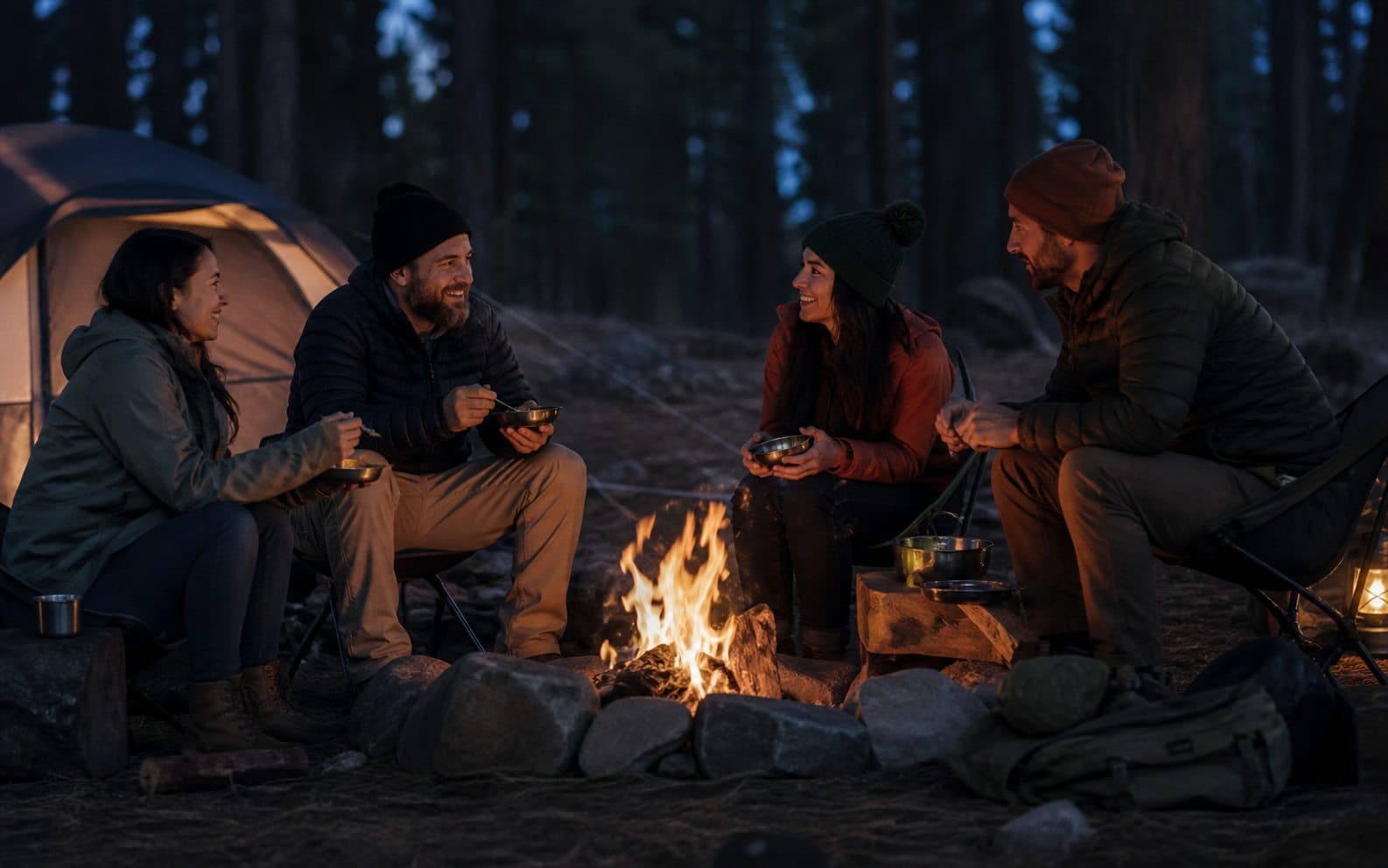
The best adult camping game is not the loudest one or the one with the longest rules. It is the game that fits the number of people still awake, their remaining social energy, the light available and the objects you remembered to pack.
Use the selector for a shortlist, or jump to the decision table. Every game below includes the complete playable version—because “bring cards” is not a rule set, and campground reception has a sense of humor.
Keepsake Camp decision tool
Find tonight's game
Filter by the group you actually have. Results link to complete rules below; nothing asks for an email or a heroic attention span.
7 games fit these filters
- Two Truths and a Lie →
3+ players · 15 min · Quiet · No gear
Easy conversation starter for a group that is still warming up.
- Farkle →
2–6 players · 25 min · Social · Pocket-size
Compact push-your-luck dice game that works at a picnic table.
- Euchre →
4 players · 35 min · Social · Pocket-size
A real partnership game for four people who want strategy.
- Twenty Questions: Camp Edition →
2+ players · 10 min · Quiet · No gear
A zero-setup fallback for two people or a quiet fire.
- Campfire Categories →
3+ players · 15 min · Social · No gear
Fast verbal rounds with no moderator and almost no explanation.
- Cornhole →
2–4 players · 25 min · Social · Yard game
A casual arrival-hour game when the site has level open ground.
- Ladder Toss →
2–4 players · 25 min · Social · Yard game
Portable competition for car campers with room to play safely.
Pick by the mood, not by the headline
| If the group needs… | Start with | Why it fits |
|---|---|---|
| An easy first-night icebreaker | Two Truths and a Lie | No equipment and no complicated explanation |
| A large-group centerpiece | Fishbowl | Familiar clues become running jokes across three rounds |
| Suspicion and theatrical arguments | Werewolf / Mafia | Best with 7+ people and one confident moderator |
| A real four-player strategy game | Euchre | Fixed teams and repeat value over several nights |
| A compact game with risk | Farkle | Six dice, quick turns and meaningful push-your-luck choices |
| Ten quiet minutes | Twenty Questions | Works with two people and nothing to unpack |
| Something people can join late | Campfire Categories | Short rounds and almost no continuity to protect |
| A game during campsite setup | Cornhole | Players can rotate without breaking the match |
| A car-camping tournament | Ladder Toss | Visible scoring and short repeatable rounds |
Quiet hours and fire restrictions still apply. “Adult game” is not campground code for “the neighboring loop should know who won.”
No-equipment camping games
Two Truths and a Lie
Players: 3+ · Time: 10–20 minutes · Best for: a group still settling in
Each person says three short statements about themselves: two true, one invented. The rest of the group can ask one follow-up question about each statement, then votes on the lie. Reveal the answer and move clockwise.
The follow-up-question rule is what keeps this from becoming three random sentences followed by pointing. For a group that knows one another well, restrict statements to outdoor trips, jobs nobody remembers, minor disasters or skills people would not guess.
Skip it when: anyone would feel pressured to disclose personal information. The game works with harmless facts; confession is not a scoring category.
Twenty Questions: Camp Edition
Players: 2+ · Time: 5–15 minutes · Best for: a quiet fire or late arrival
One person secretly chooses a thing connected to the trip: an animal, piece of gear, park, trail feature, camp meal or object visible at the site. Everyone else shares a maximum of 20 yes-or-no questions to identify it.
The chooser must answer truthfully and should announce the category before play. A correct guesser becomes the next chooser. If nobody succeeds, the chooser gets one point and reveals the answer.
Make it better: ban hyper-specific answers nobody could infer. “Tent stake” is fair. “The third tent stake in the orange bag” is a hostage situation.
Campfire Categories
Players: 3+ · Time: 10–20 minutes · Best for: flexible groups
Choose a category such as national parks, camp foods, animals, outdoor brands or things found in a backpack. Go around the circle naming one valid, unused answer. Give each player about five seconds; hesitation, repetition or an invalid answer removes that player for the round. The last remaining player chooses the next category.
Before starting, agree whether close variants count separately. Otherwise “tent,” “large tent” and “emotionally complicated tent” will consume the judicial system.
Skip it when: the group prefers collaboration. This game exposes who becomes a rules lawyer under very low stakes.
Werewolf / Mafia
Players: 7+, better with 9–14 · Time: 25–45 minutes · Best for: a large, expressive group
Choose one moderator. Secretly assign roles using cards or folded paper: for nine players, try two werewolves and six villagers, with the moderator outside play. Larger groups can add a detective who checks one player per night and a doctor who protects one player.
- Everyone closes their eyes.
- The moderator wakes the werewolves; they silently choose one player to eliminate.
- Optional special roles act when called.
- Everyone wakes. The moderator announces who left the game, without revealing private information beyond the agreed rules.
- The group debates, then votes to eliminate one suspected werewolf.
- Repeat until villagers remove every werewolf or werewolves equal the remaining villagers.
Use a head-down or outward-facing night phase so reactions are not visible. Keep accusations inside the game and set a debate limit; 90 seconds is enough for a small round.
Skip it when: players dislike elimination or social deception. Fishbowl lets everyone remain involved.
Pocket-size games
Fishbowl
Players: 6+ · Time: 30–45 minutes · Gear: paper, pens, bowl or bag, timer
Split into two teams. Every player writes three recognizable people, places, characters or objects on separate slips. Fold them into one container.
Play the same slips through three rounds, returning all slips to the bowl between rounds:
- Describe: say anything except the answer or a direct part of it.
- One word: give exactly one spoken word per slip.
- Act: use gestures only—no words or sound effects.
Teams alternate 45- or 60-second turns. A correct answer earns one point and the player draws again until time expires. Finish the current round when the bowl is empty; total the points after round three.
The repeated clues are the engine. By round three, a single eyebrow can somehow mean “the campground host's golf cart.”
Make it fair: agree on recognizable subjects and allow one penalty-free pass per turn so an obscure clue cannot trap a team.
Farkle
Players: 2–6 · Time: 20–35 minutes · Gear: six dice, score sheet
On a turn, roll all six dice and remove at least one scoring die or combination. You may bank the turn total or roll the remaining dice. A roll with no scoring dice is a Farkle: the turn earns zero. If all six dice score, pick them all up and continue with six “hot dice.”
Use this simple scoring table:
| Roll | Points |
|---|---|
| Single 1 | 100 |
| Single 5 | 50 |
| Three 1s | 1,000 |
| Three of any other number | Face value × 100 |
| 1–6 straight in one roll | 1,500 |
| Three pairs in one roll | 1,500 |
Play to 10,000. Once someone reaches it, every other player gets one final turn. Declare scoring variants before the first roll; Farkle has many household rules, and discovering yours at 9,850 points is poor diplomacy.
Euchre
Players: exactly 4 · Time: 25–45 minutes · Gear: 24-card deck (9 through ace)
Form fixed partnerships sitting opposite each other. Deal five cards per player and turn one card face up. Starting left of the dealer, players may order the dealer to pick up that suit as trump or pass. If everyone passes, make a second circuit in which a player may name another suit; if all pass again, redeal.
In the trump suit, the jack is the highest card—the right bower. The jack of the same color is second—the left bower—and counts as trump. Remaining trump cards follow ace, king, queen, 10, 9. In other suits, ace is high.
The player left of the dealer leads. Follow suit if able; highest trump wins, or highest card of the led suit if no trump appears. A team calling trump scores one point for three or four tricks and two for all five. If the calling team takes fewer than three, the defenders score two. First team to 10 wins.
Skip it when: nobody wants a teaching round. Euchre improves with repeat play; it is a poor choice for seven distracted people sharing one headlamp.
Yard games for car camping
Use only on a level, open area where thrown equipment cannot enter a road, campsite, trail or group of people. Check campground rules and quiet hours, and pack the game away before darkness makes every bolo an unsolved case.
Cornhole
Players: 2 or 4 · Time: 15–30 minutes · Gear: two boards, eight bags
Use two teams and four bags per side. Standard adult board spacing is 27 feet between front edges, but shorten it for casual play when space and safety require. Partners stand at opposite boards; players alternate underhand throws toward the other board.
A bag on the board scores one; through the hole scores three. Use cancellation scoring: only the team with the higher round total scores the difference. First to 21 wins. Decide before play whether 21 must be exact; both versions exist.
Camp adaptation: if the only safe surface is smaller, shorten both sides equally instead of expanding beyond the site's durable area.
Ladder Toss
Players: 2 or 4 · Time: 15–30 minutes · Gear: ladder target and three bolos per side
Place the toss line about 15 feet from the ladder, or closer for a casual game. Players alternate underhand throws. A bolo wrapping the top, middle or bottom rung commonly scores three, two or one point. After all throws, remove the bolos and begin the next round.
Play to exactly 21 only if the group wants the extra arithmetic; otherwise first to at least 21 is a cleaner campground rule. Use the equipment manufacturer's safety directions and keep spectators clear of the throwing lane.
How this list was selected
We chose games that cover different group sizes, social energy and packing constraints. The selector uses the rules encoded in this page—not popularity, affiliate commission or a claim that Keepsake Camp field-tested every game. These are widely known games with common rules; Farkle, Euchre, cornhole and ladder-toss variants differ, so the article states its scoring version where that matters.
For a mixed-age group, use the best campfire games for families. For younger players, see campfire games for kids. If the group would rather perform than compete, campfire storytelling games are the better branch.
FAQ
What are the best camping games for adults with no equipment?+
Two Truths and a Lie is an easy icebreaker, Twenty Questions works for two or more people, Campfire Categories suits flexible groups, and Werewolf works best with at least seven. Choose by group size and whether people want quiet conversation, fast recall or social deduction.
What camping game works for exactly four adults?+
Euchre is the strongest strategic option if the group will learn its trump rules. Farkle is easier to teach, while cornhole or ladder toss work when you have the equipment and a safe playing area.
What is a good adult camping game for a large group?+
Fishbowl works well from six players upward and keeps everyone involved across three rounds. Werewolf is better from seven upward when the group enjoys debate, deception and player elimination.
Can I print the camping game rules?+
Yes. Use the Print or save rules button in the selector, then choose a printer or Save as PDF in your browser. Save the page before leaving reliable reception.