campfire / games
Campfire Games for Kids
Six seated campfire games for kids with clear rules, calm adaptations, 20 print-ready question cards and firm boundaries around an active fire.
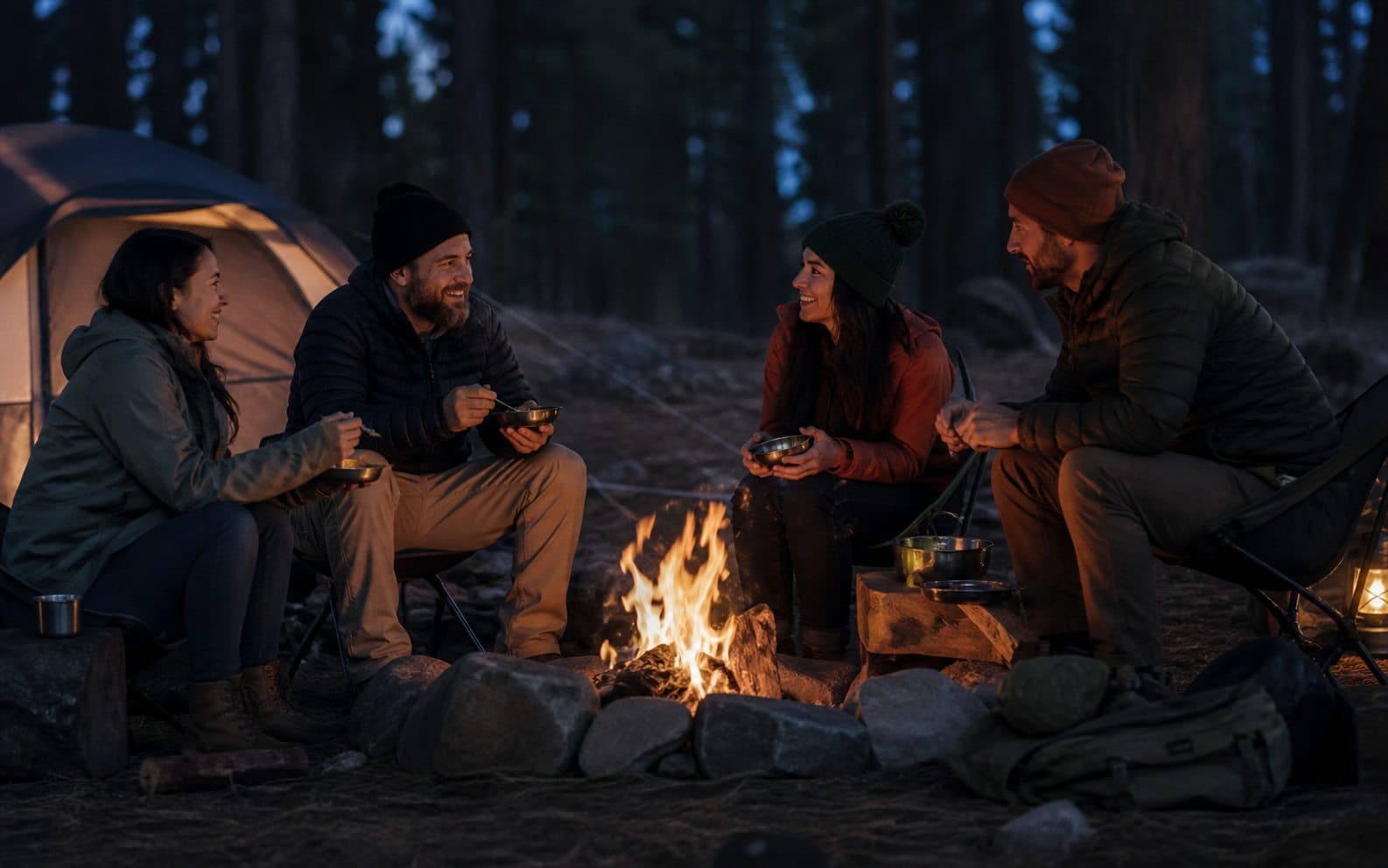
The campfire circle asks for something specific: games kids can play sitting still, without running around a dark campsite. These six use short turns, optional help and no required elimination. They are different from the field games and relay races that belong earlier in the evening while there is still light and plenty of room.
1. "I'm Going Camping and I'm Bringing..."
Players: 3+, seated in a circle. Age: 5+ (older kids can play the harder alphabetical version below).
The first player says "I'm going camping and I'm bringing a [item]." The next player repeats the full phrase, adds the first item, and adds one of their own. Each player repeats the growing list before adding to it. If someone misses an item, offer a clue, let the circle help or allow a free pass. Nobody needs to be eliminated for the list to become satisfyingly ridiculous. For an older group, require each new item to start with the next letter of the alphabet.
2. The alphabet game (adjective edition)
Players: 3+, seated in a circle. Age: 7+, once kids can reliably think of words on the spot.
Going around the circle, each player names an adjective and a camping-related noun that both start with the same letter, moving through the alphabet as you go — "Adventurous ants," "Brave bears," and so on. Skip Q, X, and Z, or let the group vote on a creative save. This one runs faster than it sounds and works well as a five-minute filler between other games.
3. Animal sound guessing
Players: 4+, seated. Age: 3+ — one of the few games on this list that works for the youngest kids in a mixed-age group.
One player makes an animal sound (real or invented) while remaining seated and facing normally; everyone else guesses which animal, or invents their own name for whatever the sound clearly wasn't. Younger kids can be given a picture card of an animal to imitate if guessing what to be is the harder part for them.
4. Campfire Simon Says
Players: 4+, seated near the fire. Age: 4+.
Use standard Simon Says rules with small camping-themed actions: "Simon says zip your sleeping bag," "Simon says point to the moon," or "Simon says mime roasting a marshmallow." Near an active fire, everyone stays seated and movements stay above the lap. Move a standing version to a separate, well-lit area away from the fire ring.
5. Pass-the-object question game
Players: 4+, seated in a circle. Age: 6+. Material: one small, soft object brought from home, such as a bandana or stuffed animal.
Pass the object hand to hand while the group counts quietly or says a short verse together. Whoever holds it when the counting stops may answer a question, ask for another card or pass without explaining. Use the 20 cards below instead of inventing questions while everyone waits.
20 print-ready question cards
Use your browser's Print command, print this table, cut along the rows and then cut each row down the middle to separate all 20 cards. A leader can also read directly from the screen. None of the questions asks a child to reveal a fear, secret or private experience.
| Card | Question | Card | Question |
|---|---|---|---|
| 1 | What is the best sound you have heard at camp? | 11 | Invent a name for a new trail. |
| 2 | Invent an animal and give it a name. | 12 | Which animal would make the funniest campsite neighbor—from a safe distance? |
| 3 | Which superpower would make tent setup easier? | 13 | What would improve a rainy afternoon at camp? |
| 4 | What snack tastes best outdoors? | 14 | Choose a song for the campsite soundtrack. |
| 5 | If you controlled tomorrow's weather, what would you choose? | 15 | Where would you build an imaginary campsite? |
| 6 | Choose a mascot for this trip. | 16 | Invent a new flavour of camp cookie. |
| 7 | Give your tent a ridiculous name. | 17 | What outdoor smell should become a candle? |
| 8 | What camp skill would you teach a friendly robot? | 18 | Sunrise or stargazing—and why? |
| 9 | Plan one fun evening with no campfire. | 19 | Name one way campers can help each other. |
| 10 | What colour have you noticed most outdoors today? | 20 | Make the sound effect for camp waking up. |
6. Two-word story
Players: 3+, seated in a circle. Age: 6+.
Going around the circle, each player adds exactly two words to a shared story — no more, no less. It forces short, quick contributions and tends toward funnier, stranger stories than a one-word or full-sentence version would, since two words is just enough to twist the plot but not enough to finish a thought.
Keeping the circle working for mixed ages
Games 1, 3 and 4 flex down to younger kids most easily: shorten the list, use an animal picture or keep movements tiny. Games 2, 5 and 6 ask for more vocabulary, verbal expression or working memory. Read question cards aloud, allow extra time and keep the free-pass rule for every age.
For higher-energy games earlier in the day, our camping games for kids guide covers team and relay games built for open space rather than the fire circle, and best campfire games covers the mixed-age, no-prop options that work when adults and kids are playing together. Wind the evening down further with funny campfire jokes once the games wrap up.
FAQ
What campfire games work for young kids?+
Animal sound guessing works from about age 3, and seated Campfire Simon Says from about age 4. Both can use imitation, listening and optional help instead of reading or elimination.
What's a good campfire memory game?+
"I'm Going Camping and I'm Bringing..." builds a shared list. Offer clues, circle help or a free pass when someone forgets an item; nobody needs to be eliminated.
Can I print the question cards?+
Yes. Use your browser's Print command and print the 20-card table. Cut along the rows, or let a leader read the questions directly from the page.
How do you keep a campfire game calm and safe near the fire?+
Keep every player seated near an active fire, pass soft props hand to hand and avoid running, blindfolds, backward steps or tossing. Move any standing game to a separate, well-lit area away from the fire ring.
Sources reviewed
Fact-checked Sep 4, 2026
These references support factual or safety-sensitive claims in this article. Access dates show when our editors last verified the source.
- National Park Service — Campfire Safety
Official source · Accessed Sep 4, 2026