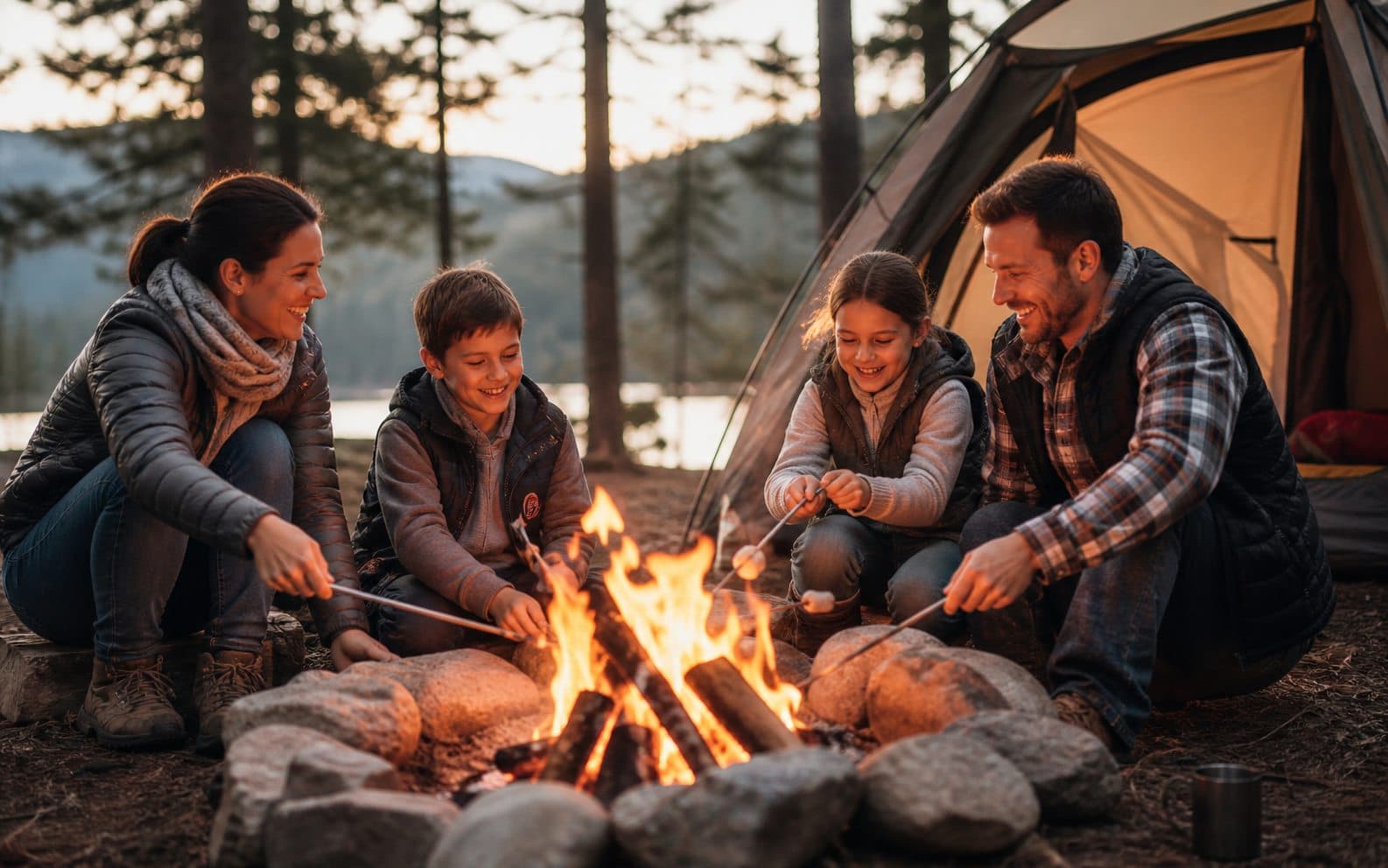
family / activities
Camping Games for Kids: Pick One That Fits
Choose a camping game by age, group size, energy, space and equipment, then use complete rules for eight low-waste campsite games.
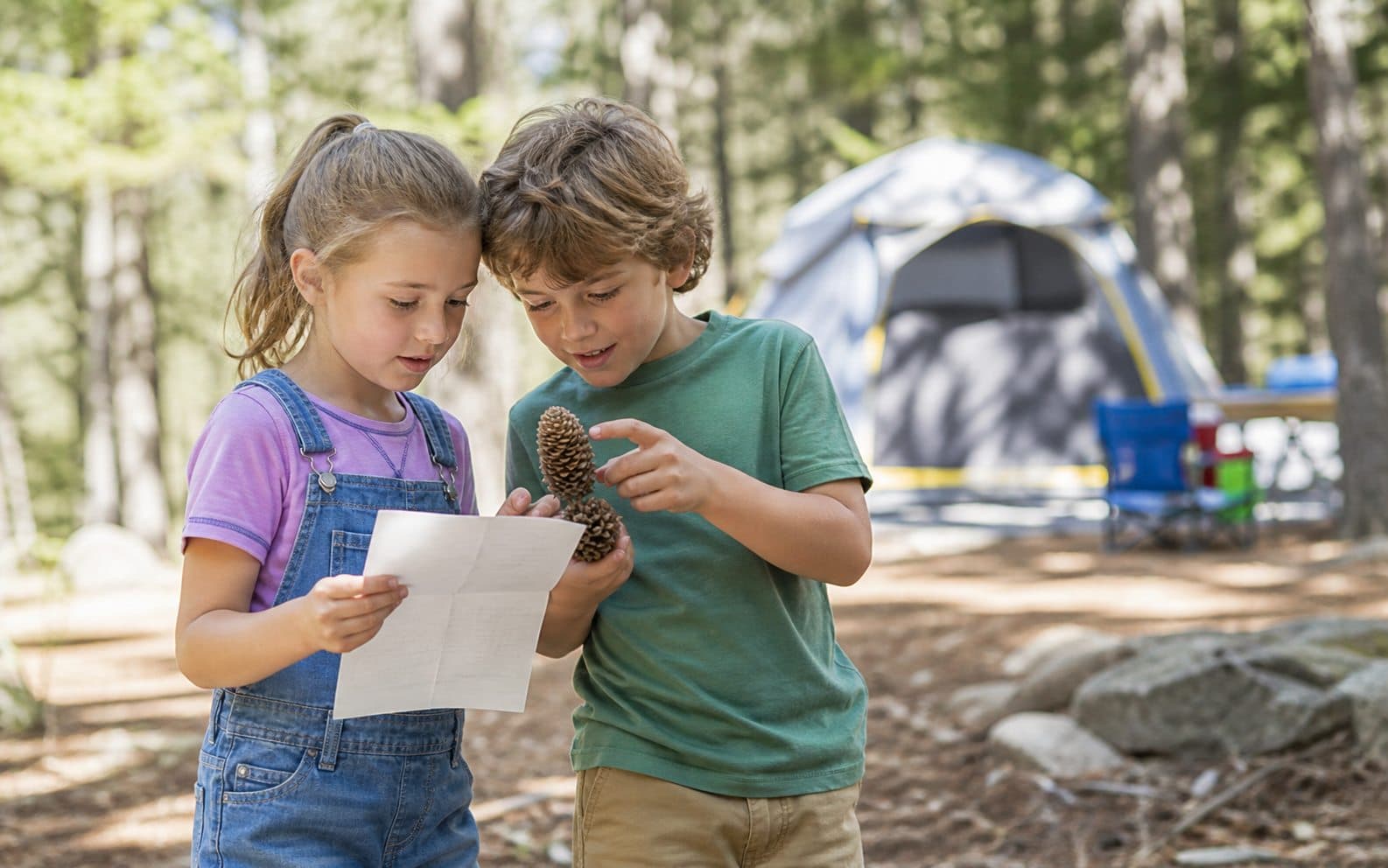
The best camping game is not the longest list on the internet. It is the game that fits the children, space, weather and five minutes of attention you actually have.
Use the picker first. It filters eight games with complete rules below; no email gate, app download or shopping list required.
Keepsake Camp game picker
Find a game for this group
Filter by the youngest player, group size, available space and energy. Every result links to complete rules below.
Age, group-size and time ranges are editorial operating ranges. They help preserve pace and ease of supervision; they are not hard safety boundaries.
8 recommended games
- Campsite Charades →
Ages 4–12 · 3–20 players · 15 min
Quiet, weather-flexible and easy to scale for mixed ages.
- I’m Going Camping →
Ages 5–12 · 2–20 players · 10 min
A no-gear memory game for a picnic table, tent or waiting line.
- Animal Movement Relay →
Ages 3–9 · 4–24 players · 15 min
A relay that works without speed being the only way to contribute.
- Color Corners →
Ages 4–10 · 4–20 players · 12 min
Fast rounds with visible boundaries and almost no explanation.
- Nature Detective →
Ages 5–12 · 2–12 players · 20 min
Observation prompts turn a short walk into a game without collecting nature.
- Sock Toss Targets →
Ages 3–12 · 2–16 players · 15 min
Adjustable distances make one game work for siblings of different ages.
- Sound Map →
Ages 4–12 · 1–12 players · 10 min
A genuine wind-down activity that rewards listening instead of volume.
- Spoon-and-Ball Relay →
Ages 5–12 · 4–20 players · 15 min
A reusable relay with simple rules and no balloon debris.
Quick decision table
| Situation | Start with | Why it fits |
|---|---|---|
| One or two children | Nature Detective or Sound Map | No team structure required |
| Mixed ages | Sock Toss Targets | Each child can use a different throwing line |
| High energy and level open space | Animal Movement Relay | Short rounds and visible boundaries |
| Rain or a small covered area | Campsite Charades | No running or equipment |
| Kids need to settle before bed | I’m Going Camping | Seated, predictable and easy to stop |
| A larger multi-family group | Color Corners | Everyone plays at once without elimination |
Age labels are starting points, not guarantees. Use the youngest participant's ability, mobility, communication needs and comfort—not the oldest child's enthusiasm—to set the pace.
The five rules before any game
- Set a visible boundary. Use trees, cones, chairs or a clear section of level ground. Roads, neighboring sites, water, fire rings and steep terrain stay outside it.
- Walk the area first. Remove loose equipment and identify roots, holes, hot surfaces, poison plants or other hazards without disturbing the site.
- Choose an adult stop signal. One whistle pattern or a clear word ends the round immediately.
- Keep elimination short. Prefer points, roles or quick rotations so a child is not watching everyone else play for twenty minutes.
- Match the activity to current conditions. Heat, smoke, lightning, darkness and campground quiet hours override the schedule.
1. Campsite Charades
Ages: 4–12. Players: 3–20. Time: 15 minutes. Space: picnic table, tent or covered shelter. Equipment: none.
One player silently acts out a camping prompt while the group guesses. Use familiar prompts for younger children—pitching a tent, paddling, seeing a squirrel, putting on a backpack—and more specific ones for older players.
Give each actor 45 seconds. A correct guess earns one point for the group, not only the person who shouted first. The shared score keeps quieter children involved and avoids turning every round into a volume contest.
Make it easier: let the actor choose from two whispered prompts. Make it harder: use only animal movements or campsite jobs.
2. I’m Going Camping memory game
Ages: 5–12. Players: 2–20. Time: 10 minutes. Space: anywhere seated. Equipment: none.
The first player says, “I’m going camping, and I’m bringing a tent.” The next repeats the tent and adds one item. Continue around the circle, repeating the growing list in order.
When somebody forgets, let the group offer one clue and continue. Nobody needs to be eliminated. For younger players, cap the chain at eight items, celebrate the completed list and begin a new category such as camp foods or animals.
This is our first choice when dinner needs ten more minutes and everyone has already asked twice.
3. Animal Movement Relay
Ages: 3–9. Players: 4–24. Time: 15 minutes. Space: level open ground. Equipment: two visible turnaround markers.
Split players into small, balanced teams. Call one movement for each round: bear walk, frog hop, tiny mouse steps or slow heron steps. One player travels to the marker and back, then tags the next.
Keep the course short enough that movement remains controlled. Walking is always an accepted alternative. Run three rounds and change the animal each time; do not use speed to rank children across different ages or mobility levels.
Safety: no blindfolds, backward running or movements that put heads near hard ground. Stop if the surface becomes wet or crowded.
4. Color Corners
Ages: 4–10. Players: 4–20. Time: 12 minutes. Space: bounded open area. Equipment: four colored objects or paper cards.
Place one color at each corner of the play area. One caller closes their eyes and counts slowly from five while everyone walks—not sprints—to a corner. The caller names a color. Players at that corner earn a point, perform a simple movement or become the next callers.
Avoid elimination. Five quick rounds work better than a long game in which half the group stands outside the boundary.
For children who should not move quickly, replace corners with four colored cards on a picnic table and let players point or place a token.
5. Nature Detective
Ages: 5–12. Players: 2–12. Time: 20 minutes. Space: campsite or short supervised walk. Equipment: none, or a camera.
Give the group observation prompts: find two leaf shapes, hear three different sounds, spot evidence that an animal was present, or find a natural object shaped like a letter.
Players point, photograph or sketch. They do not collect. Rocky Mountain National Park uses observation, sounds and animal signs in its Junior Ranger activities and tells children not to feed or approach wildlife.
Use the dedicated nature scavenger hunt builder when you want a printable list by age, season and setting.
6. Sock Toss Targets
Ages: 3–12. Players: 2–16. Time: 15 minutes. Space: small campsite or covered shelter. Equipment: rolled pairs of socks and containers.
Place three containers at increasing distances. Each player gets three tosses: one point for the closest target, two for the middle and three for the farthest.
Move the throwing line for each child rather than insisting everyone use the same distance. Run individual practice first, then a cooperative round where the group tries to reach a shared total.
Use soft rolled socks rather than rocks, pinecones or food. Keep every target away from tents, vehicles, people and cooking equipment.
7. Sound Map
Ages: 4–12. Players: 1–12. Time: 10 minutes. Space: seated campsite or supervised trail stop. Equipment: paper and pencils are optional.
Everyone sits quietly for one minute. Each time a player hears a sound, they point in its direction or mark it around a dot representing themselves. Compare maps afterward: wind, birds, water, footsteps, a zipper, a distant vehicle.
The goal is observation, not perfect identification. Younger children can count sounds on their fingers. Older children can separate human, animal and weather sounds.
Use this when the group needs to downshift. Calling it “mandatory quiet time” has noticeably worse branding.
8. Spoon-and-Ball Relay
Ages: 5–12. Players: 4–20. Time: 15 minutes. Space: level open ground. Equipment: one spoon and reusable soft ball per team.
Teams line up behind a start line. Each player carries the ball on the spoon to a marker and back, then hands both to the next teammate. If the ball falls, the player stops, replaces it where it landed and continues.
Walking is the default. Increase difficulty by lengthening the route slightly, not by requiring running. Use a ball too large to be a choking hazard for the youngest child present, and follow the product's age guidance.
Turn the games into a camp field day
For twelve or more children, create three supervised stations instead of making the whole group wait through one activity:
- active station: Animal Movement Relay or Color Corners;
- skill station: Sock Toss or Spoon-and-Ball Relay;
- calm station: Charades, Sound Map or Nature Detective.
Rotate every 10–15 minutes. Put the clearest adult communicator at the active station, not automatically the most competitive one. Finish while the games are still working; a field day does not improve merely because the schedule has an empty fourth hour.
What to pack
A useful reusable game bag contains:
- four colored cards or fabric squares;
- six rolled pairs of socks;
- three collapsible containers or targets;
- two large soft balls and two spoons;
- paper, pencils and a small timer;
- the printed rules.
That kit supports all eight games and leaves no water-balloon cleanup. For evenings, use campfire games. For bad weather, compare rainy-day camping activities.
FAQ
What camping game works for mixed ages?+
Sock Toss Targets is the easiest starting point because each child can use a different throwing line while sharing the same rules. Campsite Charades also works when prompts are adjusted by age.
What are good no-equipment camping games for kids?+
Campsite Charades, I’m Going Camping and Nature Detective need no dedicated equipment. Sound Map can also be played by pointing and counting instead of drawing.
What camping games work in the rain?+
Use a substantial covered area that is safe for the current weather, then choose seated or low-movement games such as Campsite Charades, I’m Going Camping, Sound Map or Sock Toss Targets. An open picnic shelter is not lightning shelter.
Why are balloon games excluded?+
Broken and deflated balloons create cleanup and choking hazards. The CPSC advises keeping deflated balloons away from children under eight, so this guide uses reusable soft balls and rolled socks instead.
Sources reviewed
Fact-checked Aug 30, 2026
These references support factual or safety-sensitive claims in this article. Access dates show when our editors last verified the source.
- U.S. Consumer Product Safety Commission — Toy Safety
Official source · Accessed Aug 30, 2026
- Rocky Mountain National Park — Junior Ranger Activities for Ages 5 and Under
Official source · Accessed Aug 30, 2026