family / activities
Nature Scavenger Hunt for Kids: Build and Print One
Build a printable nature scavenger hunt by age, season and setting, with look-don't-collect prompts and rules that protect children and the site.
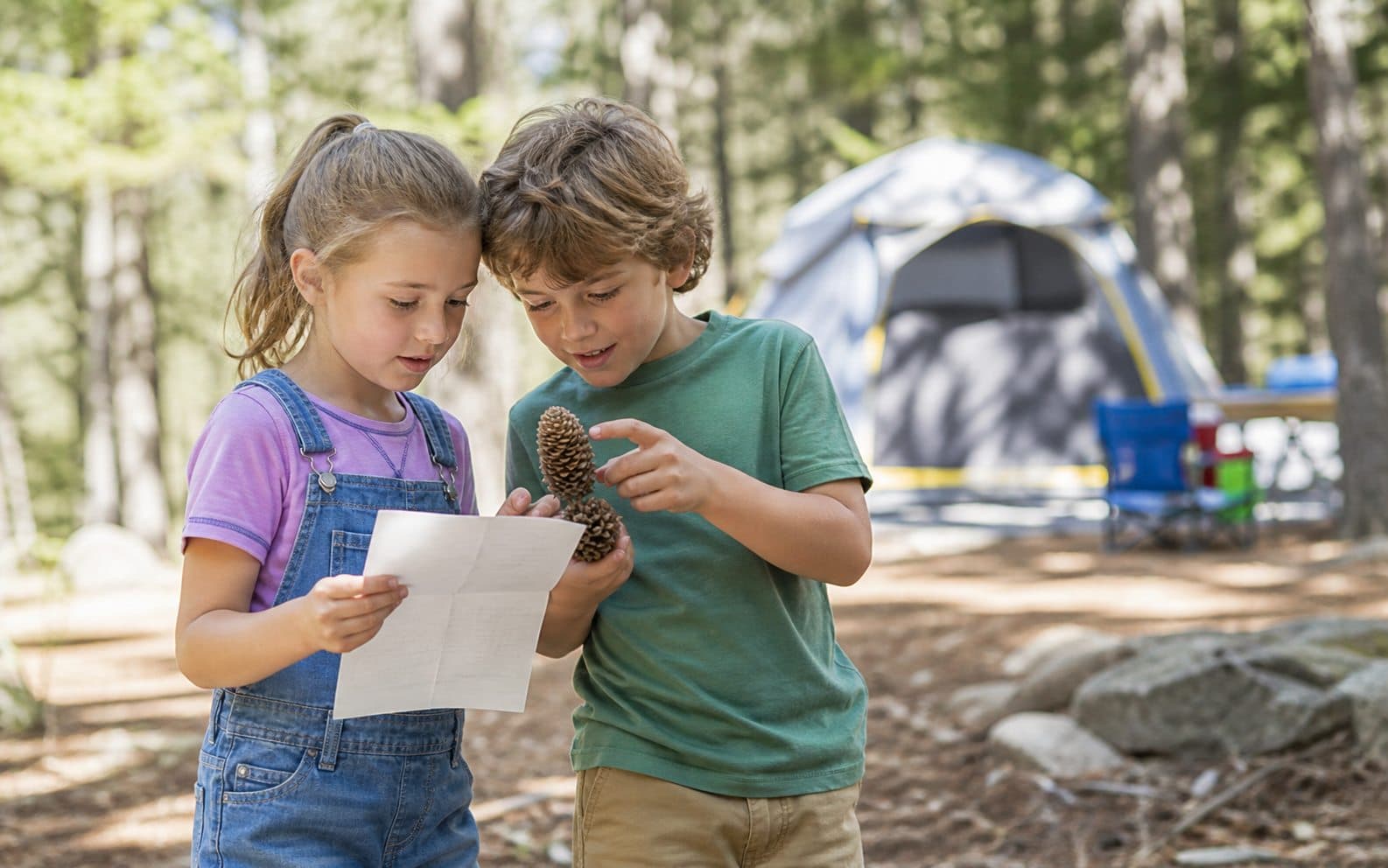
A useful nature scavenger hunt asks children to notice more without collecting more. Choose the age, season, setting and list length below, then print the result. Every prompt is designed for pointing, photographing, listening or sketching.
Keepsake Camp hunt builder
Build a look-don't-collect hunt
Choose the child's age, season and setting. The prompts change; the rule does not: point, photograph or sketch, then leave every natural item where it belongs.
0 of 8 found · summer · campground
Stay within the adult-set boundary. Do not touch wildlife, nests, scat, unknown plants or mushrooms. Follow the site's current trail, shoreline and collecting rules.
The rule that changes the whole hunt
Do not hand out collection bags. Hand out a pencil, camera or imaginary detective badge.
The National Park Service recommends photo scavenger hunts as a way to enjoy natural objects without removing them. Leaves, sticks, rocks and even dead material still play roles in the ecosystem, and site-specific regulations may prohibit collecting them.
Use this instruction before starting:
Find it. Point to it or record it. Leave it where it is.
That makes the rules clearer for children and the cleanup considerably lighter for adults.
Choose the hunt by age
| Youngest child | Best prompt style | Good list length | Adult role |
|---|---|---|---|
| 3–4 | Colors, textures, simple shapes and sounds | 4–6 | Stay together and read each prompt aloud |
| 5–7 | Categories, comparisons and obvious animal signs | 6–8 | Set the boundary and help interpret clues |
| 8–10 | Multiple observations, simple identification and inference | 8–10 | Ask how they know rather than supplying answers |
| 11–12 | Evidence, patterns and ecosystem relationships | 8–12 | Let them document findings and defend choices |
These ranges are starting points. A younger child with strong nature knowledge may want harder prompts; an older child may prefer a shorter hunt with photography or drawing. Difficulty should come from observation, not from sending children farther away.
Set the boundary before the timer
A hunt needs a physical limit that children can recognize:
- At a campground: stay within the campsite loop segment or between named landmarks; roads and other occupied sites are outside the game.
- On a trail: remain on the permitted route and within the adult's agreed distance.
- Near water: use a boundary well back from the edge; shore access, current, cold water and local rules determine whether the area is suitable.
- In a group: use pairs or small teams and one fixed meeting point.
Do not use “where you can still hear me” as the boundary. Campgrounds are remarkably efficient at turning one voice into several indistinguishable voices.
Set a return time, but do not make speed the main scoring system. A race rewards the person who looks least carefully and runs most quickly—the opposite of the activity.
What children should not touch
Observation does not require handling. Children should not touch:
- wildlife, nests, eggs or dens;
- scat, bones or animal remains;
- mushrooms or unknown plants;
- cultural objects, fossils or artifacts;
- poison ivy or other locally hazardous plants;
- sharp litter, fishing hooks or broken glass;
- moving water, unstable banks or ice.
If a child spots something unsafe or culturally significant, mark the location from a safe distance and tell a ranger or campground employee. Do not turn “bonus points” into an incentive to approach it.
Rocky Mountain National Park's Junior Ranger material uses animal signs, outdoor sounds and scavenger prompts while telling children not to feed or approach wildlife and to leave natural objects in place. That is the model here: observe first, protect the subject second, score the game third.
Three ready-to-use hunt formats
Picture hunt for ages 3–4
Use six large symbols or drawings:
- something green;
- something round;
- something rough;
- something that moves;
- a sound from above;
- a sign made by people.
Read one prompt at a time. A child can point rather than speak, and the group can complete the board together. Ten focused minutes is more useful than insisting every square be finished.
Detective hunt for ages 5–8
Ask children to find:
- two different leaf edges;
- evidence an animal passed through;
- a place where water may collect;
- something shaped by weather;
- three different sounds;
- one human-made object that belongs there;
- one piece of litter to report to an adult;
- a natural hiding place viewed from outside.
The value is in the explanation. “Show me what made you choose that” produces more observation than simply checking the box.
Evidence hunt for ages 9–12
Use prompts that allow more than one defensible answer:
- evidence of decomposition;
- two adaptations to shade, wind, cold or water;
- a relationship between two living things;
- a sign of recent weather;
- a natural pattern that repeats;
- evidence of responsible human use;
- evidence of human impact that should be reported or corrected safely;
- one question the site makes you want to research later.
Do not require species identification unless a reliable field guide or official park resource is available. “I don't know yet” is a valid observation, not a failed hunt.
Seasonal prompts that are actually seasonal
Spring: buds, new leaf color, water movement and signs of nesting viewed from a distance.
Summer: insect movement, shade differences, dry versus damp ground and plant variety without picking.
Fall: leaf-color variation, seed movement, animal food sources and changes in daylight or temperature.
Winter: tracks in snow or mud, evergreen versus leafless trees, frost patterns and locations where snow melts first.
Conditions matter more than the calendar. A winter list built for snow is not useful during a snow-free coastal trip, and spring nesting prompts should never encourage approaching an active nest.
Make it cooperative instead of competitive
For siblings or a multi-family group, give every team a different job:
- spotter finds a possible match;
- recorder checks or sketches it;
- photographer documents it where permitted;
- rule keeper confirms the group stayed within bounds and left the item untouched.
Rotate roles every two prompts. This gives a child who is slower, younger or less comfortable running a meaningful way to contribute.
A shared target—“Can all teams document twelve different observations?”—usually creates better conversation than declaring the first team back the winner.
What to bring
- the printed list or an offline screenshot;
- one pencil per team and a hard surface for writing;
- a camera only if photography is appropriate and permitted;
- weather-appropriate layers and water already required for the outing;
- a local field guide or official park app if identification is part of the plan.
Skip buckets and specimen bags. If you include litter cleanup, adults handle sharp or unknown objects and follow the site's disposal guidance.
For more active choices, use the camping game picker. For poor weather, see rainy-day camping activities. For an evening walk, read night hiking safety first rather than converting this list into an unsupervised after-dark hunt.
FAQ
What should be on a nature scavenger hunt for kids?+
Use observable colors, textures, sounds, shapes, weather signs and animal evidence matched to the youngest child. Avoid prompts that require collecting, touching wildlife or leaving the permitted route.
Can children collect leaves, rocks or pinecones during the hunt?+
Do not assume they can. National Park Service guidance recommends leaving natural objects where they are, and local regulations may prohibit collection. Point, photograph or sketch instead.
How long should a children’s scavenger hunt be?+
Start with 4–6 prompts for ages 3–4, 6–8 for ages 5–7 and 8–10 for older children. End while observation is still working rather than requiring every item to be found.
How do you run a scavenger hunt with mixed ages?+
Use teams and rotate roles such as spotter, recorder, photographer and rule keeper. Adjust individual prompts, but keep one shared boundary and adult supervision plan.
Sources reviewed
Fact-checked Aug 30, 2026
These references support factual or safety-sensitive claims in this article. Access dates show when our editors last verified the source.
- National Park Service — Leave What You Find
Official source · Accessed Aug 30, 2026
- Rocky Mountain National Park — Junior Ranger Activities for Ages 5 and Under
Official source · Accessed Aug 30, 2026