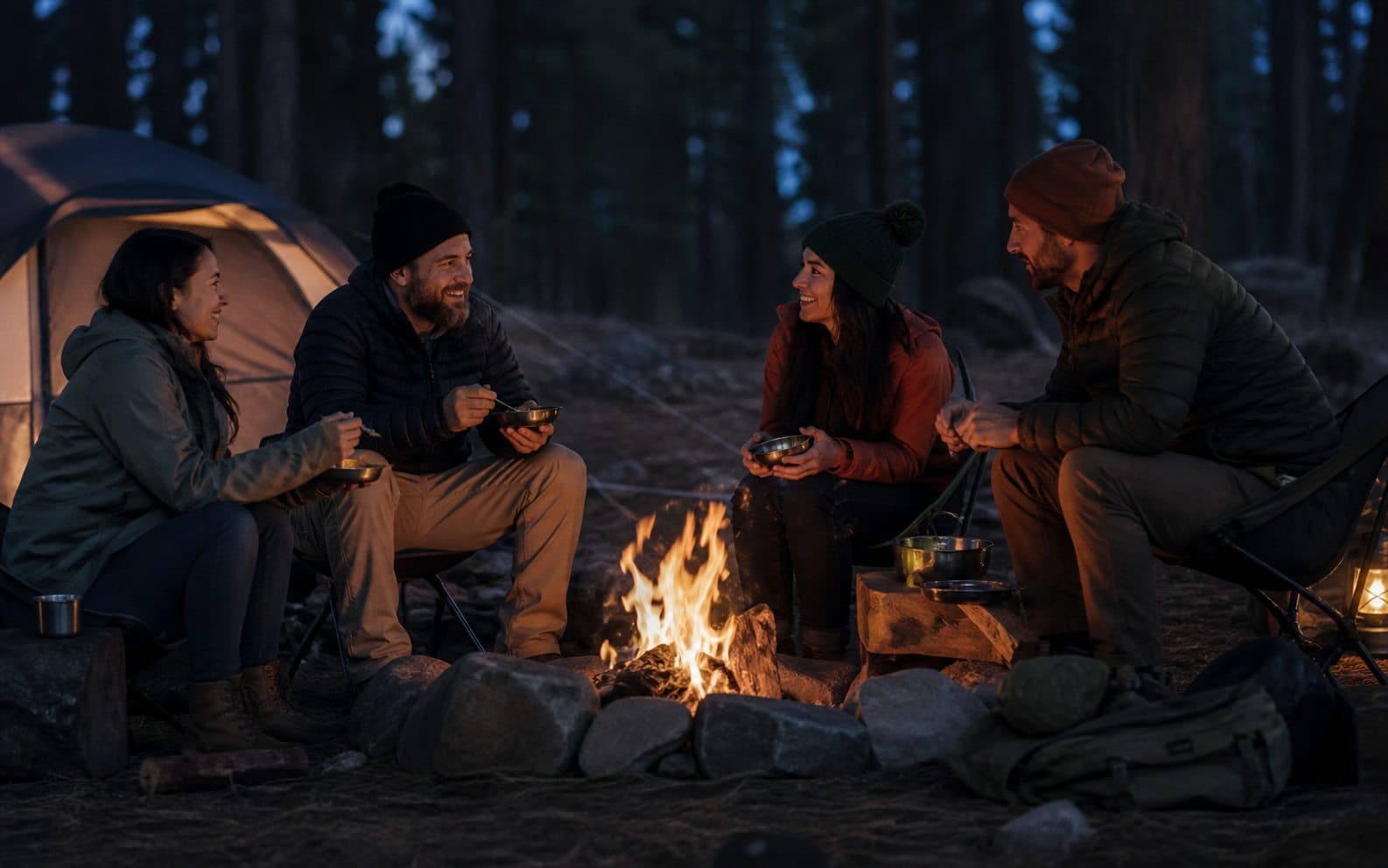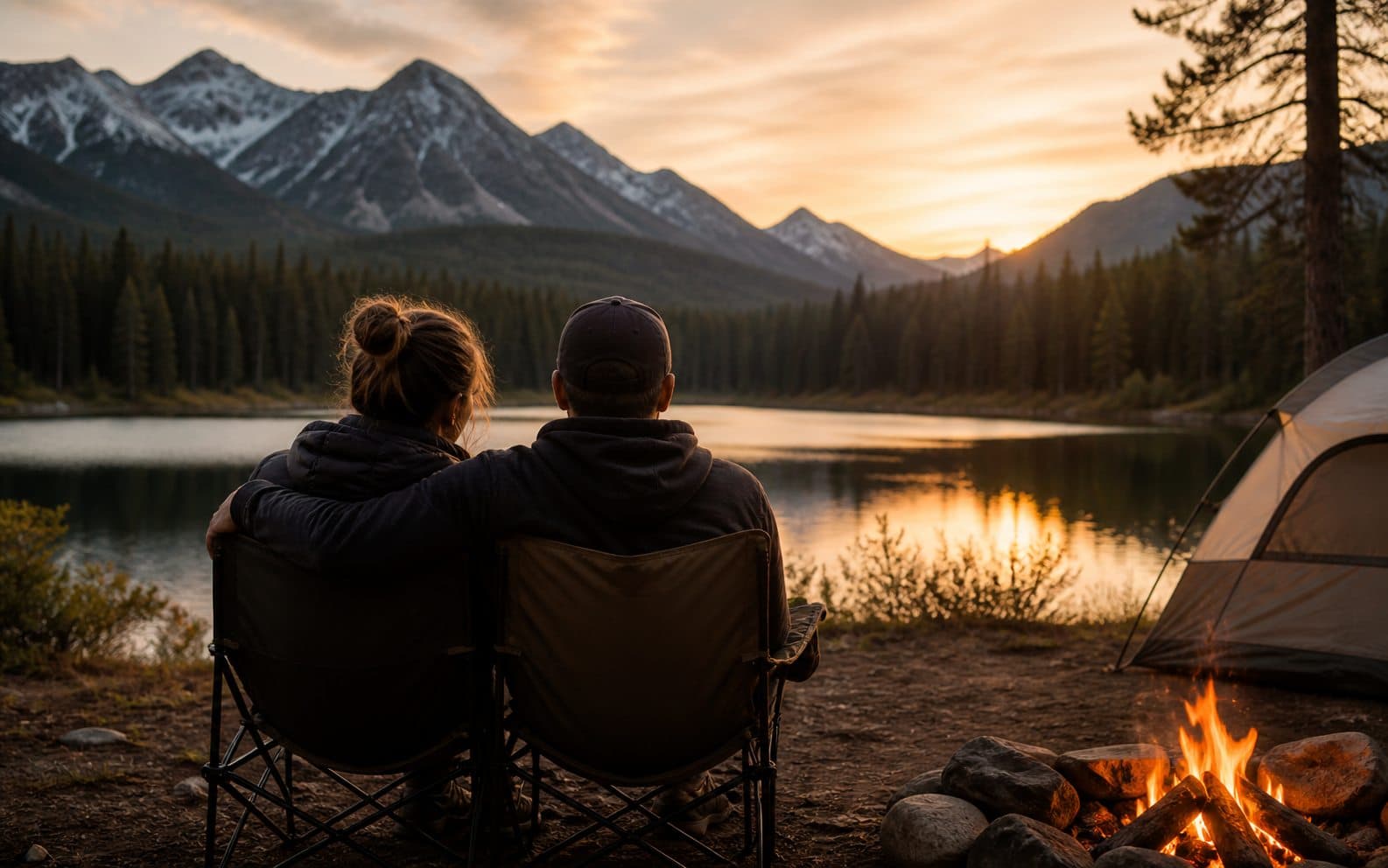
campfire / outdoor activities
Stargazing While Camping
Plan a better stargazing night while camping with a darkness-and-Moon checklist, a 60-minute observing plan, naked-eye targets, and safety guidance.
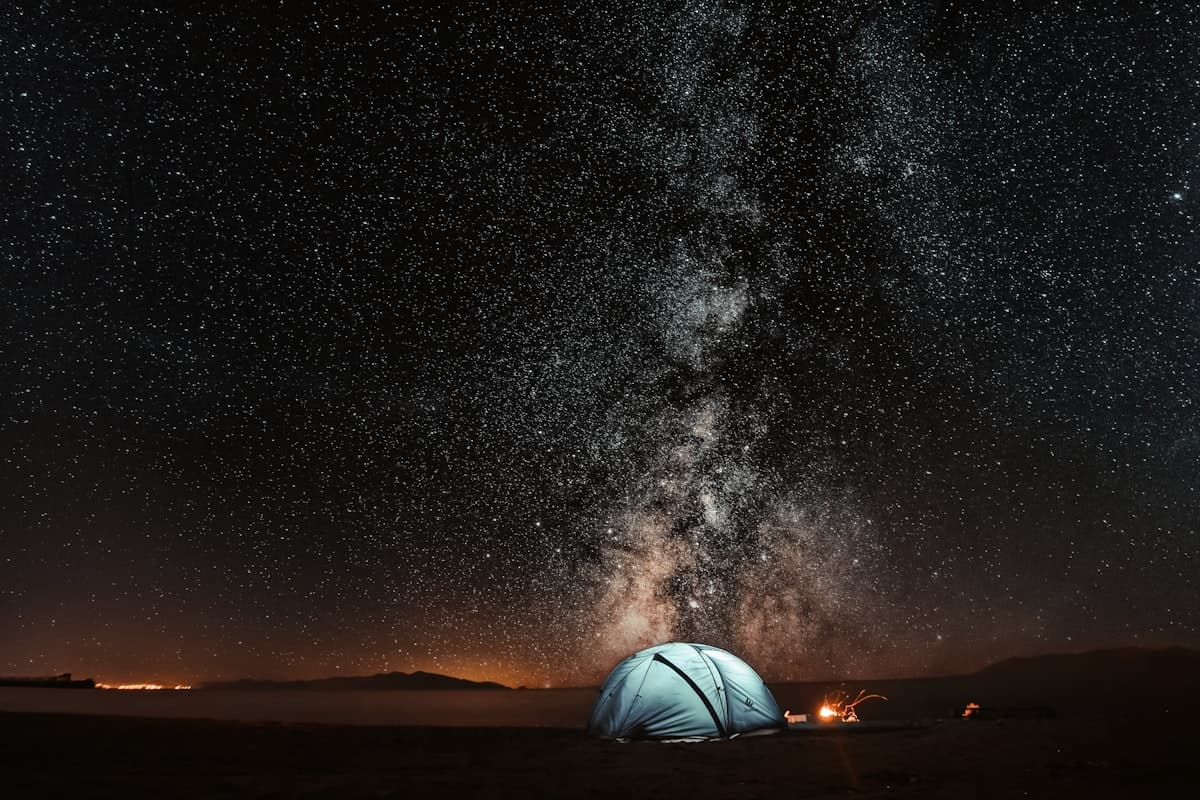
The stars did not forget to show up. Your eyes may simply be five minutes out of lantern light, or the Moon may be doing an excellent impression of a streetlamp.
For a better stargazing night while camping, improve three things before buying anything: site darkness, Moon timing, and about 30 minutes away from bright light. Binoculars can add detail later. Darkness is the upgrade that helps everything.
The five-minute trip check
Check these conditions before driving to a campsite solely for the sky. Forecasts and access rules change, so repeat the check on the day of the trip.
| Check | What you want | What to do if it is not ideal |
|---|---|---|
| Clouds and smoke | A clear forecast and safe air conditions | Move the session to the clearer part of the night; never travel into unsafe smoke |
| Moon | Less moonlight during the object you want to see | Observe the Moon itself, wait until it sets, or save faint targets for another night |
| Darkness | A site away from direct lamps and large light domes | Use trees or terrain to block glare without entering an unsafe area |
| Horizon | An open view in the direction of your target | Choose a safe clearing identified before dark |
| Access | Legal nighttime access and a known route | Confirm campground hours, closures, permits, and local wildlife guidance |
Use NASA's current skywatching guidance to see what is visible for the month. DarkSky International maintains information about certified International Dark Sky Places, but certification covers several kinds of places and conservation programs. Confirm that the specific location offers the darkness, overnight access, and camping rules you need.
Give your eyes about 30 minutes
Dark adaptation is gradual. NASA's beginner guidance says eyes take approximately 30 minutes to adapt to a dark sky, while a bright light can temporarily spoil that sensitivity. Put away white lights, dim the phone as far as practical, and use a dim red light only when needed. Red is gentler on night vision than white, but brighter is still not better.
The first ten minutes can feel underwhelming. Stay put. As your eyes adapt, more stars appear and the sky gains structure. If a vehicle's headlights sweep through the site, you have not failed astronomy; give your eyes time again.
How dark is dark enough?
The Bortle scale is a nine-class visual description of night-sky darkness, not a complete laboratory measurement of all light pollution. Class 1 describes an excellent dark-sky site; Class 9 describes an inner-city sky. DarkSky International uses Bortle observations alongside instruments and photographs in night-sky quality surveys.
Treat a Bortle estimate as a planning clue, because humidity, smoke, snow, nearby lamps, the Moon, and the observer all affect what a particular night looks like.
| Approximate class | What the campsite may feel like | A sensible first target |
|---|---|---|
| 1–3 | Very dark to rural sky; the Milky Way can be prominent when season and Moon cooperate | Milky Way structure, meteors, faint constellations |
| 4–6 | Rural-suburban to bright suburban sky; a light dome may wash out part of the horizon | Bright constellations, Polaris, planets, the Moon |
| 7–9 | Bright suburban to inner-city sky; faint objects are difficult | Moon, bright planets, the brightest stars |
These ranges are expectations, not promises. A dark site under a bright Moon can show less of the Milky Way than a reader expects; a clear moonless night can make the same campsite feel transformed.
What is worth looking for tonight?
Start with one target you can identify, not a frantic tour of everything above the tent.
The Moon
Moonlight competes with faint stars, but the Moon is not a ruined stargazing night. Its craters and the line between light and shadow are rewarding through binoculars. If the Moon is bright, make it the plan instead of spending an hour resenting it.
The Milky Way's bright central region
At mid-northern latitudes, the bright region toward the centre of our galaxy is associated with Sagittarius and is best placed in the southern sky during summer evenings. NASA/JPL's July skywatching guidance shows how the Teapot-shaped star pattern in Sagittarius can point toward it. Exact visibility depends on latitude, date, time, darkness, clouds, smoke, and moonlight; check a current sky map rather than treating "summer" as a guarantee.
The Big Dipper and Polaris
From many northern locations, extend an imaginary line through the two stars at the outer edge of the Big Dipper's bowl to find Polaris. The pattern's height and orientation change with latitude, season, and time, and obstructions can hide it. Polaris appears to move very little because it lies close to the north celestial pole.
Meteor showers
Annual showers such as the Perseids and Geminids are worth planning around, but the predicted peak, Moon, weather, and your location all matter. Check a current calendar from an astronomy authority shortly before the trip. Meteors can appear anywhere in the sky, so a wide unaided-eye view is often more useful than a telescope.
Planets
Bright planets often look steadier than stars because atmospheric turbulence affects their apparent disks differently, but "it does not twinkle" is only a clue, not proof. Objects low on the horizon can shimmer, and not every bright point is a planet. Confirm the object with a current sky map.
Use averted vision for faint detail
If a faint patch disappears when you stare directly at it, look slightly beside it. This is called averted vision. Rod cells, which are sensitive in dim light, are more concentrated away from the centre of the retina, so an off-centre view can reveal a faint object more clearly.
Move your gaze just to one side rather than dramatically turning your head. The technique helps with subtle Milky Way structure and faint objects; it will not rescue a clouded or brightly lit sky.
A printable 60-minute stargazing plan
Copy this into your trip notes or print the page. Choose the targets before dark so the session does not become 45 minutes of downloading an app on one bar of signal.
Before sunset
- Confirm legal access, weather, smoke, Moon timing, and park alerts.
- Inspect the observing spot in daylight for roots, water, cliffs, roads, and wildlife concerns.
- Download a current sky map for the campsite and date.
- Set headlamps to dim red mode and keep a white light accessible for safety.
- Choose three targets: easy __________, medium __________, bonus __________.
After dark
| Minutes | What to do | Why |
|---|---|---|
| 0–10 | Settle into the known safe area; switch off bright lights | Starts dark adaptation without walking around blindly |
| 10–30 | Find one bright landmark and let your eyes adjust | Gives sensitivity time to improve |
| 30–45 | Try the medium target and averted vision | Uses your better-adapted vision for fainter detail |
| 45–55 | Scan broadly for meteors or compare different parts of the sky | Adds discovery without needing equipment |
| 55–60 | Record what you saw and leave with lights on as needed | A safe exit matters more than preserving night vision |
What we actually saw: ______________________________________________
What changed the view: _____________________________________________
What we will try next time: ________________________________________
Campfire timing without sabotaging the sky
If faint stars are the priority, stargaze before lighting the fire. If the group wants the fire first, extinguish it completely and then allow roughly 30 minutes away from bright flames, lanterns, and screens before expecting dark-adapted vision. Glowing coals and campsite lights still add light.
Never compromise fire safety for darkness. Follow current restrictions, keep the required water and tools nearby, and put the fire out completely before leaving it.
Pair the session with camping activities for adults, or use a constellation round from best campfire games while everyone is learning the sky.
Stargaze safely
The safest dark spot is one you already inspected in daylight. The National Park Service recommends learning the terrain before dark and, when leaving camp at night, going with a companion and carrying a headlamp. Keep the light accessible even while preserving night vision. Stay away from water edges, cliffs, roads, and unfamiliar trails, and follow current wildlife and closure guidance.
Sources
- NASA Night Sky Network: stargazing for beginners and dark adaptation
- NASA/JPL: finding the Milky Way's centre from mid-northern latitudes
- NASA: why stars and planets appear to twinkle differently
- NASA Night Sky Network: averted vision
- DarkSky International: conducting a night-sky quality survey
- National Park Service: finding and setting up a campsite safely
FAQ
How long does it take for your eyes to adjust to the dark for stargazing?+
Allow about 30 minutes away from bright light. Adaptation is gradual, and a bright phone, lantern, or vehicle headlight can temporarily reduce it. Use only a dim red light when practical, but keep a brighter safety light accessible.
What is the best time of year to see the Milky Way while camping?+
At mid-northern latitudes, the bright central region is well placed toward the southern sky on summer evenings, but latitude, date, time, darkness, moonlight, clouds, and smoke all affect visibility. Check a current sky map for the campsite rather than relying on season alone.
Do you need special equipment to stargaze while camping?+
No. For a first session, a darker safe site, favourable Moon timing, clear conditions, and about 30 minutes of dark adaptation matter more than a telescope. Binoculars are a useful optional next step.
Can you stargaze when the Moon is bright?+
Yes. Bright moonlight makes faint targets such as Milky Way structure harder to see, so observe the Moon, bright planets, and bright stars instead, or wait until the Moon sets if it does so during your session.
Sources reviewed
Fact-checked Sep 4, 2026
These references support factual or safety-sensitive claims in this article. Access dates show when our editors last verified the source.
- NASA — Current Skywatching Guidance
Official source · Accessed Sep 4, 2026
- NASA Night Sky Network — Dark Adaptation
Official source · Accessed Sep 4, 2026
- NASA JPL — Finding the Milky Way Centre
Official source · Accessed Sep 4, 2026
- DarkSky International — International Dark Sky Places
Expert guidance · Accessed Sep 4, 2026
- National Park Service — Campsite Safety
Official source · Accessed Sep 4, 2026