campfire / games
Camping Trivia
Twenty fact-checked camping trivia questions, a separate answer key, a gentle difficulty progression, tiebreakers and a score sheet.
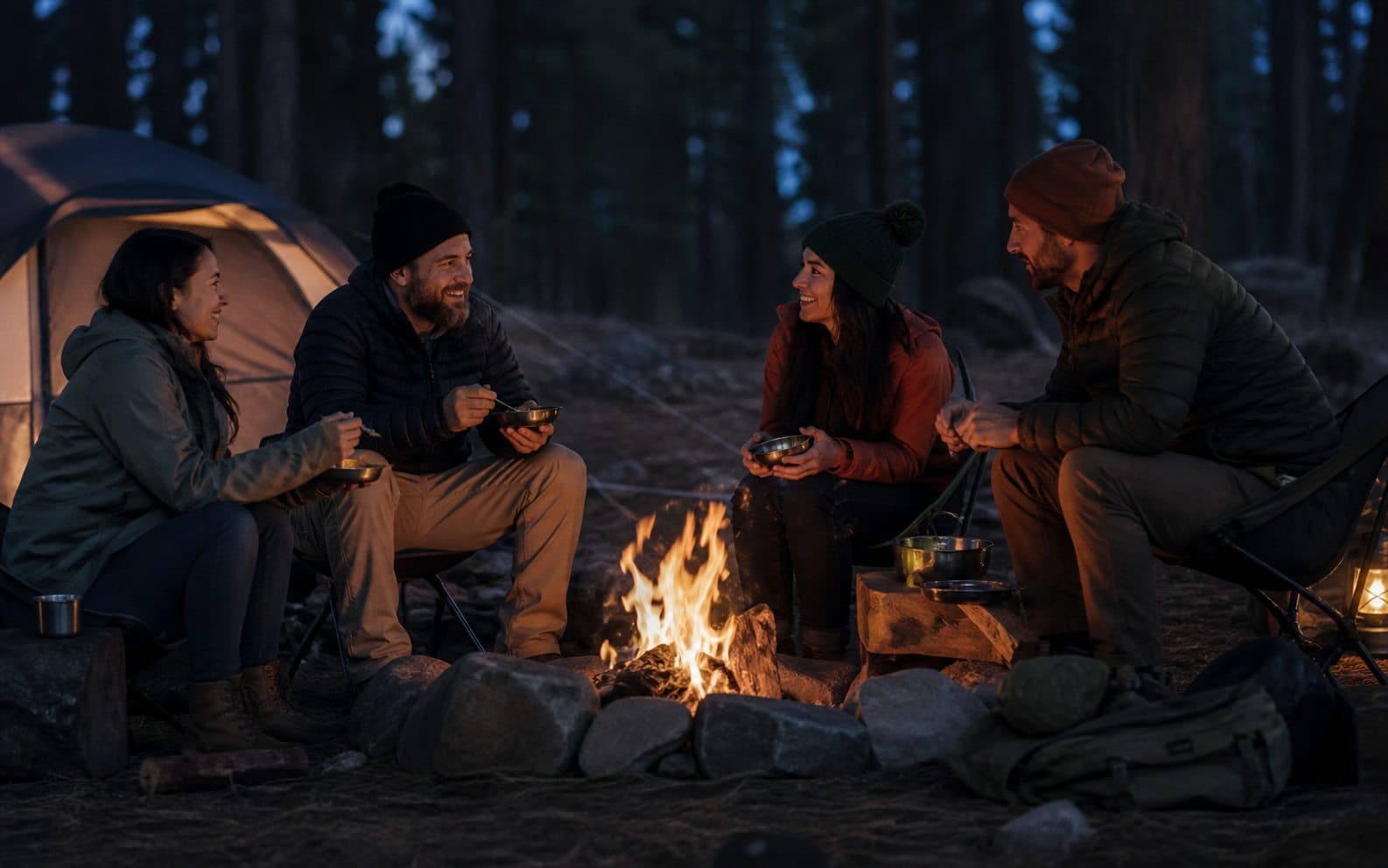
Twenty questions, four categories, one answer key at the end. You can run this directly from a phone without letting the players see the answers. The first two questions in each round are approachable, the next two are medium, and the fifth is the one that makes at least one confident camper stare suspiciously into the fire.
Fast setup: make teams, read five questions per round, give 30 seconds for each answer, and award one point per correct answer. Use the tiebreakers only if needed.
How to run it
Split into teams of 2–4, or play individually if the group is small. One person reads each question aloud; teams write their answers before anything is revealed. A complete game takes about 20–25 minutes.
| Round | Team 1 | Team 2 | Team 3 | Team 4 |
|---|---|---|---|---|
| National parks | /5 | /5 | /5 | /5 |
| Gear and skills | /5 | /5 | /5 | /5 |
| Wildlife and nature | /5 | /5 | /5 | /5 |
| Quick-fire | /5 | /5 | /5 | /5 |
| Total | /20 | /20 | /20 | /20 |
For mixed-experience groups, let teams use one trail pass: before hearing the answer, they can trade one hard question for half a point. It prevents the person who owns three topographic maps from becoming the evening's only functioning institution.
National parks
- Which national park was the first ever established, in 1872?
- What's the largest national park in the United States by area?
- Among sites carrying the designation “National Park,” which is the smallest in the United States by area?
- Which was the most-visited U.S. national park in 2025?
- What Canadian national park contains Lake Louise and the southern section of the Icefields Parkway?
Gear and skills
- What does the "R-value" of a sleeping pad measure?
- According to Lodge's coal chart, how many standard briquettes start a 12-inch camp Dutch oven near 350°F?
- What temperature range does food safety guidance call the "danger zone" for bacteria growth?
- On a topographic map, what do closely spaced contour lines indicate?
- In the NPS backcountry guidance used for this quiz, how far should food be stored from your tent: 100 feet, 100 yards, or one mile?
Wildlife and nature
- Brown bears and inland grizzly bears belong to what scientific species?
- Why does water boil at a lower temperature at high altitude?
- Name two physical traits that help distinguish a brown/grizzly bear from a black bear without using fur colour.
- True or false: all mosquitoes bite mainly at dawn and dusk.
- What is the difference between a snag and a widowmaker?
Quick-fire
- True or false: a “four-person” label guarantees comfortable space for four adults plus their gear.
- Before thinking about wind direction, what three campsite hazards should influence where you pitch a tent?
- How long can perishable food generally remain above 40°F before it must be discarded?
- What's the name for camping without a tent, sleeping directly under the sky?
- According to REI's tent designers' wind-tunnel testing, should a tent stake be driven vertically or at a 45-degree angle for maximum holding power in most soil?
Answer key
- Yellowstone National Park (1872) — the National Park Service calls it the world's first national park.
- Wrangell-St. Elias National Park and Preserve, Alaska — 13.2 million acres, the largest unit in the U.S. National Park System.
- Gateway Arch National Park, Missouri — about 91 acres. Smaller NPS units exist under other designations; this question compares places formally designated “National Park.”
- Great Smoky Mountains National Park, straddling Tennessee and North Carolina — the most-visited U.S. national park in 2025, with 11,527,939 recreation visits.
- Banff National Park, Alberta — home to Lake Louise and the Icefields Parkway's southern section; the road continues north into Jasper National Park.
- Insulation from ground cold — a higher R-value means better insulation against the cold ground beneath you, separate from the pad's cushioning comfort.
- 25 briquettes — Lodge's chart starts a 12-inch oven near 350°F with 17 on the lid and 8 below. Wind, cold, charcoal type and the recipe change the heat, so this is a starting point rather than a universal formula.
- 40°F to 140°F — the range the USDA calls the "danger zone," where bacteria multiply fastest.
- Steep terrain — the closer together the lines, the steeper the slope.
- 100 yards — the NPS general camping guidance used here. Local rules can differ, and a designated food locker or campground rule overrides a quiz answer.
- Ursus arctos — “brown bear” and “grizzly bear” are geographic common names for the same species.
- Lower air pressure at altitude — less pressure means water molecules escape into vapor at a lower temperature, which is why high-altitude cooking often needs longer times.
- Use a combination. Brown/grizzly bears typically show a shoulder hump, dished facial profile, shorter rounded ears and longer front claws; black bears lack the hump and usually have a straighter profile, taller ears and shorter curved claws. Colour alone is unreliable.
- False. Many species peak around dawn, dusk or night, while others bite during the day. The CDC advises protection across the day and night where mosquito-borne disease is a risk.
- A snag is a dead tree still standing; a widowmaker is a dangerous dead, broken or suspended branch that may fall. Both belong in the overhead-hazard check before pitching.
- False. Capacity labels describe intended occupancy, not a universal comfort allowance for bodies and gear. Compare floor dimensions with your actual sleep system; sizing up is a practical preference, not a technical rule.
- Drainage, overhead hazards and exposure. Avoid depressions or runoff paths, dead trees or hanging limbs, and exposed locations first. Then use the manufacturer's pitch guidance and orient openings or guylines for the actual wind.
- 2 hours — or 1 hour above 90°F. USDA guidance says to discard the food after that limit; cooling it again does not reset its safety.
- Cowboy camping — sleeping directly under the sky with a pad and sleeping bag, no tent.
- Vertically — REI's current expert guidance says a fully vertical stake gives maximum holding power in most soil. Guyline direction and soil still matter, so follow the shelter manufacturer's instructions.
Tiebreakers
Ask both teams to write a number. Closest answer wins; no phone calculators, because this is a campfire, not quarterly reporting.
- How many recreation visits did Great Smoky Mountains National Park record in 2025? Answer: 11,527,939.
- How large is Wrangell-St. Elias National Park and Preserve? Answer: 13.2 million acres.
If both teams are equally close, settle it with a 30-second challenge: name as many items as possible that should never be stored loose in a tent in bear country. Food, trash, toothpaste, sunscreen and bug repellent all count.
Scoring and variants
One point per correct answer is the simplest scoring system. For experienced groups, announce one wager question before each round and allow a bet of zero to three points. Do not make every question a wager unless your goal is to turn a relaxed evening into an audit.
Pair this with camping games for adults or best campfire games if the group wants more after a round of trivia, and our funny campfire jokes work well as the wind-down once scores are settled.
Sources and fact-checking
The answers were rechecked on 4 September 2026. Park history, size and visitation use the NPS Yellowstone history, NPS system FAQ, Gateway Arch nature page and 2025 visitation release. The Banff answer uses Parks Canada. Gear and map answers use the Lodge coal chart, USGS map guide and REI tent setup guidance.
Safety and nature answers use NPS guidance for bear identification, food storage and hazard trees; USDA guidance for camp food safety and high-altitude cooking; and the CDC Yellow Book mosquito guidance. Tent capacity and the term “cowboy camping” vary by manufacturer and community, so those two answers are framed as practical usage rather than universal standards. Local park rules always override general guidance.
FAQ
How many questions should a camping trivia game have?+
20 questions runs about 20–25 minutes at a relaxed pace — enough to feel substantial without dragging once the answers get harder to guess.
What topics work well for camping trivia?+
National parks, gear and skills, and wildlife are reliable categories — they're broad enough that most groups have at least a few strong guessers per category, which keeps the game competitive.
Sources reviewed
Fact-checked Sep 4, 2026
These references support factual or safety-sensitive claims in this article. Access dates show when our editors last verified the source.
- National Park Service — 2025 visitation
Official source · Accessed Sep 4, 2026
- USDA — food safety while camping
Official source · Accessed Sep 4, 2026
- USGS — topographic map symbols
Official source · Accessed Sep 4, 2026
- Parks Canada — Banff National Park
Official source · Accessed Sep 4, 2026
- Lodge Cast Iron — camp Dutch oven coal chart
· Accessed Sep 4, 2026
- National Park Service — bear identification
Official source · Accessed Sep 4, 2026
- CDC Yellow Book — mosquito activity
Official source · Accessed Sep 4, 2026
- REI — tent setup
· Accessed Sep 4, 2026