guides / camping tips
Best Family Tents: A Fit-First Buying Guide
Choose a family tent by usable sleeping space, campsite fit, weather, setup effort and storage—not a person rating or a universal winner.
The best family tent is not automatically the one with the highest capacity, tallest ceiling or longest feature list. It is the smallest shelter that comfortably fits your actual sleepers and sleep system, works on the campsites you use, handles the weather you accept, and can be pitched by the adults who will really pitch it.
That answer is less glamorous than crowning a polyester palace “best overall.” It is also more likely to keep everyone dry without requiring a campsite the size of a suburban driveway.
The 60-second family tent decision
Start with your most common trip—not the imaginary expedition that appears whenever outdoor gear is on sale.
| Your usual situation | Prioritize | Acceptable tradeoff | Be cautious with |
|---|---|---|---|
| Two adults and one or two young children at developed campgrounds | Floor layout, simple setup, ventilation, two useful doors | Moderate packed weight | A nominal capacity that leaves no room for a crib or bags |
| Family of four using wide pads or air mattresses | Exact floor dimensions, door width, vertical wall space | A larger packed volume if the vehicle can carry it | Choosing by “4-person” alone |
| One adult often pitches while supervising children | Repeatable solo setup, reachable clips, fewer ambiguous parts | Less headroom or fewer rooms | Very tall tents that require two people to control |
| Windy, exposed or shoulder-season sites | Lower profile, manufacturer-rated season, full coverage fly, structural guylines | Less standing room and mesh | Tall cabin walls chosen only for livability |
| Rainy multi-day family trips | Covered entry, ventilation, fly coverage, usable indoor floor area | More setup time | Screen rooms or awnings that are not protected in wind-driven rain |
| Walk-in campsites or a small car | Packed size, carry weight, number of bags | Less furniture-like interior space | Treating weight as irrelevant because the trip is “car camping” |
If two tents survive this first pass, compare their floor dimensions, peak height shape, doors, vestibules, packed size and setup system. Price comes after fit: a bargain tent that does not fit the pad layout is simply an unusually large receipt holder.
You can also open the Keepsake Camp Gear Finder to filter researched tents, see why each result matches and compare products from the same category. Missing specifications remain visible rather than being filled with guesses.
1. Draw the sleeping layout before choosing capacity
A tent's “person” rating is closer to maximum pad occupancy than a comfort promise. Coleman says a four-person model generally means four sleeping-bag-size pads placed close together. REI likewise recommends considering the people, pets, gear and living space that must share the floor.
Before shopping, write down:
- the number and actual width of sleeping pads or mattresses;
- the tallest sleeper's required floor length;
- whether a crib, dog bed or nighttime medical equipment needs protected space;
- how much floor area must remain clear for entry and changing;
- whether bags can stay in the vehicle or a vestibule.
Then sketch those rectangles inside each candidate's published floor dimensions. Do not assume that equal square footage means equal usefulness: tapered corners, sloped walls and door placement can make two tents with the same area behave very differently.
Sizing up by one or two nominal places often improves comfort for family car camping, but it is an editorial shortcut, not a law. A larger tent also needs a larger pad, more vehicle and storage space, and may be harder for one person to pitch. Our tent sleeping capacity guide works through that calculation in detail.
2. Check whether the tent fits the campsite
Families often measure the sleeping surface and forget the space needed outside it. The real pitched footprint includes the tent body, vestibules, guyline reach and safe movement around every door.
Before buying a large cabin or multi-room tent, check the dimensions of the tent pads at campgrounds you actually visit. REI notes that some sites sized for four-person tents may not accommodate shelters spanning roughly 100 to 150 square feet. A shelter can fit the family perfectly and still not fit the reservation.
Ask three practical questions:
- Can the body sit entirely on the designated pad?
- Can required vestibules and structural guylines be deployed without entering a road, fire-ring area or neighboring site?
- Can everyone use the doors at night without stepping over a child, a dog or a line?
More doors reduce midnight crawling. They also add zippers and seams, so judge their placement and weather protection rather than counting them like cup holders.
3. Match the shape to the weather you will accept
Cabin tents use steep walls to create standing room and usable space near the perimeter. Dome and lower-profile structures give up some of that room and generally present less wall area to wind. Neither shape is universally better.
For sheltered summer campgrounds, livability may be the sensible priority. For exposed beaches, open prairie or shoulder-season trips, a lower profile, suitable season rating, full fly coverage and usable structural guylines deserve more weight.
Do not reduce weather protection to one hydrostatic-head number. Fabric rating matters, but so do fly coverage, seam construction, floor design, pole geometry, anchoring, ventilation, condition and the quality of the pitch. A larger number on one fabric does not prove that the whole shelter is the better storm choice.
Most importantly, compare the manufacturer's stated season and intended use with your plans. A three-season family tent is not made into a winter or severe-weather shelter by adding optimism.
4. Treat setup as a product specification
The setup question is not “Can somebody pitch it?” It is “Can our available adult pitch it correctly, in the expected conditions, while the rest of family camp continues happening?”
Look for:
- a model-specific manual or clear setup video available before purchase;
- color-coded corners, clips and fly attachments;
- pole sections that can be controlled without excessive reach;
- a realistic number of required stakes and guylines;
- independent reports that distinguish first setup from practiced setup;
- replacement poles, hubs and repair support.
Pre-attached or hubbed systems can reduce decisions, but “instant” does not mean immune to incorrect anchoring. A freestanding frame can hold its shape before staking, yet MSR explicitly says freestanding tents still need to be anchored because wind can move an unsecured shelter.
Use our tent setup guide to inspect the sequence and troubleshooting points before the return window closes. Pitch the final candidate at home with the person most likely to set it up alone.
5. Compare usable height, not peak height alone
Peak height is measured at the tallest point. It does not tell you how much of the floor has that clearance.
A high central peak with sharply sloping walls may allow one adult to stand in one spot. Straighter walls may create more changing and sitting space across the perimeter, but tall broad walls can catch more wind. Look at the profile, pole crossings and wall angles alongside the headline number.
For a family, useful questions are more revealing:
- Can an adult sit upright beside the sleeping pads?
- Can someone change without standing on bedding?
- Can the chosen mattress pass through the door before inflation?
- Can a parent reach the highest clips during setup?
These are not glamorous specifications. Neither is putting trousers on while folded like a camping chair.
6. Use vestibules for wet gear—not food storage
A vestibule is covered, floorless space outside the inner tent. It can keep boots, wet rainwear and some equipment out of the sleeping area. Compare its shape and door path, not only its listed area: a large vestibule that blocks entry when loaded may be less useful than a smaller one beside a second door.
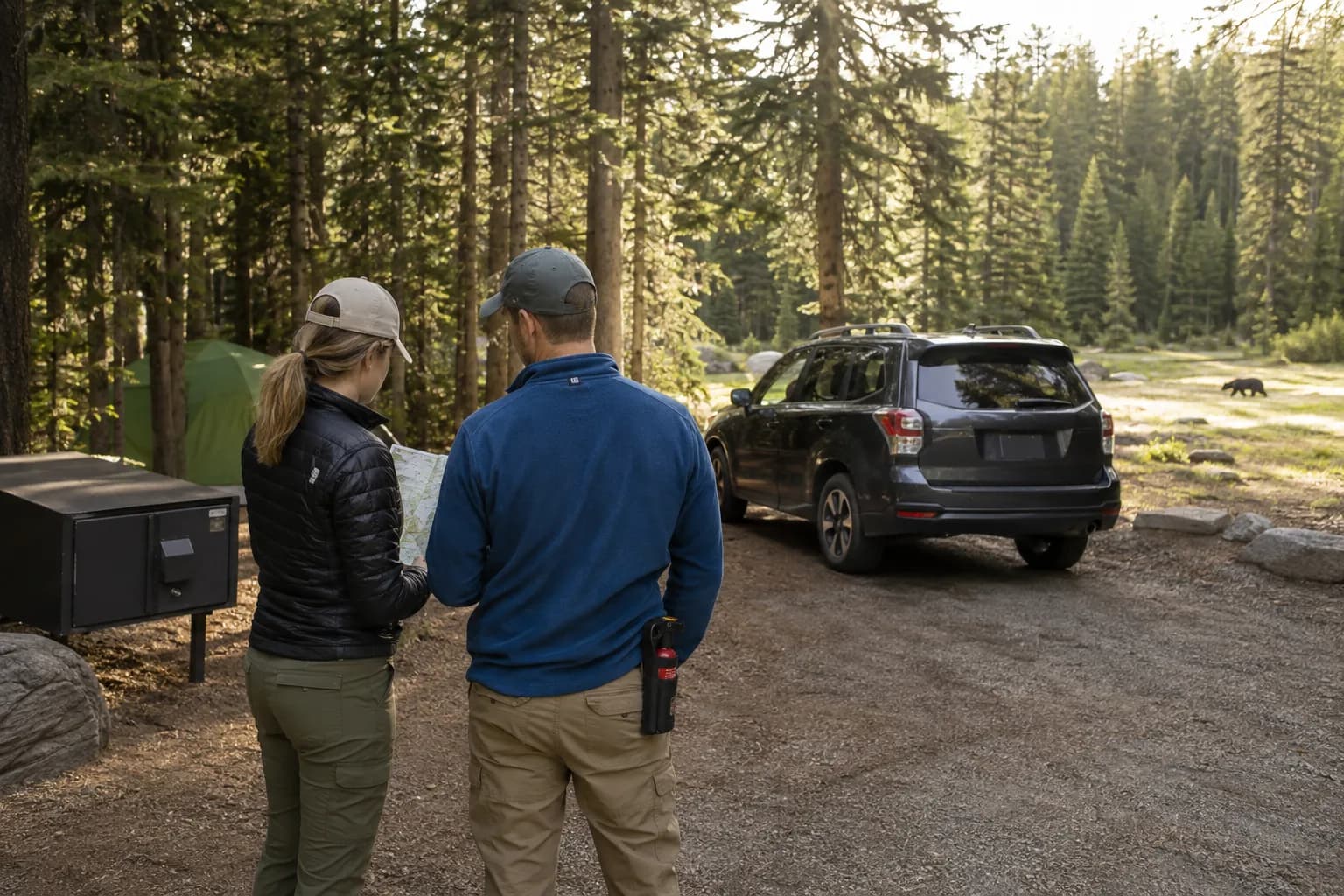
Do not treat the vestibule as a safe overnight home for food, garbage, toiletries, pet food or a cooler. It is still part of a soft-sided shelter. The National Park Service says not to store food in a tent and notes that local parks may require lockers, approved bear-resistant containers or other specific methods. Follow the campground's current wildlife rules.
For rainy trips, check whether the fly lets a person enter without dumping water into the inner tent and whether vents remain usable with the fly closed. Ventilation helps manage condensation from multiple sleepers; it cannot guarantee a dry interior when warm humid air meets cold fabric, but poor airflow makes that problem harder.
7. Do not ignore packed size and weight
Weight matters less when a vehicle carries the shelter to the pad. It does not become meaningless.
An oversized family tent may occupy a large section of a small trunk, require a long carry from overflow parking, or become the item nobody wants to dry and store at home. Compare:
- total packed weight and whether components can be split;
- packed length, especially for pre-attached frames;
- number of bags and loose components;
- storage space available at home;
- whether one adult can lift and control the package.
Choose the comfort you will use, not the maximum volume you can technically transport once.
The Keepsake Camp shortlist worksheet
Score only products that pass the non-negotiables. A zero under fit, site or weather is not rescued by a discount.
| Decision | Candidate A | Candidate B | Candidate C |
|---|---|---|---|
| Sleep system fits on published floor plan (pass/fail) | |||
| Fits usual campsite plus required lines (pass/fail) | |||
| Intended season and exposure match (pass/fail) | |||
| Usable doors and nighttime path (0–3) | |||
| One-adult setup confidence (0–3) | |||
| Covered wet-gear space (0–3) | |||
| Ventilation with fly deployed (0–3) | |||
| Packed size and carry effort (0–3) | |||
| Repair parts, warranty and documentation (0–3) | |||
| Price after the fit test (0–3) |
For each score, save the specification, manual page, photograph or credible review that supports it. “Looks roomy” is not evidence; it is what every tent looks like before four sleeping pads arrive.
Our verdict
For most family car-camping trips, start with a three-season tent whose measured floor layout gives your sleep system room to work, whose pitched footprint fits your normal sites, and whose setup can be repeated by one available adult. Favor useful door placement, ventilation and covered wet-gear space over decorative features.
Choose a cabin-style design when standing room and interior livability matter more than wind efficiency. Choose a lower-profile structure when exposure and weather stability matter more. Skip any tent whose manual, floor dimensions or intended conditions are too vague to verify—even if its capacity number and sale badge are impressively large.
That is our version of “best”: not the tent that wins every imaginary category, but the one least likely to become the family's largest unused closet item.
FAQ
What size tent is best for a family of four?+
Do not decide from the person rating alone. Draw the exact widths and lengths of the family’s pads, mattresses, crib or dog bed inside the published floor dimensions, then leave a usable entry path. Many car-camping families prefer a nominal six-person tent, but campsite size, setup effort and the actual floor shape can make a well-designed four-person or a larger model the better fit.
Is a cabin tent or dome tent better for a family?+
Cabin tents usually provide more standing room and usable space near the walls. Lower-profile dome structures generally present less wall area to wind. Choose cabin-style livability for sheltered family camping and give greater weight to lower profiles, anchoring and manufacturer-rated conditions for exposed sites.
Can food or a cooler stay in a tent vestibule?+
Do not use a vestibule as overnight food storage. It is part of a soft-sided shelter. Store food, garbage, toiletries, pet food and coolers according to the campground’s current wildlife rules, which may require a locker, hard-sided vehicle or approved bear-resistant container.
Does a freestanding family tent need to be staked?+
Yes. Freestanding describes a frame that can hold its shape without stakes; it does not make the shelter wind-secure. Anchor the tent and use the structural guylines required by its manual and the conditions.
Sources reviewed
Fact-checked Aug 30, 2026
These references support factual or safety-sensitive claims in this article. Access dates show when our editors last verified the source.
- REI Co-op — What to Look for in a Camping Tent
Expert guidance · Accessed Aug 30, 2026
- Coleman — Tent Buying Guide
Official source · Accessed Aug 30, 2026
- MSR — Tents and Shelters Owner's Manual
Official source · Accessed Aug 30, 2026
- National Park Service — Bear Safety: Storing Food
Official source · Accessed Aug 30, 2026