campfire / stories
Campfire Stories for Kids: 5 Original Tales, None Scary
Five original, gentle campfire stories for kids with age guides, honest telling times, audience refrains and simple storyteller cues.
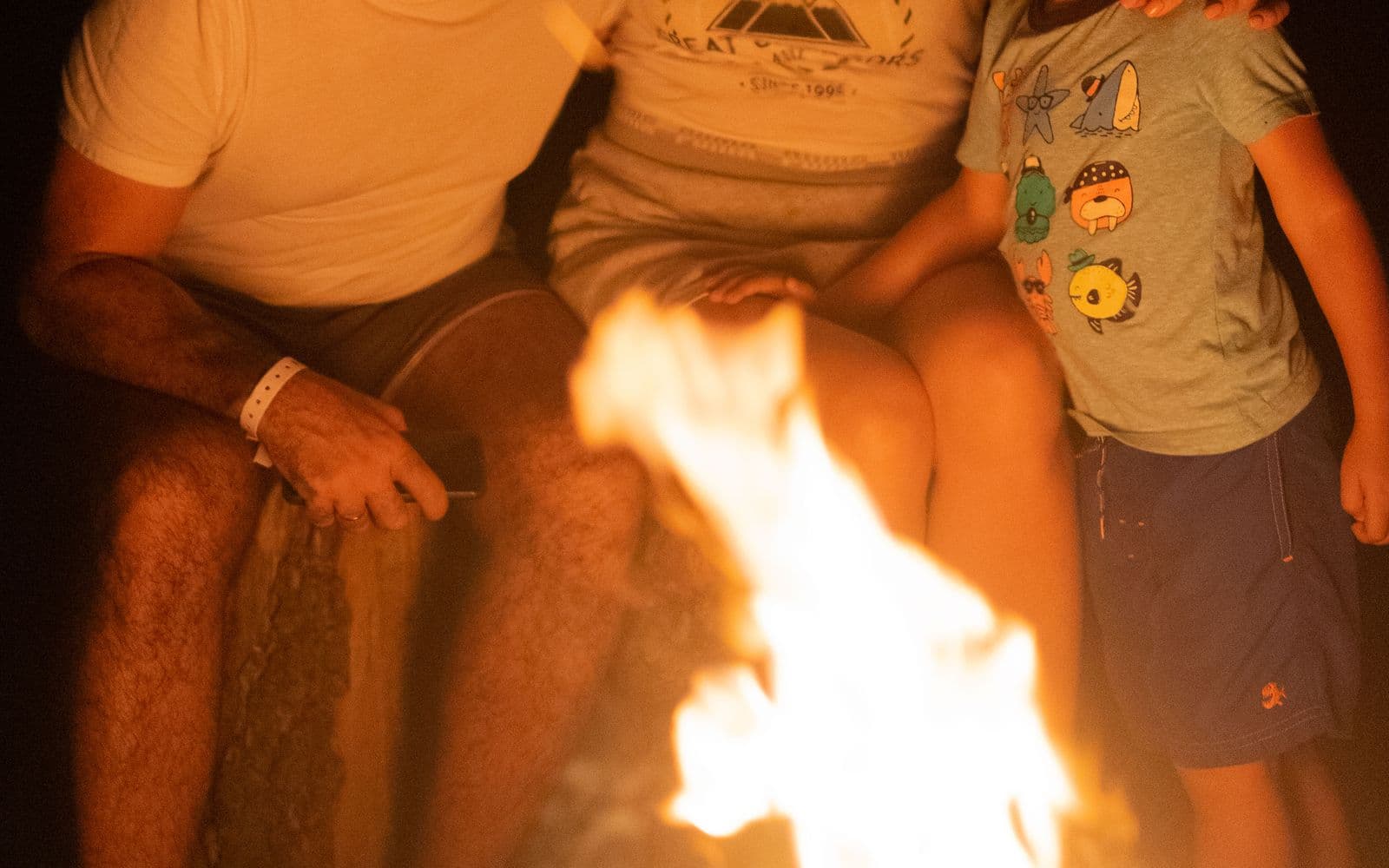
None of these five are scary—that is the whole assignment. Our scary campfire stories collection covers the intensity-rated, older-kid side. These are for younger listeners or the final story before bed, when nobody needs to spend forty minutes negotiating with a shadow shaped like a rain jacket.
Hero photo by Atlantic Ambience via Pexels.
Each story includes one line for the group to repeat. Read it once first, then slow down at the bold cues. The times below assume the children join in; a straight read will be shorter.
Choose tonight's story
| Story | Age | With participation | Energy | Group line |
|---|---|---|---|---|
| The Raccoon Who Wanted S'mores | 4+ | 2–3 min | Silly | “Snack packed, campsite clean!” |
| The Lantern That Found Its Way Home | 5+ | 2–3 min | Gentle mystery | “Stop, think, tell a grown-up.” |
| The Loudest Frog in the Forest | 4+ | 2–3 min | Loud, then calm | “Small frog, big song!” |
| The Star That Fell Into the Lake | 5+ | 2–3 min | Quiet wonder | “Some mysteries can stay mysteries.” |
| The Tent That Snored | 5+ | 5–6 min, estimated | Silly mystery | “Hrrrrr-ROOF... pffft-flap.” |
The Raccoon Who Wanted S'mores
Ages: 4+. Telling time: 2–3 minutes. Group line: “Snack packed, campsite clean!”
Rollo the raccoon had never tasted a s'more, but he had smelled approximately nine thousand of them.
Every evening, the campground air carried toasted sugar, warm chocolate and the occasional marshmallow burned into a tiny black moon. Rollo would sit behind a cedar stump and sniff.
“Tonight,” he whispered, “I shall investigate dessert.”
At campsite twelve, Maya spotted two bright eyes beyond the lantern light. Rollo took one careful step toward the picnic table. Maya took one careful step toward the cooler.
“Dad,” she whispered, “our visitor looks hungry.”
Dad closed the cooler and pointed to the metal food locker. “Wild animals find their own food. If we feed him, he may keep coming back to people—and that is dangerous for him.”
Together they swept up the crumbs, washed the sticky roasting forks and locked away the food. Every time they finished a job, Maya said, “Snack packed, campsite clean!”
Have the group repeat it.
Rollo sniffed once more. No marshmallow. No chocolate. Not even a lonely cracker corner.
So he waddled back into the forest, where he found beetles beneath a log, wild berries on a bush and absolutely nobody asking him to wear a napkin. By breakfast, the campsite was still tidy, Rollo was still wild, and Maya had learned that sometimes the kindest snack is the one you do not share.
The Lantern That Found Its Way Home
Ages: 5+. Telling time: 2–3 minutes. Group line: “Stop, think, tell a grown-up.”
Nora noticed the empty loop on her backpack just as the last orange stripe disappeared from the sky.
Her lantern was gone.
She remembered setting it beside a boulder when she tied her shoe. The trail was short. She knew every turn. For one wobbly second, going back alone felt like a brave idea.
Then an owl called from the dark trees: Who? Who?
“Who should go alone?” Nora muttered. “Not me.”
She took a breath and used the rule her family practised whenever a plan went sideways: “Stop, think, tell a grown-up.”
Have the group repeat it quietly.
Her aunt listened, checked that everyone else was safe at camp and said, “A lantern is equipment. You are a person. We do not risk a person to rescue equipment in the dark.”
They told the campground host where it had been lost. The host said the trail would be checked at first light. Then they clipped a spare light inside the tent and waited until morning.
At sunrise, the host stopped by their campsite carrying the lantern, switched off and perfectly ordinary. A paper tag hung from its handle: Found beside the boulder after your report. Good choice waiting for daylight.
Nora took it with both hands. After that, she checked three things before leaving any stop: backpack, buddy, light. The lantern had not really found its own way home—but it had helped Nora find a safer rule.
The Loudest Frog in the Forest
Ages: 4+. Telling time: 2–3 minutes. Group line: “Small frog, big song!”
Pip was the smallest frog at Mossy Pond and the owner of its largest opinion.
“I have,” he announced every evening, “the loudest croak in the entire forest.”
He filled his tiny belly with air.
Pause and invite the group: “Small frog, big song!”
“RIBBIT!” shouted Pip.
A heron blinked. A duck dropped a piece of pondweed. The other frogs covered the sides of their heads, which is difficult when you are a frog and have no hands.
Then one night, clouds rolled over the moon. Thunder cracked so loudly that the reeds shook. The pond went silent.
Pip was scared too. His toes squeezed the mud. But he noticed three tadpoles huddled beneath a lily pad.
“Would a song help?” he asked.
The tadpoles nodded.
Pip croaked once—not his loudest croak, just a steady one. Another frog joined him. Then another. Soon the pond had a rhythm beneath the rain: low croaks, high croaks and one duck who had misunderstood the assignment.
By morning, nobody declared Pip the loudest frog in the forest. They gave him a better title: the frog who knew when a big voice could help—and when it could give everyone a headache.
The Star That Fell Into the Lake
Ages: 5+. Telling time: 2–3 minutes. Group line: “Some mysteries can stay mysteries.”
The lake was so still that it held a second sky.
Eli could see two moons, two pine forests and twice as many stars—one set overhead and one trembling beneath the canoe dock.
Then a shooting star scratched a silver line across the darkness.
Plip.
Something flashed near the far reeds.
“It fell into the lake,” Eli whispered.
His sister June leaned forward. “Should we paddle out?”
The adults checked the dark water, the tied canoe and the children in pajamas. “Not tonight,” Mom said. “The lake will still be here in daylight.”
Eli watched the faint glow drift between the reflected stars. He wanted an answer badly enough to invent six: a moon pebble, a firefly submarine, a fish with a flashlight, a dragon's lost tooth, a soggy comet and one extremely confused glow stick.
June offered a seventh. “Maybe we do not need to know.”
Together they said, “Some mysteries can stay mysteries.”
Say it once more, softer.
In the morning, they walked the shoreline with an adult. They found smooth stones, two feathers and a bottle cap to pack out—but nothing that had fallen from the sky.
Eli was disappointed for almost a minute. Then he looked at the lake, holding the whole bright morning upside down, and decided a mystery was not an empty answer. Sometimes it was a story waiting beside you.
The Tent That Snored
Ages: 5+. Estimated telling time: 5–6 minutes. Fear: 0/4. Group sound: “Hrrrrr-ROOF... pffft-flap.” Truth label: original fiction.
The tent snored before anyone had gone to bed.
It took one long breath through the rainfly, held it, and said:
Hrrrrr-ROOF... pffft-flap.
Invite the group to make the two-part snore.
The Moreno family stopped talking.
They had spent the last hour building what Dad called “the straightest tent in the campground.” Mom had called it “a very nice tent.” Twelve-year-old Ben had called it “done yet?” And six-year-old Lena had decorated the doorstep with three pinecones that were not structural but, in her opinion, helped.
Now all four of them stood by the picnic table. Their sleeping bags were still rolled. The tent was empty.
“Ben,” Dad said, “did you leave your tablet playing something in there?”
“My tablet does not snore.”
The tent filled with the evening breeze. Its green sides rounded out, as if it were breathing in.
Hrrrrr-ROOF... pffft-flap.
Let the group answer.
Dad stared at his masterpiece.
“Maybe it’s proud of itself,” Mom said.
“Maybe it’s tired from standing up,” said Lena.
Nobody thought either answer was scientifically excellent, but both fit the evidence so far.
Dad switched on his headlamp. Lena and Ben stayed beside Mom while he checked the tent from the outside. No animal was near it. Nothing moved inside except a shadow from the fabric rising and settling with the wind.
“First theory,” Dad announced. “The zipper pulls are rattling.”
He held them still.
A breeze pushed through the campsite. The tent inhaled.
“Hrrrrr...” it began, lower now, like a bear-sized cello warming up.
Dad released the zipper pulls.
“...ROOF-pffft-flap.”
“It finished the snore without you,” Ben said.
Dad made a note of this by frowning harder.
Mom checked the instructions sewn into the tent bag. With everyone together, she opened the rainfly vent the way the manufacturer showed. The next gust came through more easily.
This time the tent said, “Hrrr-EEP... flap-flap.”
Ben tilted his head. “Now it sounds like it sneezed halfway through.”
“Second theory,” Mom said. “Better airflow changes the noise, but it isn’t making the noise.”
Dad inspected the front guyline. He had tightened it earlier, back when the tent was still the straightest one in the campground and not a musical instrument. Following the tent instructions, he adjusted it slightly.
The breeze returned.
The rainfly pulled forward. The line went taut.
Hrrrrrrrrrr-ROOF... pffft-flap.
Give the group one last, extra-long turn.
Everyone laughed except Dad, who was now being outsmarted by portable shelter.
“Longer,” Ben said. “You made it sleepier.”
Dad put his hands on his hips. “That is useful data.”
Lena had not been watching the whole tent. She was watching one small thing near Dad’s knee.
Earlier, he had rinsed their little blue collapsible cup. To keep it off the ground, he had clipped it to the front guyline by its loop. It bobbed whenever the breeze pulled the tent forward.
“The cup is chewing the string,” Lena said.
They all crouched, with Mom and Dad closest to the line.
The next breath of wind rounded the rainfly. The guyline tightened across the cup’s soft folded rim. The folds squeezed shut, pushing out a low, rubbery groan. Then the wind eased. The cup opened again, the line relaxed, and the loose edge of the fly gave one final flap.
Hrrrrr. Roof. Pffft-flap.
Not a sleepy tent. Three ordinary things working together: wind moving the rainfly, tension changing in the guyline, and one damp cup clipped exactly where no cup belonged.
“Third theory,” Lena said. “Cups should dry somewhere else.”
That one was scientifically excellent.
Dad unclipped the cup and put it with the dishes. Then he checked the tent against the manufacturer’s setup instructions and finished the adjustment. A breeze moved through the pines. The rainfly lifted and settled without a groan.
The tent was only a tent again.
Later, when the pinecones had been moved away from the doorway and everyone was ready for bed, Dad sat down in his camp chair to remove his boots.
He closed his eyes for just one second.
From the chair came a long breath.
“Hrrrrr-ROOF...”
Lena looked at the blue cup.
“Not you this time.”
Telling tips for younger kids
Keep your voice warm rather than dramatic—the goal is a story, not a jump scare wearing hiking boots. Let children repeat the group line, supply a funny answer or make the frog sound. Slow down just before the choice that resolves each story. If one lands well, tell it again on another trip; familiarity is part of the fun.
Build a one-minute campfire story together
Use this when the group wants “one more” and the adults have reached the bottom of the story barrel.
If the group wants a longer collaborative format, use the four-beat prompts in our campfire storytelling games guide.
- Ask one child for a campground animal.
- Ask another for a harmless object someone misplaced.
- Choose one small problem: rain, a strange sound, a missing mitten or a snack safely locked away.
- Give the animal three silly attempts to solve it.
- Let the group invent a repeatable line.
- End with a safe choice, a useful discovery and one joke.
Starter: “At campsite ___ lived a ___ who had never seen a ___ before. Every time it tried to help, everyone shouted, ‘___!’”
Keep real campsite rules inside the fiction: children stay with adults, nobody enters water or leaves camp alone at night, and wildlife never receives food.
Pair these with a round of funny campfire jokes for a lighter evening, or move to scary campfire stories once the group's old enough and the mood calls for something more intense.
FAQ
What age are these campfire stories appropriate for?+
All five are designed for roughly age 4 and up. They use gentle mystery, silliness and clear resolutions rather than threats or jump scares, but the adult telling the story should still adjust it for the child.
How long are these campfire stories?+
Four take about two to three minutes with participation. The Tent That Snored is longer at an estimated five to six minutes; all times remain editorial estimates until a human timed read is logged.
Are these stories based on real folklore?+
No. All five are original stories written for this page, not adaptations of traditional tales or urban legends.
Sources reviewed
Fact-checked Sep 9, 2026
These references support factual or safety-sensitive claims in this article. Access dates show when our editors last verified the source.
- National Park Service — Never Feed Wildlife
Official source · Accessed Sep 4, 2026