campfire / scary stories
13 Scary Campfire Stories to Tell Out Loud (With Telling Times)
Thirteen campfire stories written to be told aloud, each labelled with its intensity, estimated telling time, audience and provenance.
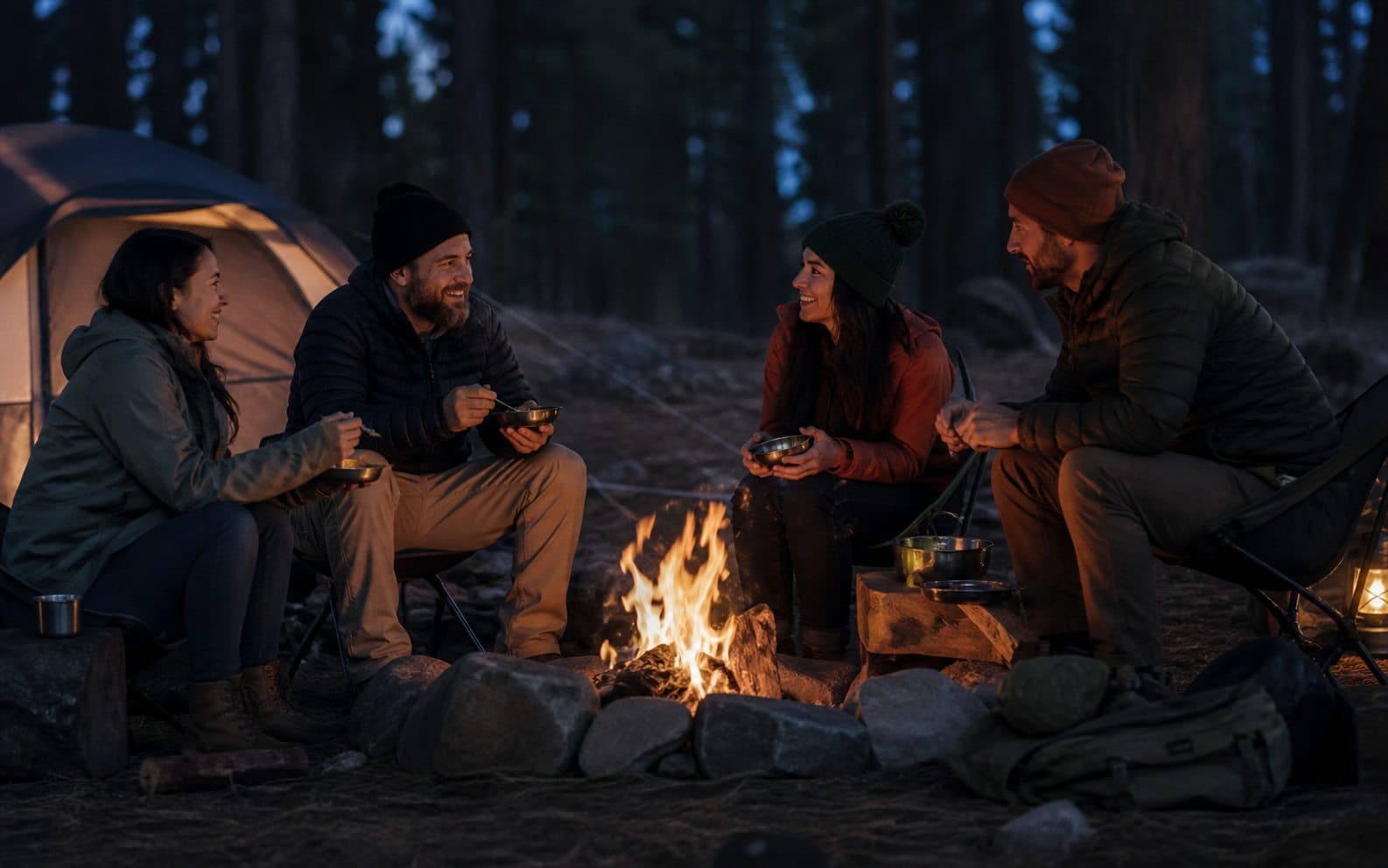
Most collections of scary campfire stories give you a summary. Summaries are useless at a fire — you cannot tell a summary out loud without it collapsing in thirty seconds.
These thirteen are written to be spoken. Each one is labelled with an estimated telling time, intensity and provenance: a traditional tale, a widely-told urban legend, or original Keepsake Camp fiction. The three newest scripts still need a human timed read, so their durations are marked as estimates rather than presented as measured facts.
Hero photo by fei wang via Pexels.
If the group wants atmosphere without the scare level, the short campfire stories collection keeps every tale under two minutes and uses mysterious rather than frightening endings.
For younger listeners who need a guaranteed soft landing, use our original campfire stories for kids: five complete scripts, zero jump scares.
Pick by intensity
| Story | Type | Telling time | Intensity |
|---|---|---|---|
| The Golden Arm | Traditional | 3 min | Mild — jump scare |
| Whose Hand Was I Holding? | Traditional | 2 min | Mild |
| Room for One More | Traditional | 3 min | Medium |
| The Hook | Urban legend | 4 min | Medium |
| High Beams | Urban legend | 4 min | Medium |
| The Third Tent | Original | 4 min | Medium |
| The Ridge Light | Original | 5 min | Medium |
| The Logbook | Original | 4 min | Strong |
| The Trail Camera | Original | 5 min | Strong |
| The Last Portage | Original | 6 min | Strong |
| The Hiccup Beyond the Circle of Light | Original | 5 min, estimated | Mild — playful spooky |
| The Weather Radio at Site Nine | Original | 9–10 min, estimated | Medium |
| Quiet Hours at Loop C | Original | 9–12 min, estimated | Strong — 14+ |
Mild works for roughly ages seven and up. Medium suits ten and up. Strong is for teenagers and adults — not because of gore, but because the endings stay unresolved, which is what keeps people awake.
Mild — for younger campers
The Golden Arm
Traditional folk tale · 3 minutes · ends in a jump scare
This is the oldest story here by some distance. Mark Twain published his own version of it in How to Tell a Story in 1895, and used it as his worked example of a tale that depends entirely on delivery rather than content.
There was a man whose wife had an arm made of solid gold. He loved her, and he loved the arm, and it was never quite clear to anyone which he loved more.
When she died, they buried her out past the field, at the edge of the trees. That night the man lay awake thinking about the gold going green in the ground. By the second night he had stopped thinking about anything else.
So he took a lantern and a shovel and he went out to the field, and he dug, and he took the golden arm, and he carried it home under his coat.
That night the wind came up. And in the wind there was a voice, very far off, saying: "Whooo took my golden arm?"
He pulled the blanket up.
The voice came again, at the fence line now: "Whooo took my golden arm?"
He pulled the blanket higher.
Closer, at the door: "Whooo took my golden arm?"
On the stairs. "Whooo took my golden arm?"
Outside the bedroom door, very quiet now: "Whooo took my golden arm?"
And then, right beside his ear —
"YOU DID!"
How to tell it: drop your voice a little quieter at each repetition, so people lean in. The last line is shouted at whoever is closest to you. It is the oldest trick at any campfire and it works every single time.
Whose Hand Was I Holding?
Traditional · 2 minutes · mild
Two sisters were walking home along a country road after dark. There were no streetlights, and clouds had covered the moon, so they held hands to keep from wandering off the gravel.
They walked a long time without speaking. At some point the younger sister squeezed the older one's hand, and the older one squeezed back.
When they reached the porch light, the younger sister said, "You were holding my hand too tight."
And the older sister said, "I was walking on the other side of the road the whole way. I thought you were behind me."
How to tell it: deliver the last line flatly, like an ordinary correction. No emphasis. The pause afterwards does all the work.
The Hiccup Beyond the Circle of Light
Original Keepsake Camp fiction · about 5 minutes, estimated · fear 1/4 · ages 7+ · playful spooky
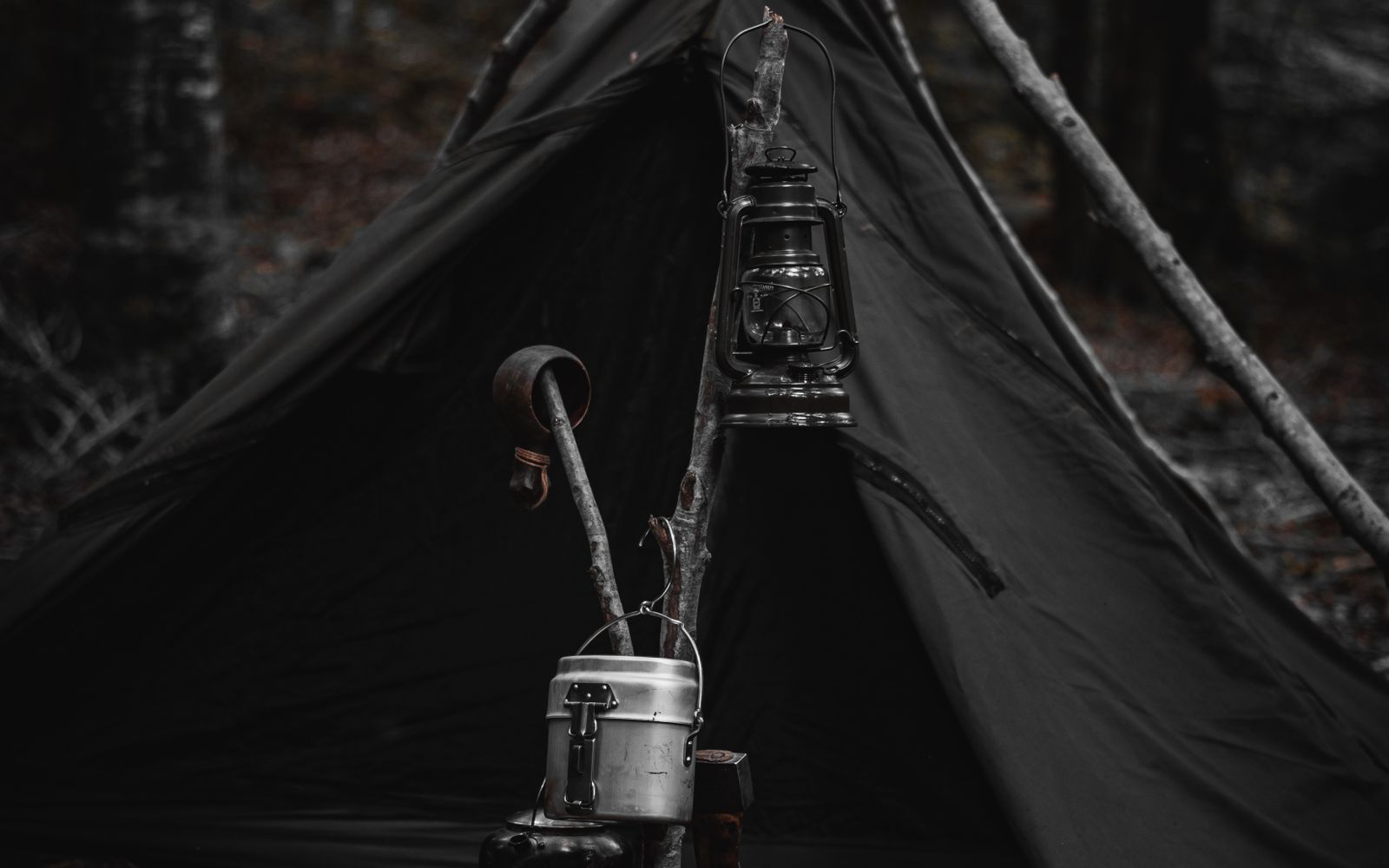
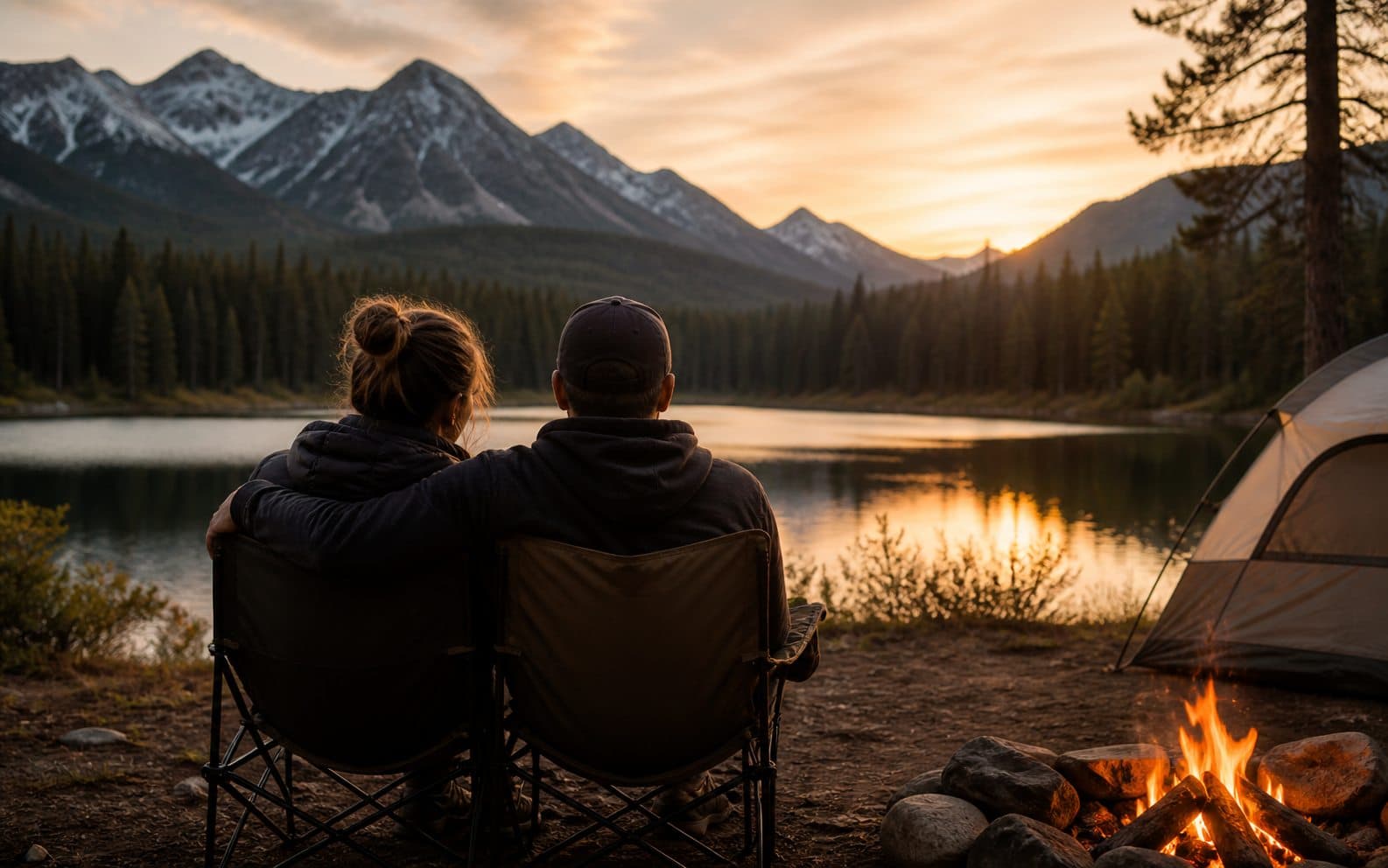
Keep the circle warm and the darkness unexplained. Photo by Araz Yurtseven via Pexels.
Before we start: this one is playful spooky. Nothing gets hurt, and the fear level is one out of four. You may say one word with the family near the end, or you may just listen. Both ways work.
Uncle Ravi finished his sentence.
From somewhere beyond the circle of light came a tiny sound.
Hic.
Then the first word of his sentence came back.
“Tonight.”
Ravi began the sentence again.
It was the first evening at Pine Needle Bend, a campground that exists only in this story. Ravi, Mom, nine-year-old Tessa and her younger brother Ben sat in four camp chairs. Their zipped tent stood a few steps behind them. Four cups of cocoa steamed on the table.
They were making up a story one sentence at a time. Mom had given them two rules: everyone stayed seated, and the last sentence had to bring the characters safely home.
Ravi had volunteered to begin.
“Tonight, a tiny boat crossed the lake without making a ripple.”
The hiccup sounded just beyond the light.
Hic.
“Tonight.”
It was not Ravi’s voice. It was not anyone’s voice. The word sounded like the hiccup had briefly taken the shape of a syllable.
Ravi blinked. Then, without meaning to, he said, “Tonight, a tiny boat crossed the lake without making a ripple.”
Hic.
“Tonight.”
Ravi drew breath to begin the same sentence a third time.
Mom held up one finger. “Stop there.”
The sentence stayed stopped.
They listened. Crickets pulsed in the grass. A screen door closed somewhere along the campground loop. Nothing moved toward them. Nothing called a name.
Tessa tucked her feet beneath her chair.
“We can end the story now,” Mom said.
Tessa thought about it. “Can we try one short sentence? From right here?”
“One,” Mom agreed. “Nobody follows a sound. Nobody leaves the chairs.”
She looked at the four faces in the circle and said, “Everyone stays together.”
Hic.
“Everyone.”
Mom’s mouth opened.
“Everyone stays together,” she repeated.
Hic.
“Everyone.”
Her mouth opened again, but this time she pressed her lips together until the urge to restart had passed.
Ben whispered, “It put the sentence back at the beginning.”
That was exactly it.
The hiccup had not stolen a word. It had not answered a question. Each time a sentence ended, its first word returned from the dark—and the speaker felt the whole sentence waiting to happen again.
Ravi tried a harmless test.
He said, “Cocoa is getting cold.”
Hic.
“Cocoa.”
He clamped both hands over his mouth before the sentence could loop.
Ben took a thoughtful sip. “The cocoa part is true.”
Tessa looked from one cup to the next. “If the first word always comes back, we need a sentence that needs its first word at the end.”
Ravi nodded slowly. “A circle instead of a straight line.”
They did not call toward the sound or move closer to it. They simply built a sentence while staying together.
Ben suggested the middle. Mom shortened it so everyone could remember. Tessa chose the word that belonged at both ends.
Home.
Mom counted all four people. Ravi pointed to the tent behind them. Tessa put both feet flat on the ground.
Then they spoke together.
“Home is where every safe story returns—”
If you want to say the final word, wait with them now.
The little sound came from beyond the circle of light.
Hic.
“Home.”
The sentence was complete.
Nobody felt pulled back to its beginning.
Ravi waited. Mom waited. Tessa and Ben waited.
No second hiccup came.
The four cups were still on the table. The four chairs were still together. Their tent waited a few steps away, exactly where it had been.
Soon the family ended the game and went inside it. Mom checked that everyone was there and zipped the door.
Outside, crickets filled the space where the hiccup had been.
The night did not repeat itself.
How to tell it: announce the fear level before starting. Keep the hiccup tiny rather than comic, pause before the audience’s final “Home,” and do not make listeners participate if they prefer silence.
Medium — the classics
Room for One More
Traditional ghost story · 3 minutes · medium
A woman was staying at a friend's country house. Her room was at the top of the stairs, and she slept badly there — the house made noises it had no reason to make.
Just after midnight she woke to headlights sweeping the ceiling. She went to the window. Below, in the drive, was an old hearse, black and long, with a driver sitting up front looking directly up at her.
He leaned out and said, quite clearly: "There's room for one more."
She stepped back from the window. When she looked again, the drive was empty. She convinced herself it was a dream, the way you do at three in the morning.
The next day she took the train back to the city. At the station she crossed to the lift to reach the platform. It was already crowded, packed shoulder to shoulder, and as she moved towards it the operator turned and looked at her and said:
"There's room for one more."
It was the same face. The same voice.
She stopped where she was and let the doors close.
The cable gave way between floors. Nobody inside survived.
How to tell it: tell the first half slowly and the second half quickly. The speed change is what makes the ending land.
The Hook
Urban legend · 4 minutes · medium
Two teenagers had driven out to the end of a dirt road to be alone. The radio was on low. It was the kind of place where the trees close over the track and the dark feels physically closer than it should.
The music stopped for a bulletin. A man had escaped from the hospital up the valley — dangerous, they said, and easily identified: he had lost his right hand, and wore a hook in its place.
The girl wanted to leave. The boy said she was being ridiculous. They argued about it, the way you argue at that age, until something scraped along the outside of the car — a long, slow drag down the paintwork.
He started the engine and drove, fast and badly, all the way back to town.
When he got out to open her door, he stopped.
Hanging from the handle, torn off at the base, was a hook.
How to tell it: resist the urge to add gore. The story's power is that the danger was outside the whole time and they never saw it.
High Beams
Urban legend · 4 minutes · medium
A woman was driving home alone on the highway, late. She noticed a truck had pulled in behind her, close, and stayed there.
After a few kilometres its headlights flicked to high beam, filling her car with white light. She flinched, slowed, and let it pass — but it did not pass. It dropped back, then flashed her again.
She sped up. It sped up. She changed lanes. It changed lanes. Every minute or so, the high beams again.
By the time she reached her street she was shaking. She pulled into her drive and ran for the door, and the truck swung in behind her and the driver threw his door open and shouted at her to get down.
There was a man in her back seat.
Every time he had risen up behind her, the trucker had hit his high beams — and every time, the man had ducked back down.
How to tell it: count the flashes out loud as you tell it. Three, four, five. The listener starts counting with you, and that is when it stops being a story they are hearing.
The Third Tent
Original · 4 minutes · medium
Two friends went camping at a small lake at the end of a logging road. There was one other party there when they arrived: a green tent, pitched neatly on the far side of the water, with nobody around it.
They set up, made dinner, and watched the light go. No one came back to the green tent.
Around eleven they heard someone moving in the brush behind their site. Not sneaking — walking, unhurried, back and forth, the way you pace when you are waiting for something.
One of them called out. The walking stopped. Then it started again, in exactly the same rhythm, exactly the same stretch of ground, for another twenty minutes.
Neither of them slept much.
In the morning the green tent was gone. Not packed up — gone, with the grass beneath it still flattened and still wet, and four peg holes in the ground.
They walked back to their own site, and behind it, in the soft ground where the pacing had been, they found a line of boot prints. The prints went back and forth, dozens of times, over the same eight metres.
None of them faced away. Every single one pointed at the tent.
How to tell it: tell it as if you are trying to work out what happened, not as if you already know. The confusion is the atmosphere.
The Ridge Light
Original · 5 minutes · medium
There is a ridge above a lake where people used to hike up for the view. Halfway along the ridge trail is a cairn, and hikers add a stone to it as they pass. It has been there long enough that nobody remembers who started it.
A man went up alone one October to watch the sunset. He stayed too long — the light went faster than he expected — and started down in the dark with a headlamp.
About twenty minutes below the cairn he saw another light on the trail ahead, coming up towards him. He was relieved. He called out a greeting.
The light stopped.
He kept walking. The light stayed where it was, maybe two hundred metres below him, steady, not moving.
He called again. Nothing. He carried on down, and the light held its position, and the distance between them did not close — not by a single step, for forty minutes, all the way to the trailhead.
When he reached the car park, his was the only vehicle there. He turned around and looked back up at the ridge.
The light was above him now, up at the cairn, exactly where he had been standing when he first saw it.
How to tell it: the detail that sells this one is the forty minutes. Say it plainly, like a fact you are still annoyed about.
The Weather Radio at Site Nine
Original Keepsake Camp fiction · 9–10 minutes, estimated · fear 2/4 · ages 10+ · optional static sound
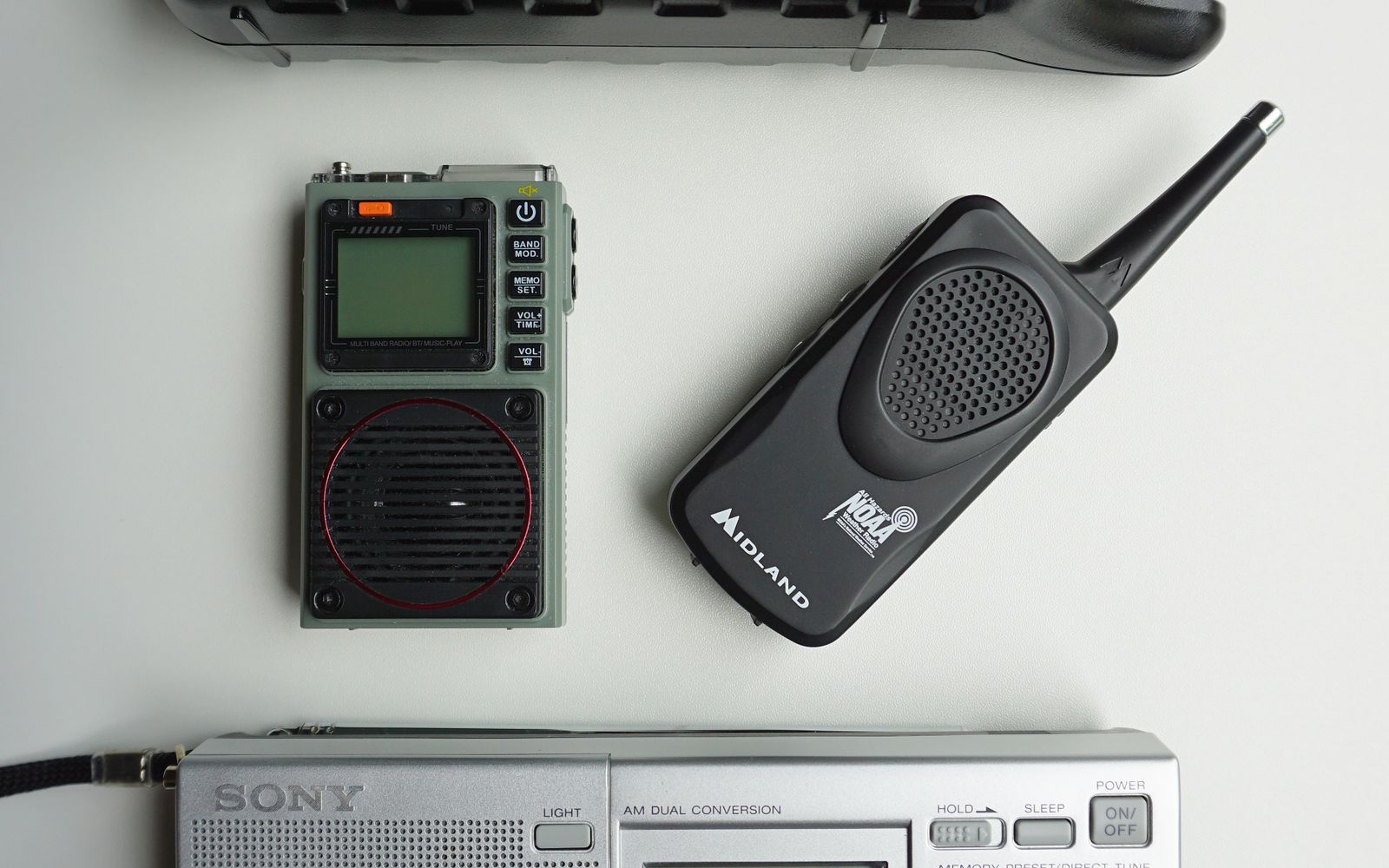
A real weather radio is safety equipment; the impossible receiver below is fiction. Photo by Nancy Zjaba via Pexels.
At 7:18, the dead radio on Site Nine cleared its throat and said:
“Five spoons, June. You counted four.”
Four minutes later, Ruth said those exact words.
The radio had no batteries.
It belonged to Ruth, who had owned it since long before anyone called a phone “smart.” She had not meant to bring it. The receiver had been at the bottom of the kitchen box between a roll of foil and a bent fly swatter, where it had apparently spent the drive to Bracken Lake Campground listening to cookware.
When Ruth found it, she laughed and set it at one end of the picnic table.
“Museum piece,” she said. “The battery door broke two summers ago.”
Dev turned the knob anyway. Nothing. He opened the back. The compartment was empty except for a pale spring and one pine needle.
That did not worry anyone. Mira had checked the official forecast before they left home and again when they arrived. The campground notice said storms were possible later that evening. They had decided to eat early, keep the vehicle keys in the daypack and listen for current alerts.
It was the kind of small decision campers make before anything feels urgent.
There were five people at Site Nine: Ruth and her grown children, Mira and Dev; Mira’s fifteen-year-old son, Cal; and Dev’s daughter, June, who was twelve and took table-setting very seriously.
June laid out the bowls. Then the spoons.
That was when the radio made three dry ticks.
Not a burst of ordinary fuzz. This sound was thinner, almost neat: tick, tick, tick—shhhhhk. Like a zipper pulled across an empty tent.
Then came the voice.
“Five spoons, June. You counted four.”
Everyone looked at the receiver.
Dev lifted it. He turned it over. He opened the empty compartment again, as though batteries might have grown there in the last ten seconds.
“Did somebody’s phone do that?” Cal asked.
They checked. No recording. No video. No open app.
Ruth tapped the radio once with one finger. “That is not the recommended repair method,” she said, and set it back down.
For four minutes, nothing happened.
Then Ruth frowned at the place settings and reached into the cutlery bag.
“Five spoons, June,” she said. “You counted four.”
Nobody laughed.
Cal looked at the time on his phone. 7:22.
“It said that at 7:18,” he said.
Dinner went quiet for a while. Spoons—five of them—scraped bowls. Far across the campground, a screen door slapped shut. The leaves over Site Nine showed their pale undersides whenever the breeze turned them.
Mira refreshed the official weather update. The storm was still some distance away, but the timing had moved earlier. She read the campground instructions again and pointed out the substantial service building named as their shelter.
“If staff tell us to move, we move,” she said. “No experiments, no arguments, no rescuing camp chairs.”
Cal glanced at the radio. “What about haunted kitchen appliances?”
“Especially those.”
At 7:31, the receiver made the sound again.
Tick, tick, tick—shhhhhk.
“Red pocket. Zip it all the way.”
This time they all heard every word.
Dev picked up the receiver before anyone could stop him and held it beside his ear. Silence. He shook it gently. The pine needle slid across the empty battery compartment.
“All right,” Cal said. “Radio, in five minutes I will say, ‘Ruth owes me twenty dollars.’”
Nothing.
June leaned closer. “Radio, in five minutes Dad will say I may have the last cookie.”
Nothing.
Ruth tried, “In five minutes, everyone will help wash dishes.”
The radio remained so perfectly quiet that even the pine needle seemed to be holding still.
They tried questions. They tried sentences. Cal counted backward from ten. June announced three increasingly unlikely cookie emergencies.
No ticks. No hiss. No voice.
“It doesn’t perform,” Mira said.
That ended the game.
She began clearing the table while Dev packed the kitchen box. Without thinking, he placed the vehicle keys in the open front pocket of the gray daypack.
Mira saw them.
“Red pocket,” she said. “Zip it all the way.”
Cal checked the time. 7:36.
Nobody needed him to explain.
Dev moved the keys to the red pocket and closed the zipper. Mira kept the pack beside her.
Then every working phone at Site Nine sounded at once.
The official alert matched the change Mira had already seen: the storm was arriving sooner. A campground vehicle rolled slowly along the loop. The host called for campers to follow the posted instructions and move to the designated building.
The group did not ask the old radio what to do.
They followed the real alert.
Dev took the gray pack. Ruth and June went with Mira. Cal started after them, then turned his head toward the blue camp chair beside the cold fire ring.
It was beginning to rain. One heavy drop struck the chair. Then another.
At the table behind him, the powerless receiver made three dry ticks.
Tick, tick, tick—shhhhhk.
“Leave the blue chair. We have everybody.”
Cal stopped.
For one second, he looked at the chair. Then at the four people waiting for him.
Mira did a head count. Ruth. Dev. June. Cal. Herself.
Five.
Cal left the chair exactly where it was.
They moved together to the designated building. Other campers were already inside. The host stood near the entrance checking site numbers from a clipboard while rain rattled hard against the roof.
“Site Nine?” the host called.
Mira raised her hand. “Leave the blue chair. We have everybody.”
Her voice sounded strange in the bright room.
Cal looked at the wall clock. 7:44.
The radio had spoken at 7:42.
The host marked the clipboard. Ruth found a bench. June sat beside her. Dev unzipped the red pocket, showed Mira the keys, and zipped it shut again.
No one was outside looking for a voice. No one had gone back for equipment. All five people from Site Nine were inside the building the campground had told them to use.
Safe first. Questions later.
The storm passed. The host waited for the official all-clear before anyone returned to the loop.
When they reached Site Nine, the rain had washed the table clean. The blue chair lay on its side. Their tents were wet but standing.
And the old receiver was exactly where they had left it.
Dev checked the empty battery compartment once more. June counted the people once more. Cal checked the time.
“Maybe we made it happen,” he said. “Maybe we only said those things because we heard them first.”
“Then why wouldn’t it say anything we asked for?” June said.
Nobody had an answer.
Mira picked up the radio to put it back in the kitchen box.
Three dry ticks sounded beneath her hand.
Tick, tick, tick—shhhhhk.
The dark speaker said:
“Site Nine, all accounted for.”
No one at the campground had spoken those words.
And no one had ever told the radio how many campers belonged to Site Nine.
Its little indicator stayed dark.
How to tell it: raise one hand when listeners should make the short static sound. Keep every safety instruction plain, not ominous. The final line belongs to the mystery only after everyone is visibly safe.
Strong — for teenagers and adults
The Logbook
Original · 4 minutes · strong
Some backcountry huts keep a logbook by the door. You write your name, the date, where you came from and where you are going, so that if you do not arrive, someone knows where to start.
A woman reached a hut in bad weather and found it empty. She lit the stove, hung her wet things, and read the logbook the way everyone does — other people's weather, other people's routes.
The last entry was from that morning. A party of three, heading over the pass to the north. She thought about the pass, and the snow, and decided she would wait a day.
She woke at some point in the night to the sound of the door. Cold air, then quiet. She lay still and listened and heard nothing more, and eventually slept.
In the morning the door was shut and the hut was empty and her things were where she had left them.
The logbook was open on the table. She had closed it.
Beneath the entry for the party of three, in wet ink, somebody had written the date, and her name, and where she had come from.
The line for where she was going was blank.
How to tell it: end there. Do not explain it. The instinct to add one more sentence is exactly what ruins this story.
The Trail Camera
Original · 5 minutes · strong
A man kept a trail camera strapped to a birch at the back of his property, mostly to see what came through at night. Deer, usually. A bear twice. Once, memorably, a neighbour's escaped goat.
The camera fired on motion and stamped every photograph with the date and time.
One week he pulled the card and found the usual — deer at 2 a.m., raccoons, nothing. Then, at 3:14 a.m. on the Thursday, a photograph of a man standing in the trees about six metres from the camera, looking at it.
He did not recognise him. He told himself it was a hunter who had wandered across the line.
The next photograph was 3:15. Same man, three metres closer. Looking at the camera.
3:16. Closer.
3:17. Close enough that the flash had washed his face out completely.
The last photograph was time-stamped 3:18, and it was not of the man. It was taken from further back, from the direction of the house, looking towards the birch — and it showed the camera on the tree, and it showed the empty ground in front of it.
Somebody had taken the camera off the tree, walked backwards, photographed it, and put it back.
How to tell it: read the timestamps out loud, one at a time, with a real pause between each. Let people work out the last one for themselves.
The Last Portage
Original · 6 minutes · strong
Two men were on the fourth day of a canoe trip, moving through a chain of small lakes that saw almost no traffic. The portages were overgrown and badly marked, and by that point they were navigating mostly by the map and the shape of the shoreline.
The last portage of the day was supposed to be four hundred metres. They found the take-out where the map said it would be, shouldered the canoe and the packs, and started walking.
At what felt like eight hundred metres they stopped. The trail was still going. It was clear, well-trodden, easy to follow — which was strange, because nothing else on that chain had been.
They kept walking. The light started to go.
At what must have been well over a kilometre, the trail ended at a lake. They put in, relieved, and paddled twenty minutes to a campsite on the far shore.
It was only when one of them got the map out to plan the morning that they saw it. There was no lake on that side of the portage. The trail on the map ran four hundred metres and came out on the same chain they had left.
They checked the compass. They checked the map. They checked the shoreline against the contours, and none of it matched anything printed on the sheet.
They did not sleep. At first light they packed and paddled back the way they had come, found the trail, and walked it.
It took four hundred metres exactly. It came out precisely where the map said it would.
Neither of them has been able to explain where they camped.
How to tell it: this one needs the setup to feel tedious and technical — maps, distances, compass bearings. The mundane detail is what makes the impossible part land.
Quiet Hours at Loop C
Original Keepsake Camp fiction · 9–12 minutes, estimated · fear 3/4 · ages 14+ · sustained supernatural threat, no graphic violence
At exactly ten, rain kept striking the picnic table, the tent, and four hooded jackets.
It simply stopped making a sound.
The drops still burst against the wood. Water still streamed from the tarp. Talia saw Owen’s mouth form her name from two steps away, but the night gave nothing back.
Loop C had been quiet before that. Not empty—just late-season quiet. One other car stood three sites down, dark and beaded with rain. The next bend disappeared among black spruce. At the loop entrance, visible along the straight strip of wet road, a brown sign read QUIET HOURS: 10 P.M.–7 A.M.
When the four friends arrived, Talia had pointed at it and said, “The campground has a bedtime.”
Marcus had looked at the rain. “The campground has better judgment than we do.”
They had checked the forecast: mild overnight temperatures, steady rain, no severe-weather alert. Their phones were charged. Dry blankets and jackets waited in the car, parked on the gravel spur attached to their site. Priya had even made everyone notice the quickest route from the table to the passenger door. She did that on every trip, and everyone teased her until they needed something she had planned.
At 9:59, they had been packing away tea things. The campground-provided wildlife-resistant food locker beside the table remained open. Owen was halfway through saying that rain sounded louder on a tarp than it had any right to.
Then the clock on Talia’s phone changed to 10:00.
Now Owen’s sentence had no ending.
Priya raised one finger: stay together.
They gathered beside the table. Their boots pressed into wet gravel without a crunch. Jackets folded and scraped without a whisper. Talia could feel her own breath in her throat, but she could not hear it. She switched on her phone’s flashlight and swept it across the tent, the car, the road, then back to the others. Nothing stood beyond the light.
Owen pointed at his ears, then at the tent. He reached for the door zipper.
Just before his fingers pulled, a pale line skimmed around the outer edge of the living pad.
It was no wider than a shoelace. It traveled once through the wet grit, making a complete border around tent and table, then vanished.
Owen gave the zipper a short, deliberate pull until the slider struck its stop.
No zip. No click.
At the far edge of the pad, the ground folded inward. A narrow dent appeared, fifteen centimetres long. Tiny notches crossed it from end to end, neat as zipper teeth.
Nobody moved for several seconds.
Talia walked toward the mark, and the others moved with her. Four sets of steps. Four rain jackets brushing. Four people breathing too quickly. The gravel remained level beneath them. No new line appeared.
Priya held up her phone.
DON'T TOUCH IT.
Talia typed beneath her words.
ZIPPER FIRST. PALE LINE FIRST.
Owen read the screen twice. His expression said coincidence, though the word itself had nowhere to go.
On the table, a metal spoon lay beside the open food locker. He pointed to it, then to the dent. Talia shook her head. Marcus glanced toward the road and the quiet-hours sign. The rain ran down its face in silver threads.
The pale line flashed again.
This time, everyone saw it complete the circuit.
Owen lifted the spoon. He waited until the line was gone, then tapped the bowl once against the tabletop.
The motion was crisp. The silence swallowed the impact.
Beside the zipper mark, wet grit sank into a shallow oval. Its rim was sharp and smooth, like metal had been pressed there from below.
Owen put the spoon down carefully, without striking the table again.
On Talia’s screen, Marcus typed:
IT SIGNALS BEFORE.
Owen added:
SHORT IMPACTS? ON PURPOSE?
They needed to know what counted. That was the dangerous part of a rule: one example could be an accident, two could be bait.
Talia watched the border. Nothing happened while Priya paced three slow steps. Nothing happened when Marcus pulled his sleeves over his hands. Nothing happened as rain struck his shoulders or as all four tapped silently on glass.
Then the pale line returned.
It did not move toward them. It held the same fixed edge, traced the same shape, and waited.
Priya looked at the others. She raised both hands. One clap, her expression said.
They nodded once.
She brought her palms together.
The clap never reached their ears.
Two hand-shaped hollows pressed themselves into the boundary. They were shallow but unmistakable: paired palms, fingertips pointing toward the road. Between the zipper teeth, the metal oval, and the hands, the gravel rose into one continuous ridge.
Owen no longer looked sceptical.
Talia wrote four words in large type.
NO MORE TESTS. CAR.
Marcus caught her sleeve before she turned. He pointed to the open food locker.
Leaving it unsecured was not an option. They had packed food properly all weekend, and fear did not make careless storage safer. Marcus showed them the locker’s hinged latch. Everyone understood what closing it would mean.
For nearly a minute, the border stayed dark.
Then the pale line made its fourth circuit.
Marcus shut the locker’s latch once.
At the boundary, a latch-shaped impression drove deeper than the others. The ridge joined it, rose the width of two fingers, and stopped.
No fifth light followed.
They tightened nothing else. They tested nothing else. They left the spoon where it lay and moved as a group along the route Priya had chosen earlier.
Their flashlights worked. Their screens worked. Their feet, breath, and wet clothing left no impressions. Talia sent one text to her sister: All four together at Loop C. Strange total silence. No immediate emergency. Waiting in the car until daylight. If we stop replying, contact the campground and emergency services.
The reply appeared less than a minute later: I have your location. Keep texting.
The passenger door opened once, slowly. No pale line crossed the site. Everyone climbed in through the same door. Priya pulled it closed with controlled pressure. Still no pale line. Still no mark.
They locked the doors and kept the engine off.
Driving the narrow loop in darkness and heavy rain felt less safe than waiting for first light. They had dry layers, blankets, charged phones, and mild temperatures. If anyone became unwell, if the water rose, or if an emergency alert appeared, they would leave and call for help. Whatever rule held Loop C did not outrank a real danger.
Nothing changed for hours.
That was worse than movement.
Rain crawled down the windows without sound. Their breathing fogged the glass. Fingers moved over screens. Sleeves brushed seats. None of it produced the pale circuit. Through the windshield, the four impressions remained where the living pad met the road, joined by their low ridge.
At 2:13, the other car three sites down remained dark. Nobody appeared beside it. Its site was too far away to inspect without separating, so they stayed where they were.
At 4:40, the rain thinned to a silver mist.
At 6:58, the sky behind the spruce turned grey. The quiet-hours sign was still visible at the entrance. The words had not changed. Nothing had been added beneath them.
Talia held up her phone so everyone could watch the minute change.
6:59.
The pale line did not return.
7:00.
From the boundary came one hard metallic snap.
The latch-shaped impression collapsed.
Then a clap cracked across the empty loop. The paired hands filled with wet grit.
A spoon struck wood.
The oval softened and disappeared.
Last came the quick run of a zipper and the tiny stop at its end. The dented teeth flattened.
Sound rushed back around them: water ticking from branches, air moving through spruce, four people drawing the same startled breath. The connecting ridge settled, but not completely. A dark, compacted scar still followed the outer limit of their site.
They packed after daylight, without discussing whether quiet hours had ended or released them.
On the drive out, Priya slowed at the next empty site. A dark line ran along its border beneath the wet needles. At the following site, there were two: one nearly erased, one fresh enough to hold rain. Farther around Loop C, old strata edged every vacant pad they could see.
The brown sign stood beside the exit, exactly where it had been all night.
Quiet hours were over.
Every site behind it had a scar.
How to tell it: open plainly, slow down after the silence falls, and let the typed lines replace spoken dialogue. The pale line appears exactly four times. Return the four sounds briefly and in reverse order at 7:00, then stop after “Every site behind it had a scar.”
Telling them well
A story at a fire is a performance, not a reading. Four things matter more than the words:
- Pace. Slow down as you approach the ending. Most people speed up, which throws the fear away.
- Silence. A three-second pause before the last line feels enormous when you are doing it and perfect to everyone listening. This is not a modern trick: Twain called the pause before the final line "the most important thing in the whole story", and said that getting its length exactly right was what made the ending land (How to Tell a Story, 1895).
- Volume. Get quieter, not louder — except for a jump scare, which is the one exception.
- Stop. When the story ends, stop talking. Do not explain, and do not apologise for it.
If you want the mechanics of building your own, our guide to campfire storytelling games covers the pass-the-story format and a four-beat structure you can improvise around.
Reading the group
Judge intensity by the youngest person at the fire, not the average. A story that gives a nine-year-old a bad night is not a good story, however well it is told — and the fix is simply to move down the table above rather than to soften the ending.
It is also worth planning what comes after. Ending a night on The Last Portage sends everyone to their tents wide awake. Follow the scary run with something that resets the mood: our campfire jokes collection exists for exactly this, and the best campfire games work well for winding a group down before sleep.
What is the best scary campfire story for kids?+
The Hiccup Beyond the Circle of Light is the gentlest spooky choice: fear level one out of four, ages seven and up, no pursuit or injury, and a reassuring ending. For a classic jump scare, choose The Golden Arm.
How long should a campfire story be?+
Two to six minutes works for most groups, but an attentive teen or adult circle can stay with a stronger story for roughly ten minutes. Every story here has a duration label; the three newest scripts are explicitly marked as editorial estimates until a human timed read is logged.
Are these campfire stories true?+
No. Five are traditional tales or widely told urban legends, and eight are original stories written for this page. Each one is labelled. We deliberately do not present fiction as something that really happened.
How do you tell a scary story well?+
Slow down as you approach the ending rather than speeding up, get quieter instead of louder, pause before the final line, and stop talking the moment the story ends. Explaining the ending is the most common way a good story gets ruined.
What should you do after telling scary stories at camp?+
Change the mood before people go to their tents, especially with children. Jokes, a simple group game, or ten minutes of ordinary conversation all work. Ending the night on the most intense story is what produces the three-in-the-morning tent wake-ups.
Thirteen stories is far more than one night needs. Pick three: something mild to warm the group up, something classic in the middle, and one strong one to finish — then stop, well before anyone has stopped enjoying it.
Sources reviewed
Fact-checked Sep 9, 2026
These references support factual or safety-sensitive claims in this article. Access dates show when our editors last verified the source.
- Mark Twain — How to Tell a Story (1895), Project Gutenberg
Expert guidance · Accessed Sep 9, 2026
- Library of Congress — American Folklife Center: popular ghost stories and urban legends
Official source · Accessed Sep 9, 2026